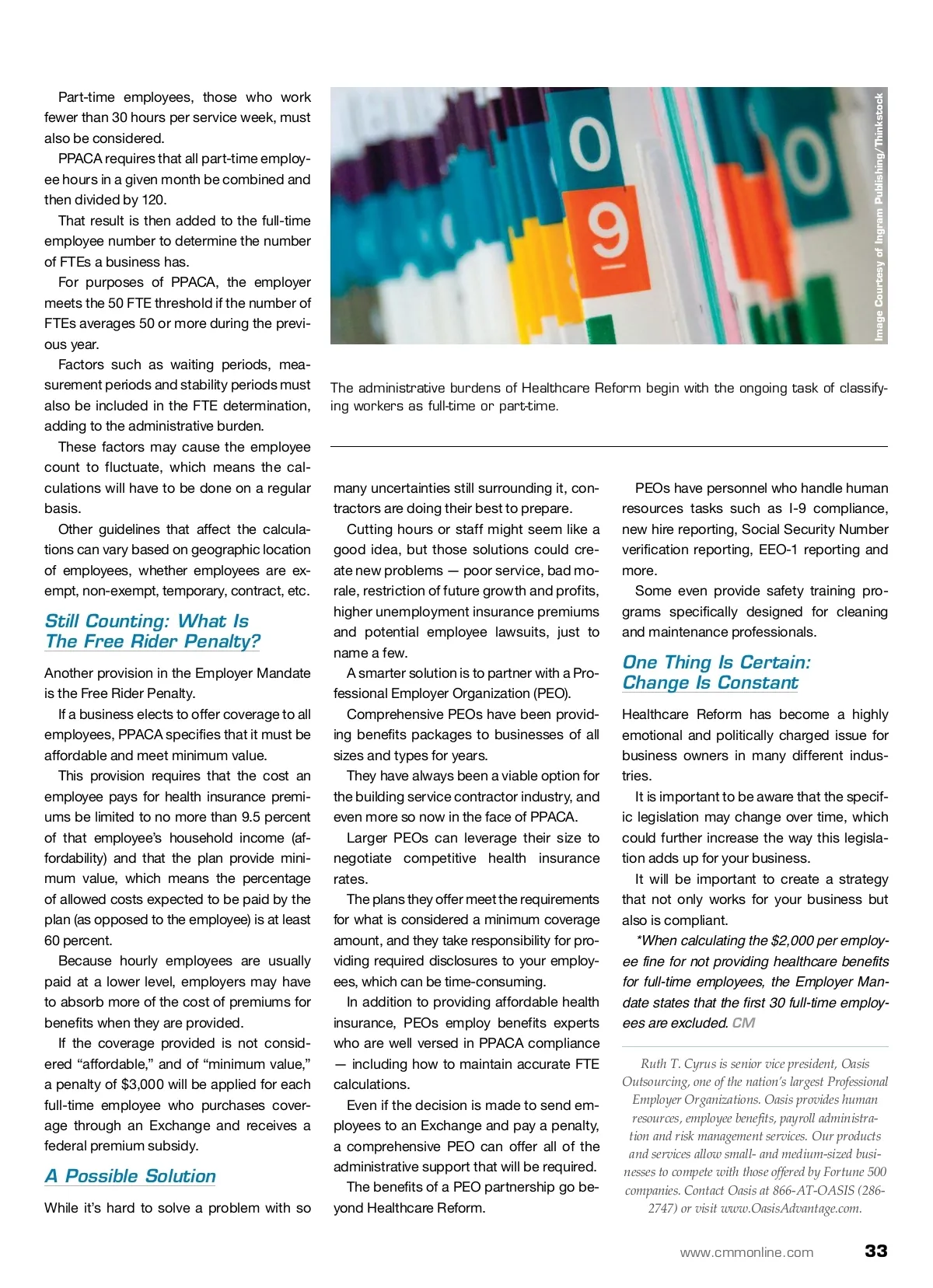
Part-time employees, those who work fewer than 30 hours per service week, must also be considered. PPACA requires that all part-time employ-ee hours in a given month be combined and then divided by 120. That result is then added to the full-time employee number to determine the number of FTEs a business has. For purposes of PPACA, the employer meets the 50 FTE threshold if the number of FTEs averages 50 or more during the previ-ous year. Factors such as waiting periods, mea-surement periods and stability periods must also be included in the FTE determination, adding to the administrative burden. These factors may cause the employee count to fluctuate, which means the cal-culations will have to be done on a regular basis. Other guidelines that affect the calcula-tions can vary based on geographic location of employees, whether employees are ex-empt, non-exempt, temporary, contract, etc. The administrative burdens of Healthcare Reform begin with the ongoing task of classify-ing workers as full-time or part-time. Still Counting: What Is The Free Rider Penalty? Another provision in the Employer Mandate is the Free Rider Penalty. If a business elects to offer coverage to all employees, PPACA specifies that it must be affordable and meet minimum value. This provision requires that the cost an employee pays for health insurance premi-ums be limited to no more than 9.5 percent of that employee’s household income (af-fordability) and that the plan provide mini-mum value, which means the percentage of allowed costs expected to be paid by the plan (as opposed to the employee) is at least 60 percent. Because hourly employees are usually paid at a lower level, employers may have to absorb more of the cost of premiums for benefits when they are provided. If the coverage provided is not consid-ered “affordable,” and of “minimum value,” a penalty of $3,000 will be applied for each full-time employee who purchases cover-age through an Exchange and receives a federal premium subsidy. A Possible Solution While it’s hard to solve a problem with so many uncertainties still surrounding it, con-tractors are doing their best to prepare. Cutting hours or staff might seem like a good idea, but those solutions could cre-ate new problems — poor service, bad mo-rale, restriction of future growth and profits, higher unemployment insurance premiums and potential employee lawsuits, just to name a few. A smarter solution is to partner with a Pro-fessional Employer Organization (PEO). Comprehensive PEOs have been provid-ing benefits packages to businesses of all sizes and types for years. They have always been a viable option for the building service contractor industry, and even more so now in the face of PPACA. Larger PEOs can leverage their size to negotiate competitive health insurance rates. The plans they offer meet the requirements for what is considered a minimum coverage amount, and they take responsibility for pro-viding required disclosures to your employ-ees, which can be time-consuming. In addition to providing affordable health insurance, PEOs employ benefits experts who are well versed in PPACA compliance — including how to maintain accurate FTE calculations. Even if the decision is made to send em-ployees to an Exchange and pay a penalty, a comprehensive PEO can offer all of the administrative support that will be required. The benefits of a PEO partnership go be-yond Healthcare Reform. PEOs have personnel who handle human resources tasks such as I-9 compliance, new hire reporting, Social Security Number verification reporting, EEO-1 reporting and more. Some even provide safety training pro-grams specifically designed for cleaning and maintenance professionals. One Thing Is Certain: Change Is Constant Healthcare Reform has become a highly emotional and politically charged issue for business owners in many different indus-tries. It is important to be aware that the specif-ic legislation may change over time, which could further increase the way this legisla-tion adds up for your business. It will be important to create a strategy that not only works for your business but also is compliant. *When calculating the $2,000 per employ-ee fine for not providing healthcare benefits for full-time employees, the Employer Man-date states that the first 30 full-time employ-ees are excluded. CM Ruth T. Cyrus is senior vice president, Oasis Outsourcing, one of the nation’s largest Professional Employer Organizations. Oasis provides human resources, employee benefits, payroll administra-tion and risk management services. Our products and services allow small-and medium-sized busi-nesses to compete with those offered by Fortune 500 companies. Contact Oasis at 866-AT-OASIS (286-2747) or visit www.OasisAdvantage.com. www.cmmonline.com 33 Image Courtesy of Ingram Publishing/Thinkstock
CMM – Archives September 2013: 33