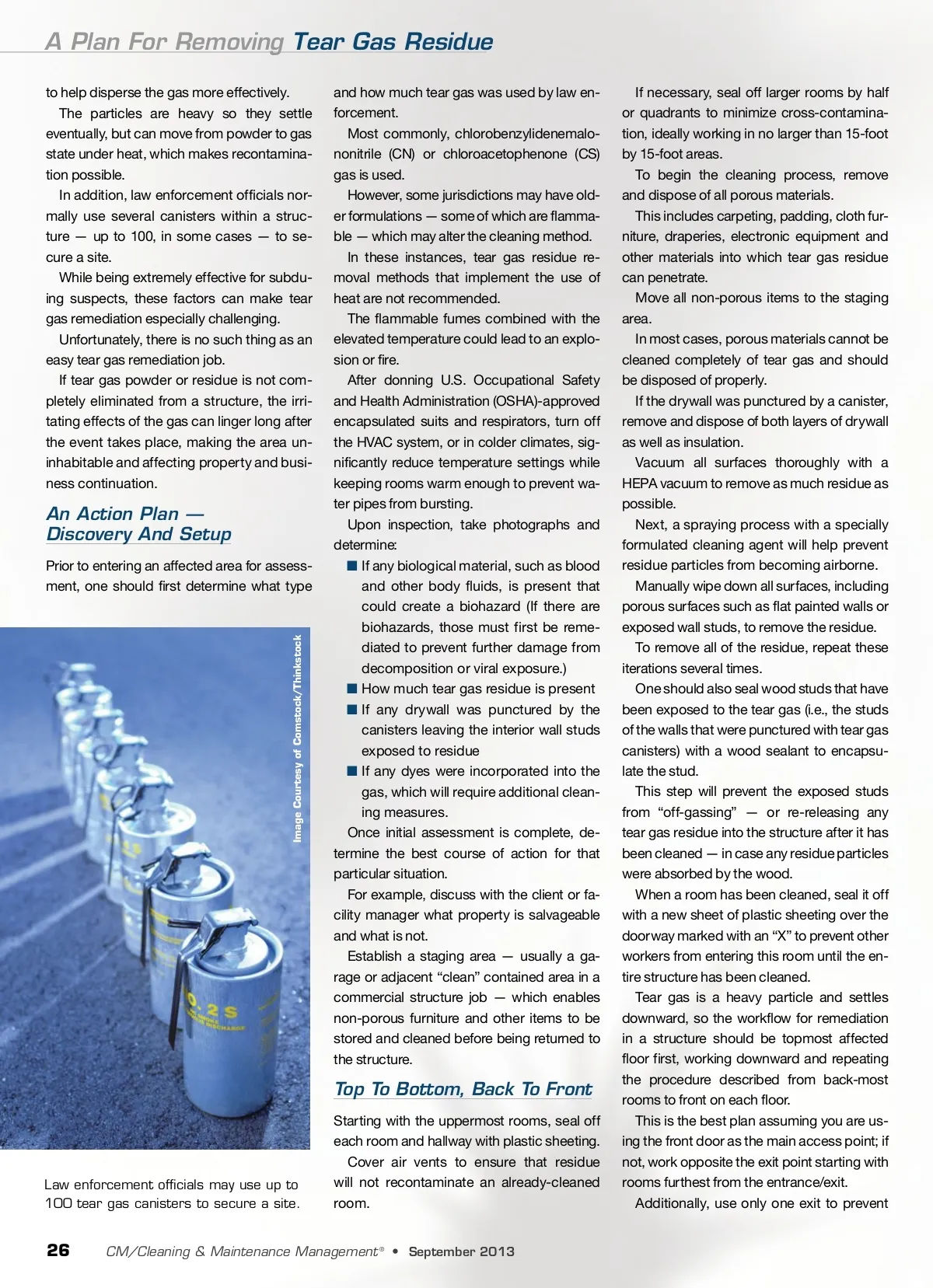
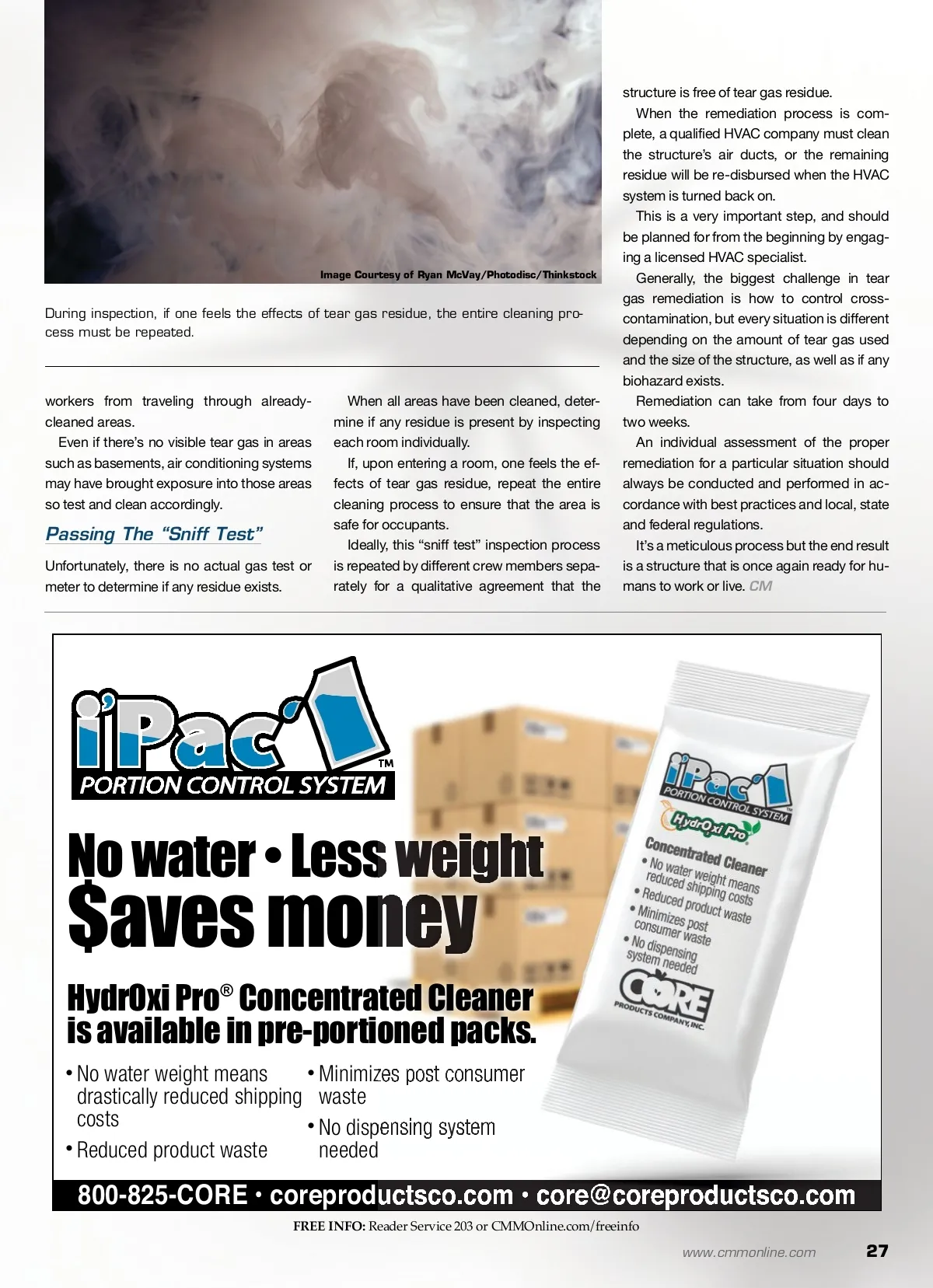
A Plan For Removing Tear Gas Residue to help disperse the gas more effectively. The particles are heavy so they settle eventually, but can move from powder to gas state under heat, which makes recontamina-tion possible. In addition, law enforcement officials nor-mally use several canisters within a struc-ture — up to 100, in some cases — to se-cure a site. While being extremely effective for subdu-ing suspects, these factors can make tear gas remediation especially challenging. Unfortunately, there is no such thing as an easy tear gas remediation job. If tear gas powder or residue is not com-pletely eliminated from a structure, the irri-tating effects of the gas can linger long after the event takes place, making the area un-inhabitable and affecting property and busi-ness continuation. and how much tear gas was used by law en-forcement. Most commonly, chlorobenzylidenemalo-nonitrile (CN) or chloroacetophenone (CS) gas is used. However, some jurisdictions may have old-er formulations — some of which are flamma-ble — which may alter the cleaning method. In these instances, tear gas residue re-moval methods that implement the use of heat are not recommended. The flammable fumes combined with the elevated temperature could lead to an explo-sion or fire. After donning U.S. Occupational Safety and Health Administration (OSHA)-approved encapsulated suits and respirators, turn off the HVAC system, or in colder climates, sig-nificantly reduce temperature settings while keeping rooms warm enough to prevent wa-ter pipes from bursting. Upon inspection, take photographs and determine: ■ If any biological material, such as blood and other body fluids, is present that could create a biohazard (If there are biohazards, those must first be reme-diated to prevent further damage from decomposition or viral exposure.) ■ How much tear gas residue is present ■ If any drywall was punctured by the canisters leaving the interior wall studs exposed to residue ■ If any dyes were incorporated into the gas, which will require additional clean-ing measures. Once initial assessment is complete, de-termine the best course of action for that particular situation. For example, discuss with the client or fa-cility manager what property is salvageable and what is not. Establish a staging area — usually a ga-rage or adjacent “clean” contained area in a commercial structure job — which enables non-porous furniture and other items to be stored and cleaned before being returned to the structure. If necessary, seal off larger rooms by half or quadrants to minimize cross-contamina-tion, ideally working in no larger than 15-foot by 15-foot areas. To begin the cleaning process, remove and dispose of all porous materials. This includes carpeting, padding, cloth fur-niture, draperies, electronic equipment and other materials into which tear gas residue can penetrate. Move all non-porous items to the staging area. In most cases, porous materials cannot be cleaned completely of tear gas and should be disposed of properly. If the drywall was punctured by a canister, remove and dispose of both layers of drywall as well as insulation. Vacuum all surfaces thoroughly with a HEPA vacuum to remove as much residue as possible. Next, a spraying process with a specially formulated cleaning agent will help prevent residue particles from becoming airborne. Manually wipe down all surfaces, including porous surfaces such as flat painted walls or exposed wall studs, to remove the residue. To remove all of the residue, repeat these iterations several times. One should also seal wood studs that have been exposed to the tear gas (i.e., the studs of the walls that were punctured with tear gas canisters) with a wood sealant to encapsu-late the stud. This step will prevent the exposed studs from “off-gassing” — or re-releasing any tear gas residue into the structure after it has been cleaned — in case any residue particles were absorbed by the wood. When a room has been cleaned, seal it off with a new sheet of plastic sheeting over the doorway marked with an “X” to prevent other workers from entering this room until the en-tire structure has been cleaned. Tear gas is a heavy particle and settles downward, so the workflow for remediation in a structure should be topmost affected floor first, working downward and repeating the procedure described from back-most rooms to front on each floor. This is the best plan assuming you are us-ing the front door as the main access point; if not, work opposite the exit point starting with rooms furthest from the entrance/exit. Additionally, use only one exit to prevent An Action Plan — Discovery And Setup Prior to entering an affected area for assess-ment, one should first determine what type Image Courtesy of Comstock/Thinkstock Top To Bottom, Back To Front Starting with the uppermost rooms, seal off each room and hallway with plastic sheeting. Cover air vents to ensure that residue will not recontaminate an already-cleaned room. Law enforcement officials may use up to 100 tear gas canisters to secure a site. 26 CM/Cleaning & Maintenance Management ® • September 2013
CMM – Archives September 2013: 26