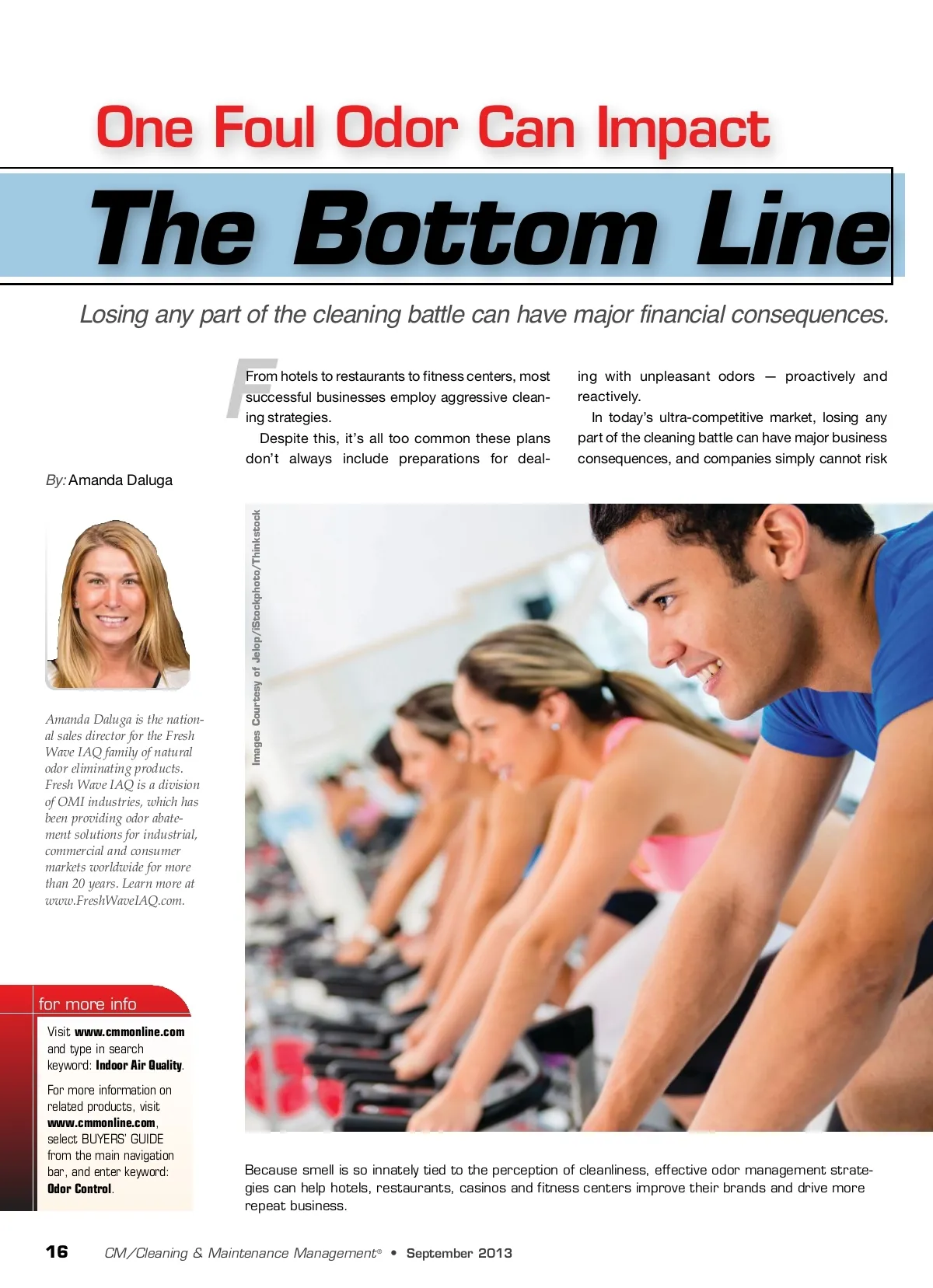
losing customers due to risks that wind up being so easily mitigated. There are a variety of ways in which all manner of businesses can be aided by ef-fective odor management strategies, includ-ing: ■ Reduced expenses associated with service call-backs ■ The elimination of costly customer ser-vice complaints ■ A reduced need for extensive out-sourced cleaning ■ More efficient realization of desired results. To understand how this works, let’s look at a few key business sectors. Hotels Cleanliness is extremely important for ho-tels, so it’s no surprise that the most popular and profitable hotels employ the most strin-gent of cleaning practices. But when it comes to odors from trash collection areas, food service stations or fit-ness centers, perception is reality, and the perception is “this hotel isn’t clean.” If you browse online travel review sites, hotel reviews are full of complaints from guests who state how foul odors — ciga-rettes, mustiness, even cleaning solution — negatively impacted their stay. The result is predictable: guests who will not return to a property, and perhaps worse — because of the importance of word-of-mouth business — guests who would not recommend the property to a friend. And unlike a printed review with a finite timeline, the Internet is forever: Reviews left on these sites can cause irreparable dam-age, and in today’s economy, no hotel can afford that. So as smell is so innately tied to the perception of cleanliness, effective odor management strategies can help hotels im-prove their brands and drive more repeat business. These spaces, which may house any number of large student populations (with sometimes questionable hygiene), science experiments gone awry and fast food es-tablishments, can be breeding grounds for nasty odors. Odors of any kind can spell disaster across the whole of the university. Imagine potential students touring a cam-pus with their parents — who are now pay-ing a high premium for their child to go to college — or potential donors coming head to head with unpleasant odors. Chances are they will remember these un-pleasant odor experiences. If donors, students and parents are the revenue engines that keep a university run-ning, think of foul odors as the gunky buildup that can slow the flow of money. Restaurants It doesn’t matter how many Michelin Stars a restaurant has, diners want to remember only one smell from their experience — the tasty food. But no matter how clean or well main-tained a restaurant is, some smells invari-ably make their way around: rank odors from wet kitchen mats, the lingering smell of burnt oven delights, even stale body odor from double shifts behind hot stoves. According to a Harris Interactive survey, 85 percent of U.S. adults would never return to a restaurant with an unpleasant odor. That’s a big number, and one to be taken seriously, especially in the age of social media. No restaurateur wants to risk a bad review because of a foul odor, and in the merciless world of the restaurant industry, one bad re-view could seriously jeopardize an establish-ment’s reputation. Casino managers looking to keep their cli-entele pulling levers for as long as possible can’t risk having players walk out early be-cause of foul odors. To help combat these odors, casinos are known to add “custom-designed scents” to the pungent, smoke-filled air — trademark, tailor-made additives for which they become known. But this does nothing to treat indoor air quality. In fact, because of the toxic chemical compounds contained in most air freshen-ers, it makes it worse — especially for peo-ple who suffer from asthma and other respi-ratory issues. To top it all off, the added scents are just layering a new strong smell into the mix cre-ating a noxious mix of scents that make the air even more unpleasant to breathe. Mitigating foul odors in casino settings cannot be left to chance: Sound odor man-agement strategies are necessary to keep the high rollers coming back. Fitness Centers Fitness centers constantly court new mem-bers with slick marketing campaigns, spe-cial offers and one-time-only discounts. While these promotions can certainly drive new membership, foul odors can over-shadow even the flashiest of efforts. The reality is that people smell, especially when they sweat. Toss in the added moisture and steam from the showers — not to mention wet tow-els — and the smell factor dramatically rises. Then there’s the odor left behind on equipment that hasn’t been properly wiped down, or the perfume and cologne, known to trigger migraines or allergic reactions, that some members may use in an effort to cover up body odor. It is challenging enough to get people to work out in the first place; adding rancid air to the mix is just another barrier to getting people into the gym. Employing proper odor management strategies is imperative for the success of most businesses, as odors can create busi-ness and PR headaches. Creating odor-free environments, on the other hand, can provide tangible commer-cial and health benefits to customers and end-users. CM Casinos In casinos, gamblers are confined to a closed space that offers a mixture of odors from tobacco smokers, food consumers and sweating customers playing through a heater. The mere fact that so many Las Vegas casinos continue to allow people to smoke indoors is astounding enough, but regard-less of the cause, even the most aggressive cleaning strategies cannot counter such a volatile cocktail of foul odors. Universities Higher education has become a competi-tive business, and as with any business, foul odor can absolutely impact the bottom line. The sheer mass of square footage en-compassed by a typical college campus — classrooms, offices, cafeterias, stadiums, housing complexes, etc. — can be daunting. www.cmmonline.com 17
CMM – Archives September 2013: 17