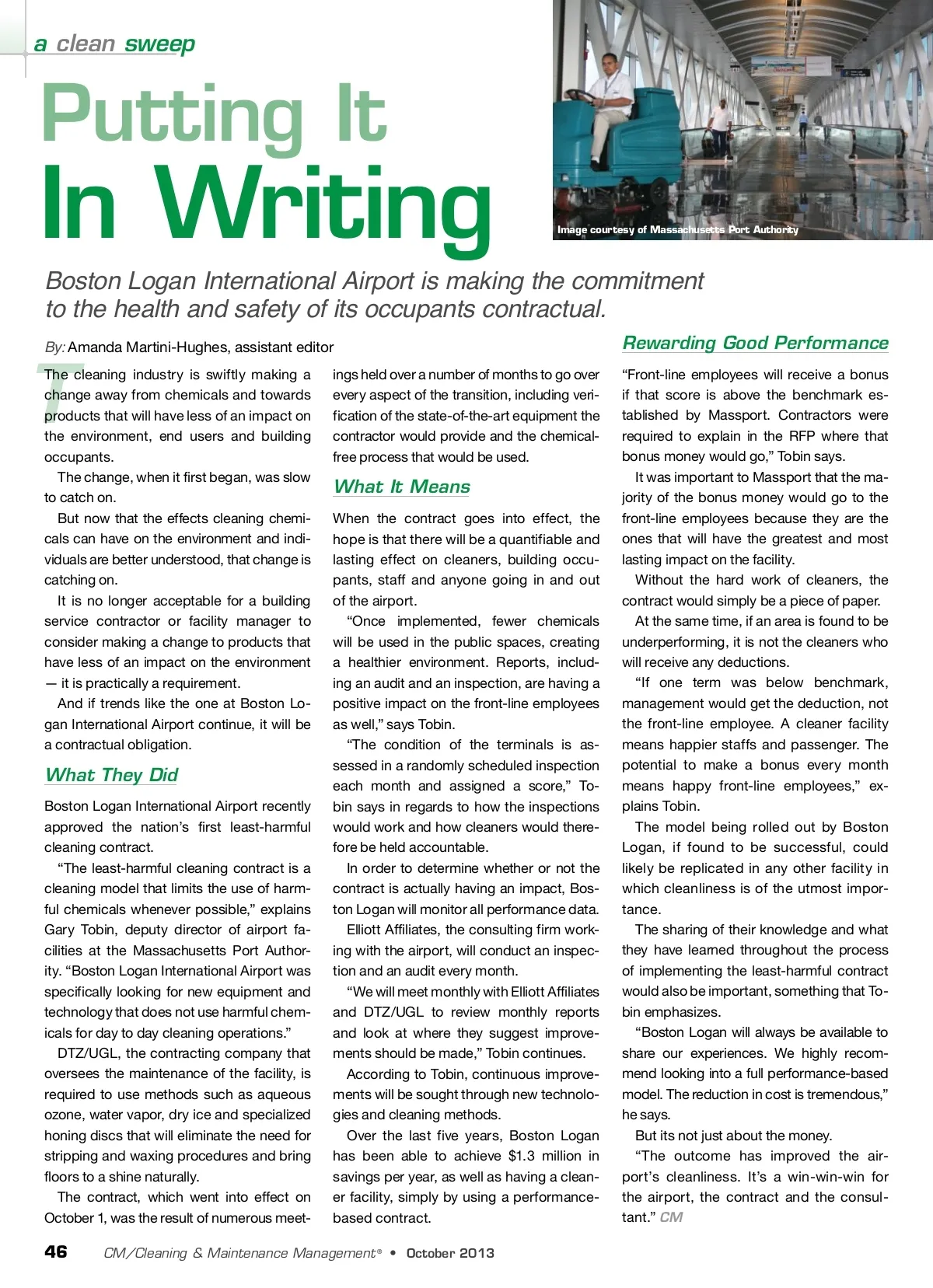
a clean sweep Putting It In Writing By: Amanda Martini-Hughes, assistant editor Image courtesy of Massachusetts Port Authority Boston Logan International Airport is making the commitment to the health and safety of its occupants contractual. Rewarding Good Performance “Front-line employees will receive a bonus if that score is above the benchmark es-tablished by Massport. Contractors were required to explain in the RFP where that bonus money would go,” Tobin says. It was important to Massport that the ma-jority of the bonus money would go to the front-line employees because they are the ones that will have the greatest and most lasting impact on the facility. Without the hard work of cleaners, the contract would simply be a piece of paper. At the same time, if an area is found to be underperforming, it is not the cleaners who will receive any deductions. “If one term was below benchmark, management would get the deduction, not the front-line employee. A cleaner facility means happier staffs and passenger. The potential to make a bonus every month means happy front-line employees,” ex-plains Tobin. The model being rolled out by Boston Logan, if found to be successful, could likely be replicated in any other facility in which cleanliness is of the utmost impor-tance. The sharing of their knowledge and what they have learned throughout the process of implementing the least-harmful contract would also be important, something that To-bin emphasizes. “Boston Logan will always be available to share our experiences. We highly recom-mend looking into a full performance-based model. The reduction in cost is tremendous,” he says. But its not just about the money. “The outcome has improved the air-port’s cleanliness. It’s a win-win-win for the airport, the contract and the consul-tant.” CM T The cleaning industry is swiftly making a change away from chemicals and towards products that will have less of an impact on the environment, end users and building occupants. The change, when it first began, was slow to catch on. But now that the effects cleaning chemi-cals can have on the environment and indi-viduals are better understood, that change is catching on. It is no longer acceptable for a building service contractor or facility manager to consider making a change to products that have less of an impact on the environment — it is practically a requirement. And if trends like the one at Boston Lo-gan International Airport continue, it will be a contractual obligation. ings held over a number of months to go over every aspect of the transition, including veri-fication of the state-of-the-art equipment the contractor would provide and the chemical-free process that would be used. What It Means When the contract goes into effect, the hope is that there will be a quantifiable and lasting effect on cleaners, building occu-pants, staff and anyone going in and out of the airport. “Once implemented, fewer chemicals will be used in the public spaces, creating a healthier environment. Reports, includ-ing an audit and an inspection, are having a positive impact on the front-line employees as well,” says Tobin. “The condition of the terminals is as-sessed in a randomly scheduled inspection each month and assigned a score,” To-bin says in regards to how the inspections would work and how cleaners would there-fore be held accountable. In order to determine whether or not the contract is actually having an impact, Bos-ton Logan will monitor all performance data. Elliott Affiliates, the consulting firm work-ing with the airport, will conduct an inspec-tion and an audit every month. “We will meet monthly with Elliott Affiliates and DTZ/UGL to review monthly reports and look at where they suggest improve-ments should be made,” Tobin continues. According to Tobin, continuous improve-ments will be sought through new technolo-gies and cleaning methods. Over the last five years, Boston Logan has been able to achieve $1.3 million in savings per year, as well as having a clean-er facility, simply by using a performance-based contract. What They Did Boston Logan International Airport recently approved the nation’s first least-harmful cleaning contract. “The least-harmful cleaning contract is a cleaning model that limits the use of harm-ful chemicals whenever possible,” explains Gary Tobin, deputy director of airport fa-cilities at the Massachusetts Port Author-ity. “Boston Logan International Airport was specifically looking for new equipment and technology that does not use harmful chem-icals for day to day cleaning operations.” DTZ/UGL, the contracting company that oversees the maintenance of the facility, is required to use methods such as aqueous ozone, water vapor, dry ice and specialized honing discs that will eliminate the need for stripping and waxing procedures and bring floors to a shine naturally. The contract, which went into effect on October 1, was the result of numerous meet-46 CM/Cleaning & Maintenance Management ® • October 2013
CMM – Archives October 2013: 46