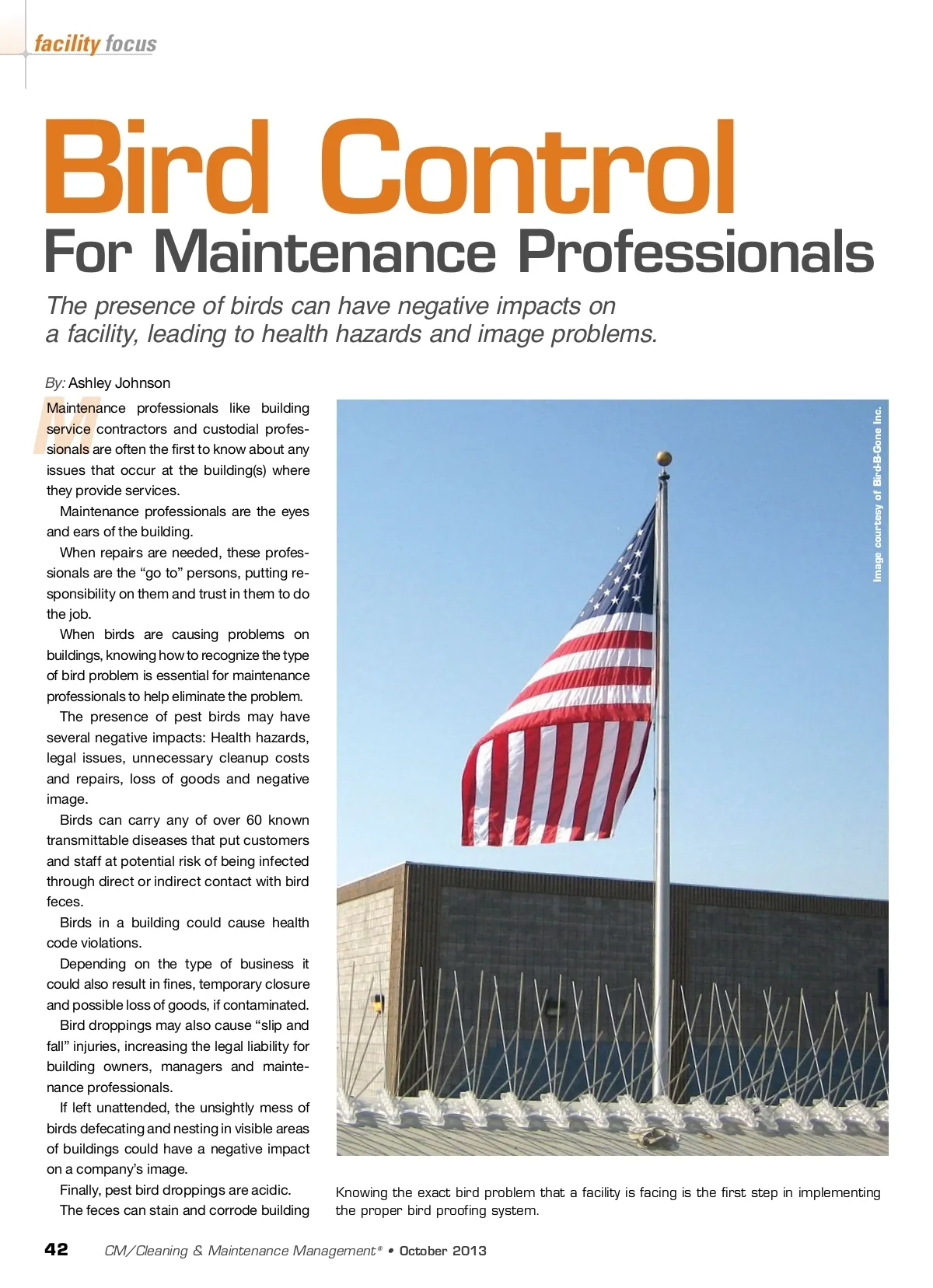
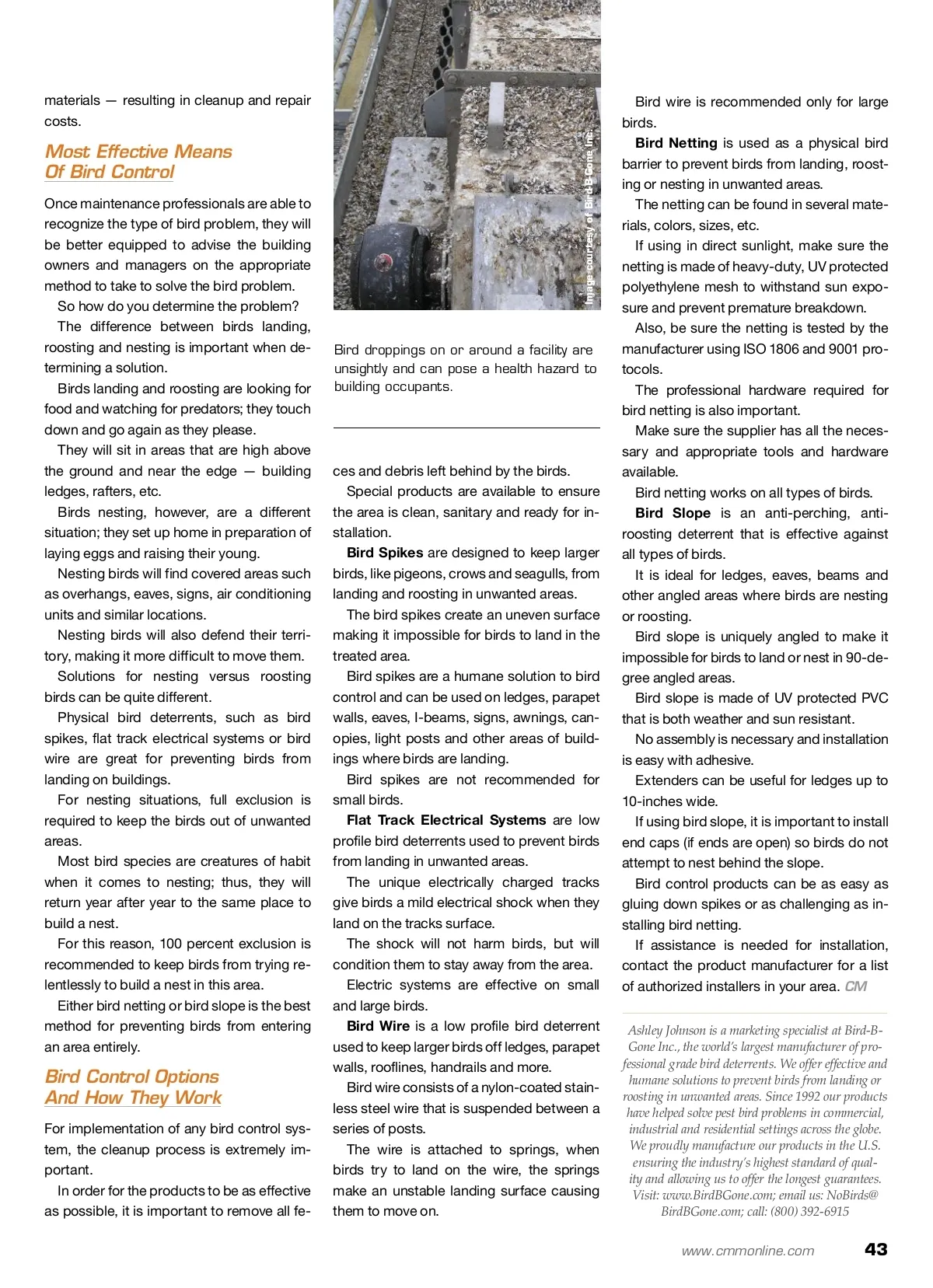
Most Effective Means Of Bird Control Once maintenance professionals are able to recognize the type of bird problem, they will be better equipped to advise the building owners and managers on the appropriate method to take to solve the bird problem. So how do you determine the problem? The difference between birds landing, roosting and nesting is important when de-termining a solution. Birds landing and roosting are looking for food and watching for predators; they touch down and go again as they please. They will sit in areas that are high above the ground and near the edge — building ledges, rafters, etc. Birds nesting, however, are a different situation; they set up home in preparation of laying eggs and raising their young. Nesting birds will find covered areas such as overhangs, eaves, signs, air conditioning units and similar locations. Nesting birds will also defend their terri-tory, making it more difficult to move them. Solutions for nesting versus roosting birds can be quite different. Physical bird deterrents, such as bird spikes, flat track electrical systems or bird wire are great for preventing birds from landing on buildings. For nesting situations, full exclusion is required to keep the birds out of unwanted areas. Most bird species are creatures of habit when it comes to nesting; thus, they will return year after year to the same place to build a nest. For this reason, 100 percent exclusion is recommended to keep birds from trying re-lentlessly to build a nest in this area. Either bird netting or bird slope is the best method for preventing birds from entering an area entirely. Bird droppings on or around a facility are unsightly and can pose a health hazard to building occupants. Bird Control Options And How They Work For implementation of any bird control sys-tem, the cleanup process is extremely im-portant. In order for the products to be as effective as possible, it is important to remove all fe-ces and debris left behind by the birds. Special products are available to ensure the area is clean, sanitary and ready for in-stallation. Bird Spikes are designed to keep larger birds, like pigeons, crows and seagulls, from landing and roosting in unwanted areas. The bird spikes create an uneven surface making it impossible for birds to land in the treated area. Bird spikes are a humane solution to bird control and can be used on ledges, parapet walls, eaves, I-beams, signs, awnings, can-opies, light posts and other areas of build-ings where birds are landing. Bird spikes are not recommended for small birds. Flat Track Electrical Systems are low profile bird deterrents used to prevent birds from landing in unwanted areas. The unique electrically charged tracks give birds a mild electrical shock when they land on the tracks surface. The shock will not harm birds, but will condition them to stay away from the area. Electric systems are effective on small and large birds. Bird Wire is a low profile bird deterrent used to keep larger birds off ledges, parapet walls, rooflines, handrails and more. Bird wire consists of a nylon-coated stain-less steel wire that is suspended between a series of posts. The wire is attached to springs, when birds try to land on the wire, the springs make an unstable landing surface causing them to move on. Image courtesy of Bird-B-Gone Inc. materials — resulting in cleanup and repair costs. Bird wire is recommended only for large birds. Bird Netting is used as a physical bird barrier to prevent birds from landing, roost-ing or nesting in unwanted areas. The netting can be found in several mate-rials, colors, sizes, etc. If using in direct sunlight, make sure the netting is made of heavy-duty, UV protected polyethylene mesh to withstand sun expo-sure and prevent premature breakdown. Also, be sure the netting is tested by the manufacturer using ISO 1806 and 9001 pro-tocols. The professional hardware required for bird netting is also important. Make sure the supplier has all the neces-sary and appropriate tools and hardware available. Bird netting works on all types of birds. Bird Slope is an anti-perching, anti-roosting deterrent that is effective against all types of birds. It is ideal for ledges, eaves, beams and other angled areas where birds are nesting or roosting. Bird slope is uniquely angled to make it impossible for birds to land or nest in 90-de-gree angled areas. Bird slope is made of UV protected PVC that is both weather and sun resistant. No assembly is necessary and installation is easy with adhesive. Extenders can be useful for ledges up to 10-inches wide. If using bird slope, it is important to install end caps (if ends are open) so birds do not attempt to nest behind the slope. Bird control products can be as easy as gluing down spikes or as challenging as in-stalling bird netting. If assistance is needed for installation, contact the product manufacturer for a list of authorized installers in your area. CM Ashley Johnson is a marketing specialist at Bird-B-Gone Inc., the world’s largest manufacturer of pro-fessional grade bird deterrents. We offer effective and humane solutions to prevent birds from landing or roosting in unwanted areas. Since 1992 our products have helped solve pest bird problems in commercial, industrial and residential settings across the globe. We proudly manufacture our products in the U.S. ensuring the industry’s highest standard of qual-ity and allowing us to offer the longest guarantees. Visit: www.BirdBGone.com; email us: NoBirds@ BirdBGone.com; call: (800) 392-6915 www.cmmonline.com 43
CMM – Archives October 2013: 43