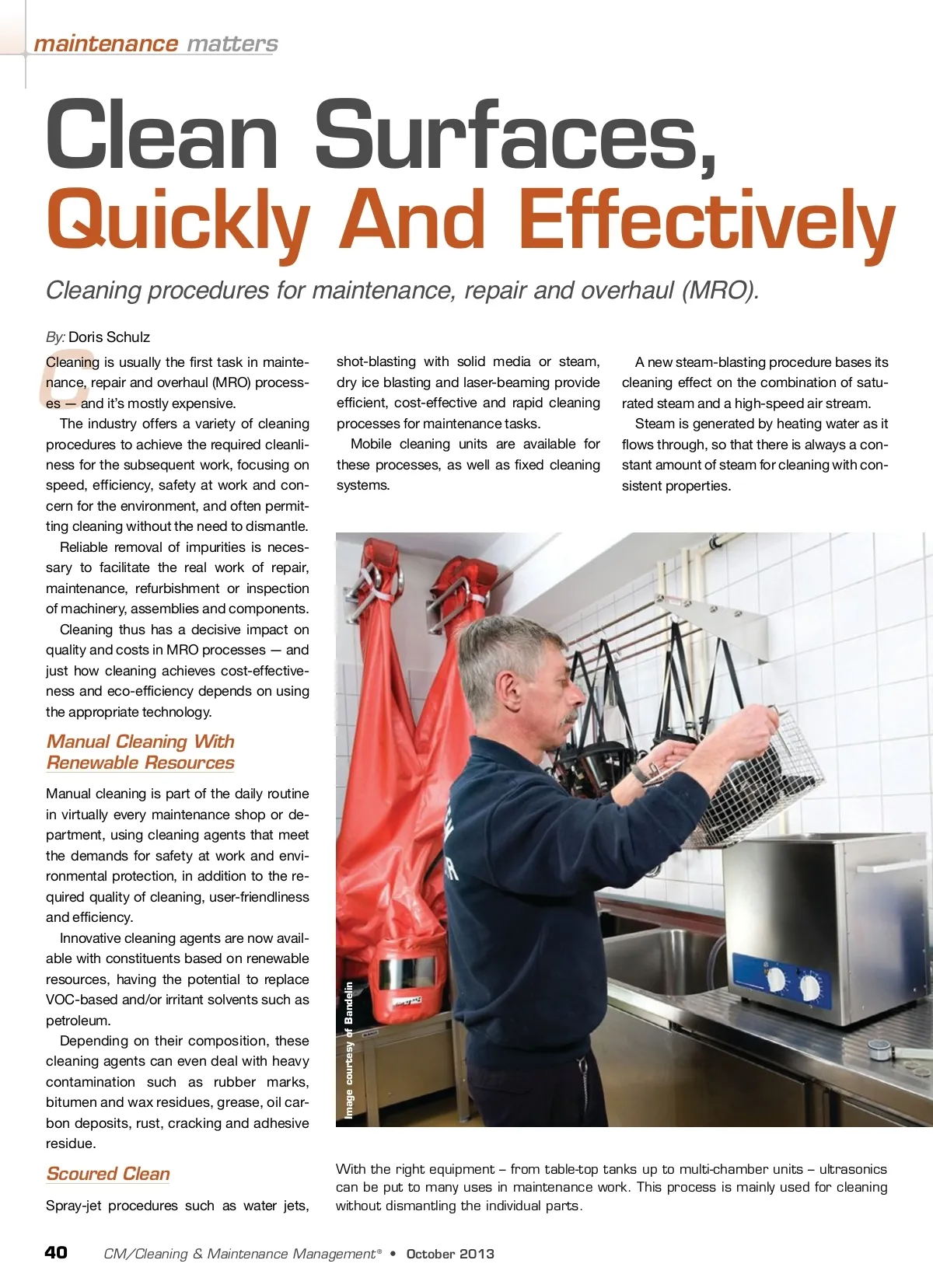
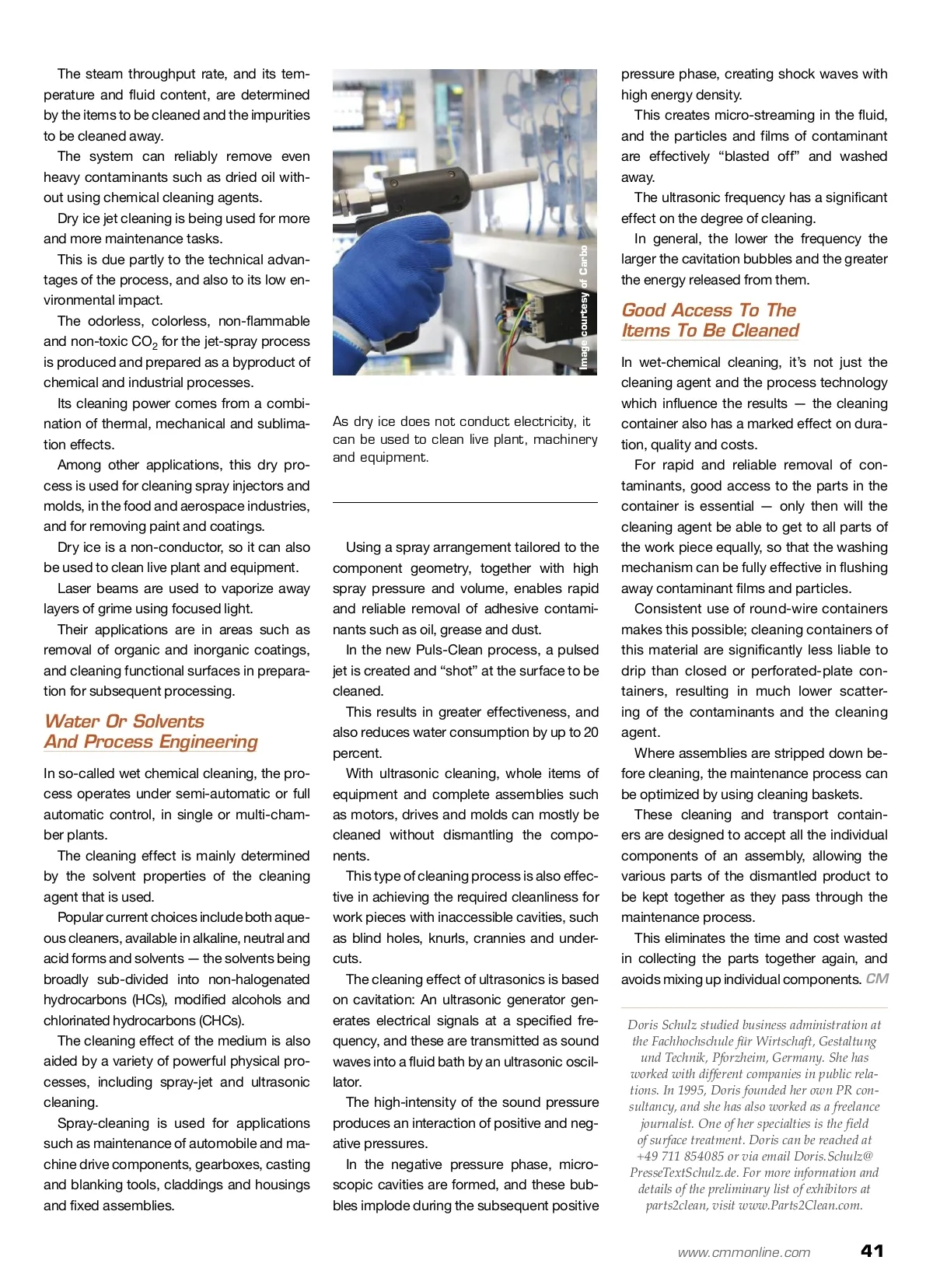
The steam throughput rate, and its tem-perature and fluid content, are determined by the items to be cleaned and the impurities to be cleaned away. The system can reliably remove even heavy contaminants such as dried oil with-out using chemical cleaning agents. Dry ice jet cleaning is being used for more and more maintenance tasks. This is due partly to the technical advan-tages of the process, and also to its low en-vironmental impact. The odorless, colorless, non-flammable and non-toxic CO 2 for the jet-spray process is produced and prepared as a byproduct of chemical and industrial processes. Its cleaning power comes from a combi-nation of thermal, mechanical and sublima-tion effects. Among other applications, this dry pro-cess is used for cleaning spray injectors and molds, in the food and aerospace industries, and for removing paint and coatings. Dry ice is a non-conductor, so it can also be used to clean live plant and equipment. Laser beams are used to vaporize away layers of grime using focused light. Their applications are in areas such as removal of organic and inorganic coatings, and cleaning functional surfaces in prepara-tion for subsequent processing. Image courtesy of Carbo pressure phase, creating shock waves with high energy density. This creates micro-streaming in the fluid, and the particles and films of contaminant are effectively “blasted off” and washed away. The ultrasonic frequency has a significant effect on the degree of cleaning. In general, the lower the frequency the larger the cavitation bubbles and the greater the energy released from them. Good Access To The Items To Be Cleaned In wet-chemical cleaning, it’s not just the cleaning agent and the process technology which influence the results — the cleaning container also has a marked effect on dura-tion, quality and costs. For rapid and reliable removal of con-taminants, good access to the parts in the container is essential — only then will the cleaning agent be able to get to all parts of the work piece equally, so that the washing mechanism can be fully effective in flushing away contaminant films and particles. Consistent use of round-wire containers makes this possible; cleaning containers of this material are significantly less liable to drip than closed or perforated-plate con-tainers, resulting in much lower scatter-ing of the contaminants and the cleaning agent. Where assemblies are stripped down be-fore cleaning, the maintenance process can be optimized by using cleaning baskets. These cleaning and transport contain-ers are designed to accept all the individual components of an assembly, allowing the various parts of the dismantled product to be kept together as they pass through the maintenance process. This eliminates the time and cost wasted in collecting the parts together again, and avoids mixing up individual components. CM Doris Schulz studied business administration at the Fachhochschule für Wirtschaft, Gestaltung und Technik, Pforzheim, Germany. She has worked with different companies in public rela-tions. In 1995, Doris founded her own PR con-sultancy, and she has also worked as a freelance journalist. One of her specialties is the field of surface treatment. Doris can be reached at +49 711 854085 or via email Doris.Schulz@ PresseTextSchulz.de. For more information and details of the preliminary list of exhibitors at parts2clean, visit www.Parts2Clean.com. As dry ice does not conduct electricity, it can be used to clean live plant, machinery and equipment. Water Or Solvents And Process Engineering In so-called wet chemical cleaning, the pro-cess operates under semi-automatic or full automatic control, in single or multi-cham-ber plants. The cleaning effect is mainly determined by the solvent properties of the cleaning agent that is used. Popular current choices include both aque-ous cleaners, available in alkaline, neutral and acid forms and solvents — the solvents being broadly sub-divided into non-halogenated hydrocarbons (HCs), modified alcohols and chlorinated hydrocarbons (CHCs). The cleaning effect of the medium is also aided by a variety of powerful physical pro-cesses, including spray-jet and ultrasonic cleaning. Spray-cleaning is used for applications such as maintenance of automobile and ma-chine drive components, gearboxes, casting and blanking tools, claddings and housings and fixed assemblies. Using a spray arrangement tailored to the component geometry, together with high spray pressure and volume, enables rapid and reliable removal of adhesive contami-nants such as oil, grease and dust. In the new Puls-Clean process, a pulsed jet is created and “shot” at the surface to be cleaned. This results in greater effectiveness, and also reduces water consumption by up to 20 percent. With ultrasonic cleaning, whole items of equipment and complete assemblies such as motors, drives and molds can mostly be cleaned without dismantling the compo-nents. This type of cleaning process is also effec-tive in achieving the required cleanliness for work pieces with inaccessible cavities, such as blind holes, knurls, crannies and under-cuts. The cleaning effect of ultrasonics is based on cavitation: An ultrasonic generator gen-erates electrical signals at a specified fre-quency, and these are transmitted as sound waves into a fluid bath by an ultrasonic oscil-lator. The high-intensity of the sound pressure produces an interaction of positive and neg-ative pressures. In the negative pressure phase, micro-scopic cavities are formed, and these bub-bles implode during the subsequent positive www.cmmonline.com 41
CMM – Archives October 2013: 41