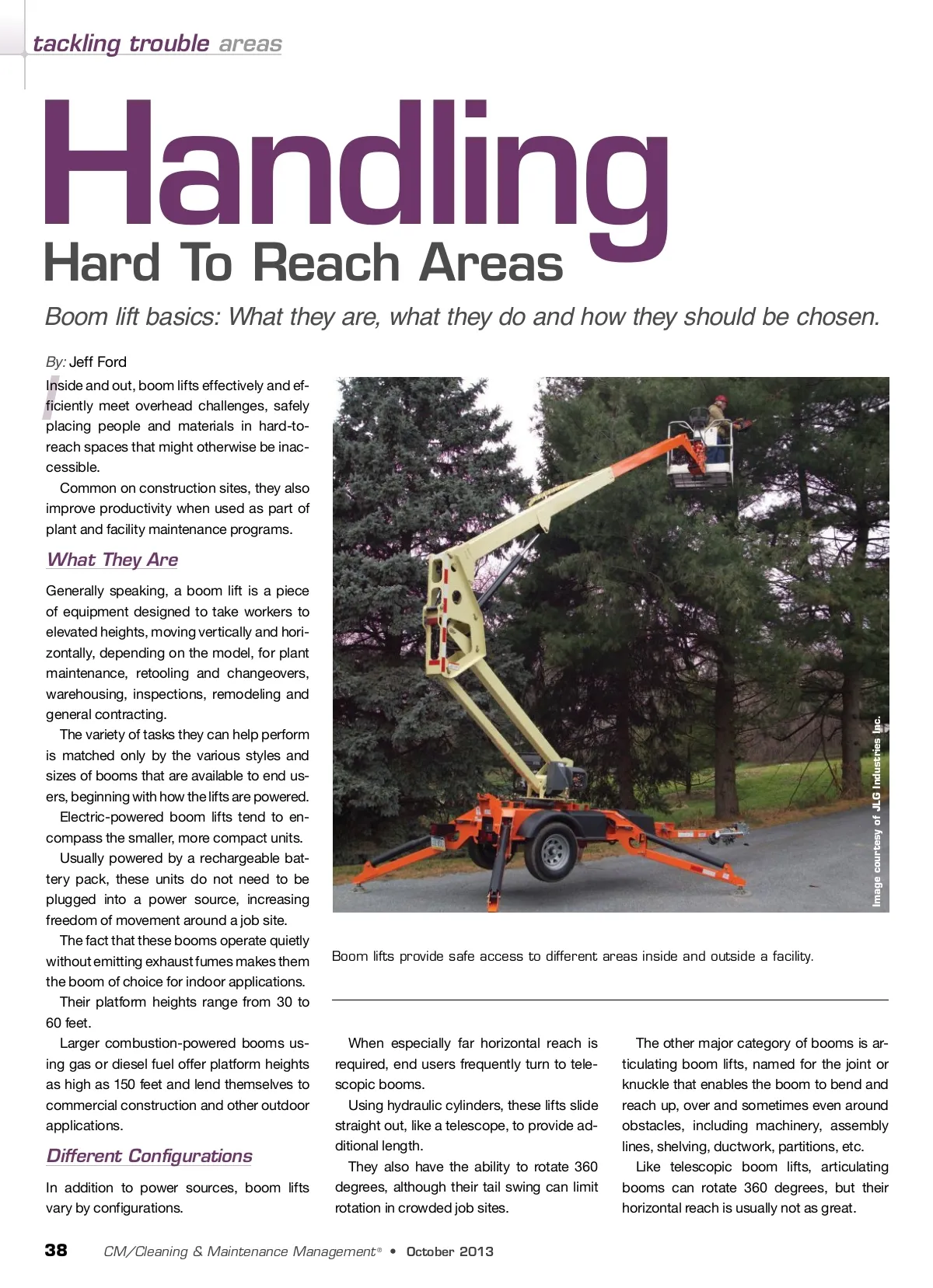
They tend to be more compact and can be electric or combustion-powered. Articulating booms can be mounted on trailers for easy towing to a location or around a job site; they can also be track-mounted. Compact crawler booms can pass through doorways and other spaces with limited access or provide accessibility on sensitive floors or other areas requiring low ground-bearing pressure. Another boom lift, the mast boom, is a vertical lift with a jib that can reach up and over obstacles in tighter spaces than an ar-ticulating boom. These mast booms, along with other electric-powered lifts, are popular choices for plant maintenance, enabling operators to check sprinkler heads and alarm systems; change light bulbs; clean windows; work on heating, ventilation and air-conditioning (HVAC) equipment; paint; and hang seasonal decorations and signage. A Number Of Uses Outside, towable articulating booms have proven invaluable in accomplishing any number of maintenance tasks. Marlin Van Zandt, operations manager at Snow Valley Ski Club in Edmonton, Alberta, Canada, found this out when he purchased a towable boom to change light bulbs that are 45 feet off the ground on the club’s 12 light poles. Until recently, Van Zandt approached this challenge using either a small utility ma-chine or a self-propelled lift and bucket that he rented. As Snow Valley continued to expand and add new light poles to its grounds, the lift no longer provided enough height to safely reach many of the bulbs. “In addition, it was next to impossible to drive the lift up 150 vertical feet of ski slopes,” Van Zandt says. “So, rather than wait for warmer weather to replace burned-out light bulbs, I began looking for a piece of equip-ment that we could move into position in the snow and provide the reach we needed.” Van Zandt purchased a towable boom lift and quickly discovered uses beyond chang-ing light bulbs, including chair maintenance. “The chairs weigh about 225 pounds each and are very awkward to handle by hand. With this machine we’re able to pluck a chair off the ski lift cable, set it on the ground, ser-vice the chair and put it back on the cable,” he says. “Nobody gets a strained back or a pinched finger, which makes everyone hap-py, and the work gets done faster.” Van Zandt adds that the boom lift could also play an important role in the club’s emer-gency planning, providing a way of evacuat-ing a mechanic suspended by fall arrest. And the uses don’t stop there. Standing in the bucket, employees at Snow Valley are able to use a snow rake to pull snow off the roof, reducing the time previously re-quired to do so by an estimated 50 percent. “We’re also looking forward to using the bucket as a platform for a photographer to take photos of skiers during the races we host here,” Van Zandt continues. Van Zandt anticipates he will continue to find uses for the boom lift, for example, re-moving broken branches from treetops in the campground the club operates. The lift’s accessory mounting tray, which accommodates a generator, air compressor or pressure washer, should come in handy if the club goes through with plans to pur-chase a tent for summer weddings, provid-ing the ability to pressure wash the tent be-fore taking it down and packing it away. Meanwhile, the boom lift has helped with painting projects. “In fact, the first job where we used the towable boom lift was not to change light bulbs, but to paint the trim around our build-ing,” Van Zandt notes. “What used to take us one week to paint took us just two days using the new boom lift and eliminated the need to erect scaffolding, which is always a challenge on hilly terrain.” Scaffolding also takes time to erect and tear down, which is time saved using a boom lift. And, unlike a boom, scaffolding is sta-tionary, making it difficult to move quickly through a facility performing routine mainte-nance tasks. Although ladders are more portable than scaffolding, they have their own set of disad-vantages when compared to boom lifts. To use a ladder correctly, a worker is re-quired to maintain three points of contact, leaving just one hand free to perform a task. Using a boom lift, the same worker can stand in a platform with two free hands and space for tools and materials, safely tied off and surrounded by railing. As a result, work can performed safely and efficiently, improving job site productivity in the process. What To Consider If a company makes the decision to take advantage of these benefits and rent or pur-chase a boom lift, the following questions should be considered to ensure the selec-tion of the boom that is most appropriate for the tasks at hand: ■ What is the required reach? ■ Are there any obstacles that need to be reached over or around? ■ Will the boom lift be used indoors or outdoors? ■ How congested is the work area? Will a tight turning radius be required? ■ What kind of power supply is accept-able? Can you use gas or diesel fuel, or will the boom be used in an office, requiring an emissions-free, quiet unit? ■ What kind of access to the work area is available — a standard doorway, garage door, etc.? ■ What kind of surface will the machine work on? Is it soft turf or concrete, level or sloped? ■ How many people need to use the boom, and what tools and materials does the task require? This will deter-mine the platform size required. ■ What types of accessories are avail-able with the boom lift? ■ Does the boom lift manufacturer or rental house offer a comprehensive aftermarket service program? By carefully answering these questions, a company is more likely to rent or purchase the boom lift that will best meet the facility’s immediate needs. And in all likelihood, once the company takes possession of the equipment and employees learn to operate it, uses for the boom lift will multiply, improving efficiencies and productivity in ways not anticipated. CM Jeff Ford is the global product director at JLG Industries Inc. He is responsible for product man-agement for the aerial work platform products, working with product development and product management teams. Ford joined the company in 1995 and has held a variety of marketing and man-agement roles, including senior manager marketing communications. Jeff holds a bachelor’s degree in business management from Penn State University and a master’s degree in business administration from Frostburg State University. www.cmmonline.com 39
CMM – Archives October 2013: 39