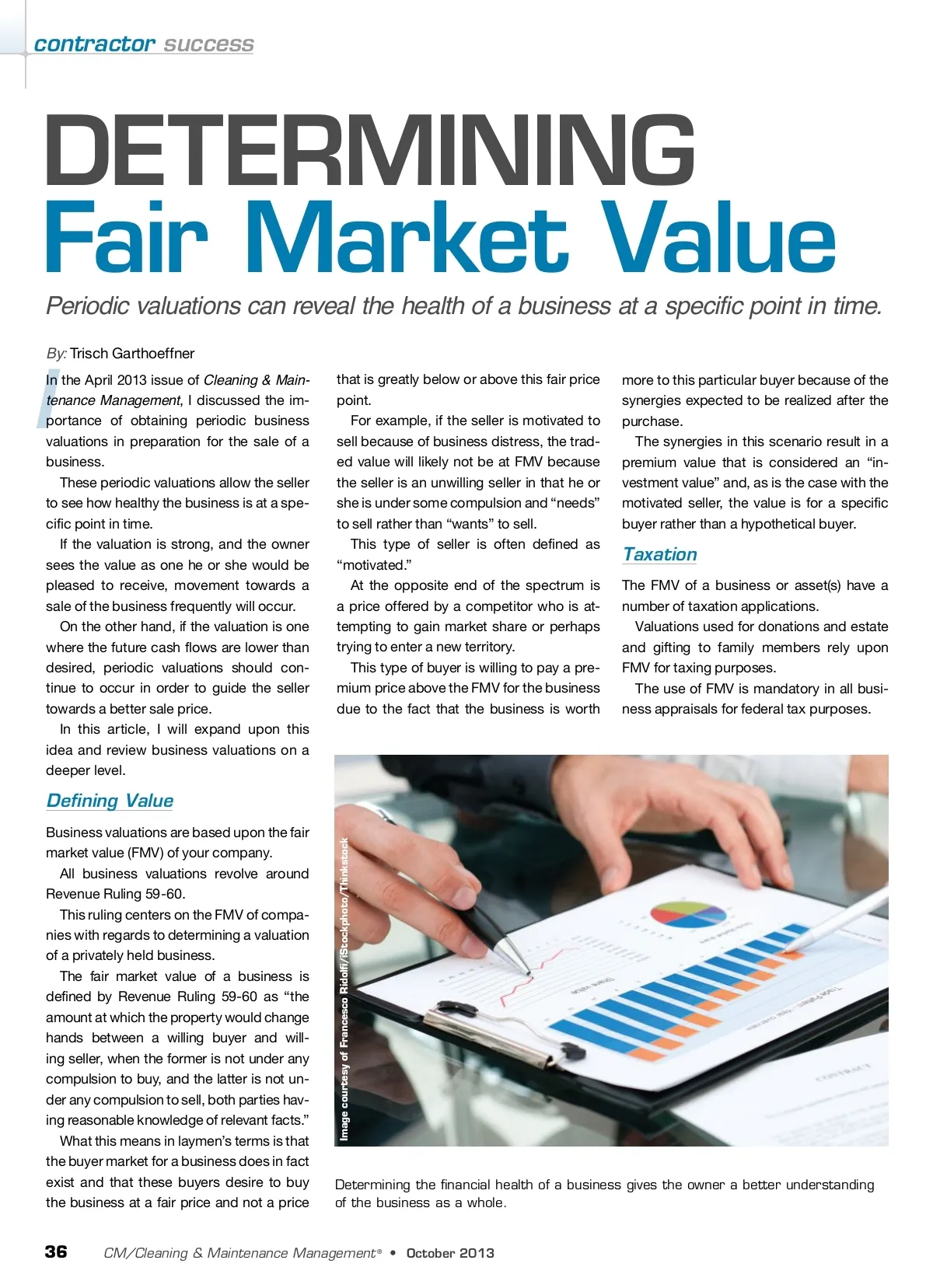
contractor success DETERMINING Fair Market Value Periodic valuations can reveal the health of a business at a specific point in time. By: Trisch Garthoeffner I In the April 2013 issue of Cleaning & Main-tenance Management , I discussed the im-portance of obtaining periodic business valuations in preparation for the sale of a business. These periodic valuations allow the seller to see how healthy the business is at a spe-cific point in time. If the valuation is strong, and the owner sees the value as one he or she would be pleased to receive, movement towards a sale of the business frequently will occur. On the other hand, if the valuation is one where the future cash flows are lower than desired, periodic valuations should con-tinue to occur in order to guide the seller towards a better sale price. In this article, I will expand upon this idea and review business valuations on a deeper level. that is greatly below or above this fair price point. For example, if the seller is motivated to sell because of business distress, the trad-ed value will likely not be at FMV because the seller is an unwilling seller in that he or she is under some compulsion and “needs” to sell rather than “wants” to sell. This type of seller is often defined as “motivated.” At the opposite end of the spectrum is a price offered by a competitor who is at-tempting to gain market share or perhaps trying to enter a new territory. This type of buyer is willing to pay a pre-mium price above the FMV for the business due to the fact that the business is worth more to this particular buyer because of the synergies expected to be realized after the purchase. The synergies in this scenario result in a premium value that is considered an “in-vestment value” and, as is the case with the motivated seller, the value is for a specific buyer rather than a hypothetical buyer. Taxation The FMV of a business or asset(s) have a number of taxation applications. Valuations used for donations and estate and gifting to family members rely upon FMV for taxing purposes. The use of FMV is mandatory in all busi-ness appraisals for federal tax purposes. Defining Value Business valuations are based upon the fair market value (FMV) of your company. All business valuations revolve around Revenue Ruling 59-60. This ruling centers on the FMV of compa-nies with regards to determining a valuation of a privately held business. The fair market value of a business is defined by Revenue Ruling 59-60 as “the amount at which the property would change hands between a willing buyer and will-ing seller, when the former is not under any compulsion to buy, and the latter is not un-der any compulsion to sell, both parties hav-ing reasonable knowledge of relevant facts.” What this means in laymen’s terms is that the buyer market for a business does in fact exist and that these buyers desire to buy the business at a fair price and not a price Image courtesy of Francesco Ridolfi/iStockphoto/Thinkstock Determining the financial health of a business gives the owner a better understanding of the business as a whole. 36 CM/Cleaning & Maintenance Management ® • October 2013
CMM – Archives October 2013: 36