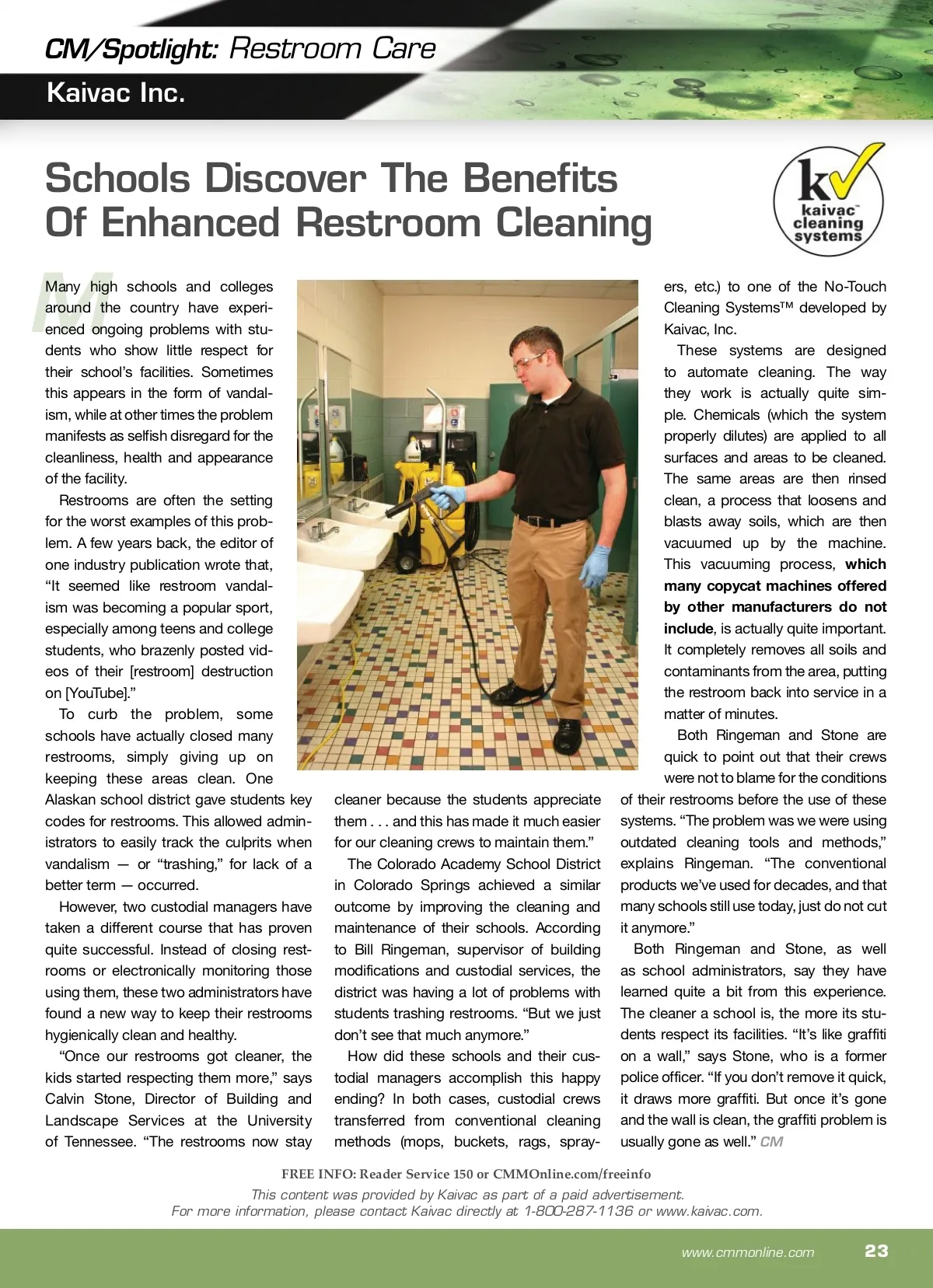
CM/Spotlight: Restroom Care Kaivac Inc. Schools Discover The Benefits Of Enhanced Restroom Cleaning M Many high schools and colleges around the country have experi-enced ongoing problems with stu-dents who show little respect for their school’s facilities. Sometimes this appears in the form of vandal-ism, while at other times the problem manifests as selfish disregard for the cleanliness, health and appearance of the facility. Restrooms are often the setting for the worst examples of this prob-lem. A few years back, the editor of one industry publication wrote that, “It seemed like restroom vandal-ism was becoming a popular sport, especially among teens and college students, who brazenly posted vid-eos of their [restroom] destruction on [YouTube].” To curb the problem, some schools have actually closed many restrooms, simply giving up on keeping these areas clean. One Alaskan school district gave students key codes for restrooms. This allowed admin-istrators to easily track the culprits when vandalism — or “trashing,” for lack of a better term — occurred. However, two custodial managers have taken a different course that has proven quite successful. Instead of closing rest-rooms or electronically monitoring those using them, these two administrators have found a new way to keep their restrooms hygienically clean and healthy. “Once our restrooms got cleaner, the kids started respecting them more,” says Calvin Stone, Director of Building and Landscape Services at the University of Tennessee. “The restrooms now stay cleaner because the students appreciate them . . . and this has made it much easier for our cleaning crews to maintain them.” The Colorado Academy School District in Colorado Springs achieved a similar outcome by improving the cleaning and maintenance of their schools. According to Bill Ringeman, supervisor of building modifications and custodial services, the district was having a lot of problems with students trashing restrooms. “But we just don’t see that much anymore.” How did these schools and their cus-todial managers accomplish this happy ending? In both cases, custodial crews transferred from conventional cleaning methods (mops, buckets, rags, spray-ers, etc.) to one of the No-Touch Cleaning Systems™ developed by Kaivac, Inc. These systems are designed to automate cleaning. The way they work is actually quite sim-ple. Chemicals (which the system properly dilutes) are applied to all surfaces and areas to be cleaned. The same areas are then rinsed clean, a process that loosens and blasts away soils, which are then vacuumed up by the machine. This vacuuming process, which many copycat machines offered by other manufacturers do not include , is actually quite important. It completely removes all soils and contaminants from the area, putting the restroom back into service in a matter of minutes. Both Ringeman and Stone are quick to point out that their crews were not to blame for the conditions of their restrooms before the use of these systems. “The problem was we were using outdated cleaning tools and methods,” explains Ringeman. “The conventional products we’ve used for decades, and that many schools still use today, just do not cut it anymore.” Both Ringeman and Stone, as well as school administrators, say they have learned quite a bit from this experience. The cleaner a school is, the more its stu-dents respect its facilities. “It’s like graffiti on a wall,” says Stone, who is a former police officer. “If you don’t remove it quick, it draws more graffiti. But once it’s gone and the wall is clean, the graffiti problem is usually gone as well.” CM FREE INFO: Reader Service 150 or CMMOnline.com/freeinfo This content was provided by Kaivac as part of a paid advertisement. For more information, please contact Kaivac directly at 1-800-287-1136 or www.kaivac.com. www.cmmonline.com 23
CMM – Archives October 2013: 23