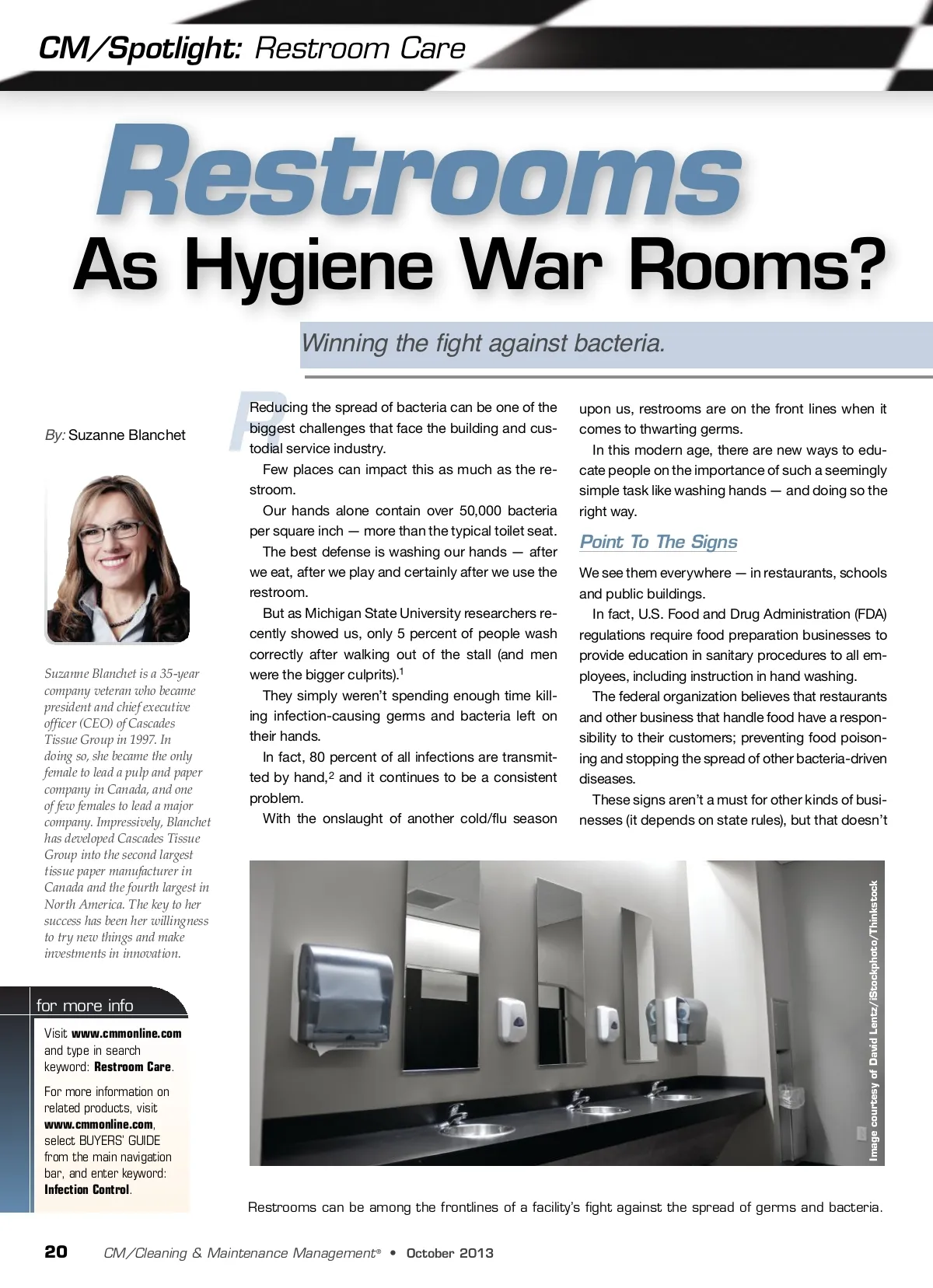
mean they’re not a good idea to post. There are some posters that show a step-by-step process on how to wash hands cor-rectly. It’s also a good idea to post them in a place people see before they get to the sink, like on the inside of a stall door. It’s even a good idea to post it on the exit, as a reminder to people leaving. You never know if it will make someone turn around and wash. Improve Cleaning There really is a proper way to wash hands. Use soap and water only, work the soap into a lather and scrub for at least 20 sec-onds (the CDC suggests humming the tune to “Happy Birthday” twice). Alcohol-based gels and sanitizers are good to have on hand, as they help kill 99.9 percent of germs. In fact, they should be used when soap and water are not available. But they do not eliminate all types of germs, and they’re simply not the same as soap. They shouldn’t be used when hands are visibly soiled, like with dirt, grease, blood and fecal matter. It’s also important to note that if there is a lot of dirt on the hands, the antibacterial hand gel may not reach the microorganisms under the dirt, according to Dr. Richard Ellison III at University of Massachusetts Medical School. If you’re concerned about sustainability and safety, it’s important to note that some studies show that the chemical triclosan in antibacterial soap might be hazardous to human health 3 and was found to be harmful in the environment. 4 If you really want an antibacterial soap, look for products that don’t list triclosan in their ingredients. stead of moving them off the hands. There have been multiple studies per-formed on this practice, like the one in Aus-tralia at the Queensland University of Tech-nology. Scientists there say hand towels are much more effective. 5 But for the millions of people who don’t read scientific journals or experiment in their bathrooms, the show “Mythbusters” on the Discovery Channel recently put this exact practice to the test. Hosts Adam Savage and Jamie Hyneman put safe amounts of Escherichia coli ( E. Coli ) on 16 people’s hands (front and back), had them properly wash with soap and water and dry with both hand towels and hot air dryers. Testing the “myth” that towels prevent the spread of more bacteria, the show scien-tifically determined that towels are best and helped kill more than 70 percent of the germs. That’s exactly why the first-ever antibac-terial towel was created last year. Impregnated with a safe, active chemical ingredient, the towel is scientifically proven to minimize hand contamination by 99.9 percent and compensate for people’s im-perfect hygiene habits without changing the way they wash or dry their hands. At the end of the day, proper hand hy-giene is an individual’s responsibility. But, by giving people the tools and edu-cation to wash and dry right in the restroom, property and sanitation managers can liter-ally dictate public health to a cleaner future. 1 The School of Hospitality Business, Michigan State University. Hand-washing study 2 Centers for Disease Control 3 http://www.mayoclinic.com/health/triclosan/ AN02141 4 Environment Canada 5 Big Pond News, June 4, 2013 CM Pick Up A Towel Wet hands pick up and transfer up to 1,000 times the number of bacteria as dry hands and provide the moisture and warmth that bacteria need to grow. That’s why the method in which hands are dried is so crucial. Air dryers often do not match the efficacy of a dry paper towel. The hot air moves the germs around in-FREE INFO: Reader Service 204 or CMMOnline.com/freeinfo www.cmmonline.com 21
CMM – Archives October 2013: 21