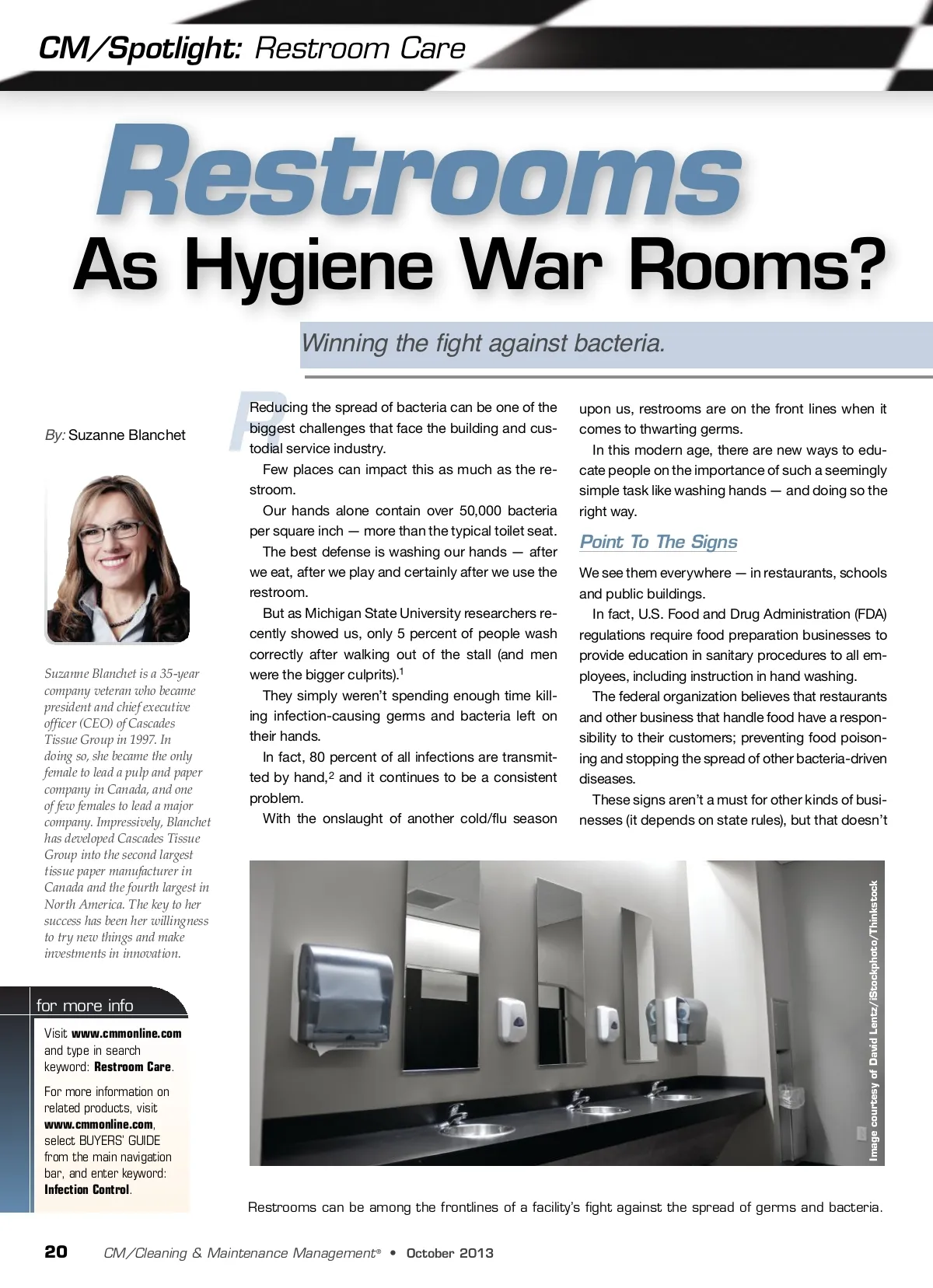
CM/Spotlight: Restroom Care Restrooms As Hygiene War Rooms? Winning the fight against bacteria. By: Suzanne Blanchet R for more info Visit www.cmmonline.com and type in search keyword: Restroom Care . For more information on related products, visit www.cmmonline.com , select BUYERS’ GUIDE from the main navigation bar, and enter keyword: Infection Control . Restrooms can be among the frontlines of a facility’s fight against the spread of germs and bacteria. 20 CM/Cleaning & Maintenance Management ® • October 2013 Image courtesy of David Lentz/iStockphoto/Thinkstock Suzanne Blanchet is a 35-year company veteran who became president and chief executive officer (CEO) of Cascades Tissue Group in 1997. In doing so, she became the only female to lead a pulp and paper company in Canada, and one of few females to lead a major company. Impressively, Blanchet has developed Cascades Tissue Group into the second largest tissue paper manufacturer in Canada and the fourth largest in North America. The key to her success has been her willingness to try new things and make investments in innovation. Reducing the spread of bacteria can be one of the biggest challenges that face the building and cus-todial service industry. Few places can impact this as much as the re-stroom. Our hands alone contain over 50,000 bacteria per square inch — more than the typical toilet seat. The best defense is washing our hands — after we eat, after we play and certainly after we use the restroom. But as Michigan State University researchers re-cently showed us, only 5 percent of people wash correctly after walking out of the stall (and men were the bigger culprits). 1 They simply weren’t spending enough time kill-ing infection-causing germs and bacteria left on their hands. In fact, 80 percent of all infections are transmit-ted by hand, 2 and it continues to be a consistent problem. With the onslaught of another cold/flu season upon us, restrooms are on the front lines when it comes to thwarting germs. In this modern age, there are new ways to edu-cate people on the importance of such a seemingly simple task like washing hands — and doing so the right way. Point To The Signs We see them everywhere — in restaurants, schools and public buildings. In fact, U.S. Food and Drug Administration (FDA) regulations require food preparation businesses to provide education in sanitary procedures to all em-ployees, including instruction in hand washing. The federal organization believes that restaurants and other business that handle food have a respon-sibility to their customers; preventing food poison-ing and stopping the spread of other bacteria-driven diseases. These signs aren’t a must for other kinds of busi-nesses (it depends on state rules), but that doesn’t
CMM – Archives October 2013: 20