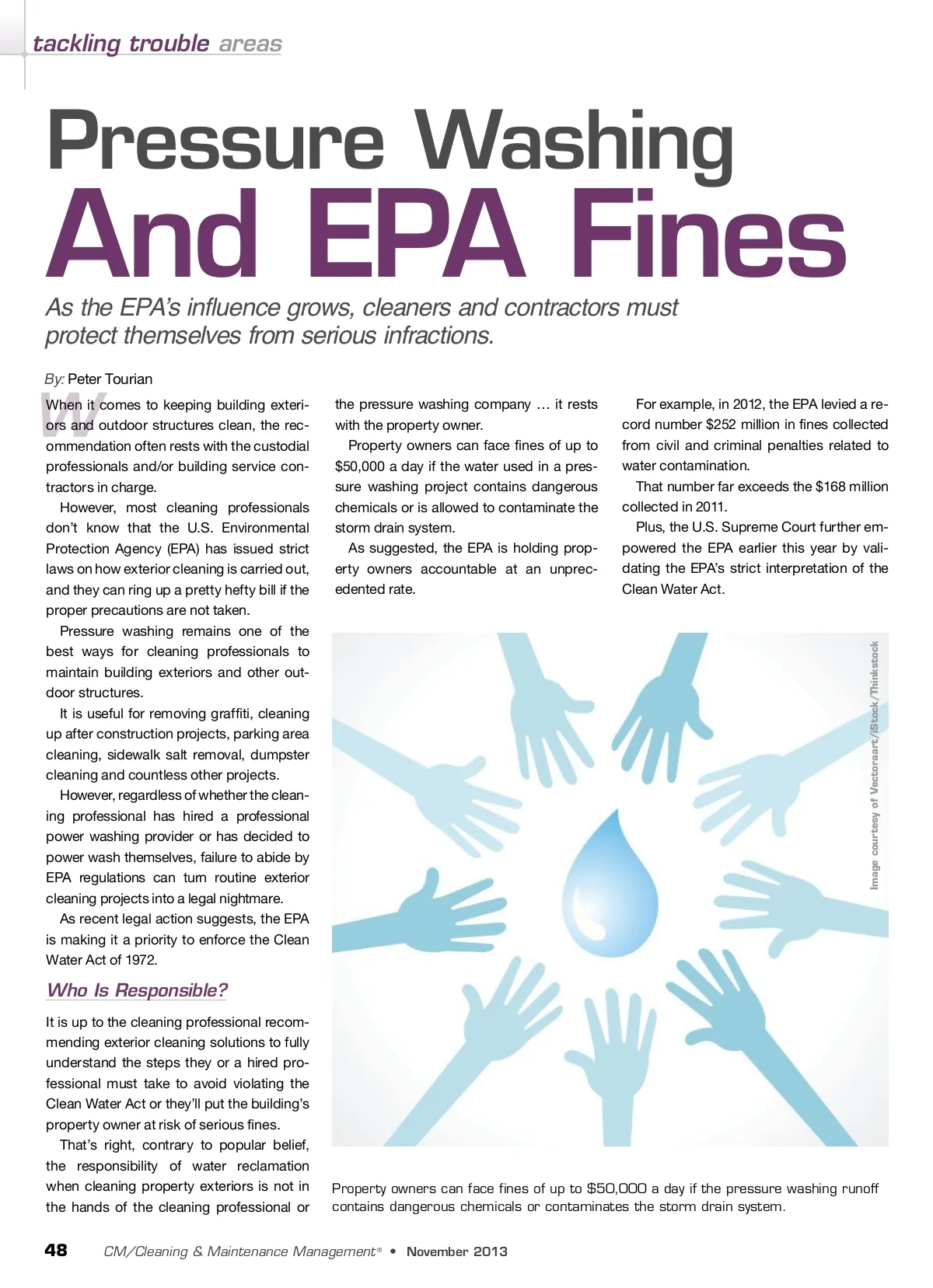
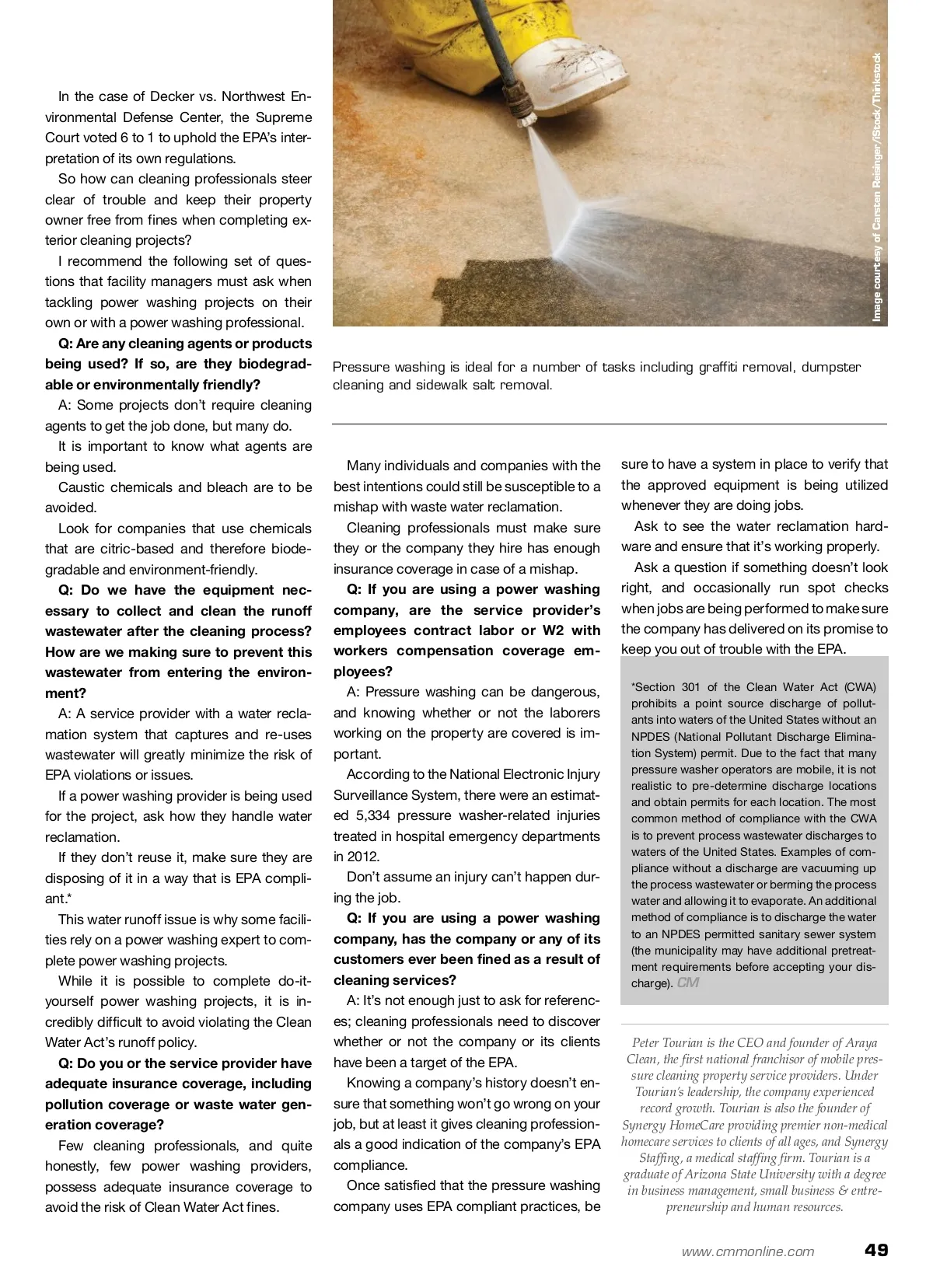
In the case of Decker vs. Northwest En-vironmental Defense Center, the Supreme Court voted 6 to 1 to uphold the EPA’s inter-pretation of its own regulations. So how can cleaning professionals steer clear of trouble and keep their property owner free from fines when completing ex-terior cleaning projects? I recommend the following set of ques-tions that facility managers must ask when tackling power washing projects on their own or with a power washing professional. Q: Are any cleaning agents or products being used? If so, are they biodegrad-able or environmentally friendly? A: Some projects don’t require cleaning agents to get the job done, but many do. It is important to know what agents are being used. Caustic chemicals and bleach are to be avoided. Look for companies that use chemicals that are citric-based and therefore biode-gradable and environment-friendly. Q: Do we have the equipment nec-essary to collect and clean the runoff wastewater after the cleaning process? How are we making sure to prevent this wastewater from entering the environ-ment? A: A service provider with a water recla-mation system that captures and re-uses wastewater will greatly minimize the risk of EPA violations or issues. If a power washing provider is being used for the project, ask how they handle water reclamation. If they don’t reuse it, make sure they are disposing of it in a way that is EPA compli-ant.* This water runoff issue is why some facili-ties rely on a power washing expert to com-plete power washing projects. While it is possible to complete do-it-yourself power washing projects, it is in-credibly difficult to avoid violating the Clean Water Act’s runoff policy. Q: Do you or the service provider have adequate insurance coverage, including pollution coverage or waste water gen-eration coverage? Few cleaning professionals, and quite honestly, few power washing providers, possess adequate insurance coverage to avoid the risk of Clean Water Act fines. Pressure washing is ideal for a number of tasks including graffiti removal, dumpster cleaning and sidewalk salt removal. Many individuals and companies with the best intentions could still be susceptible to a mishap with waste water reclamation. Cleaning professionals must make sure they or the company they hire has enough insurance coverage in case of a mishap. Q: If you are using a power washing company, are the service provider’s employees contract labor or W2 with workers compensation coverage em-ployees? A: Pressure washing can be dangerous, and knowing whether or not the laborers working on the property are covered is im-portant. According to the National Electronic Injury Surveillance System, there were an estimat-ed 5,334 pressure washer-related injuries treated in hospital emergency departments in 2012. Don’t assume an injury can’t happen dur-ing the job. Q: If you are using a power washing company, has the company or any of its customers ever been fined as a result of cleaning services? A: It’s not enough just to ask for referenc-es; cleaning professionals need to discover whether or not the company or its clients have been a target of the EPA. Knowing a company’s history doesn’t en-sure that something won’t go wrong on your job, but at least it gives cleaning profession-als a good indication of the company’s EPA compliance. Once satisfied that the pressure washing company uses EPA compliant practices, be sure to have a system in place to verify that the approved equipment is being utilized whenever they are doing jobs. Ask to see the water reclamation hard-ware and ensure that it’s working properly. Ask a question if something doesn’t look right, and occasionally run spot checks when jobs are being performed to make sure the company has delivered on its promise to keep you out of trouble with the EPA. *Section 301 of the Clean Water Act (CWA) prohibits a point source discharge of pollut-ants into waters of the United States without an NPDES (National Pollutant Discharge Elimina-tion System) permit. Due to the fact that many pressure washer operators are mobile, it is not realistic to pre-determine discharge locations and obtain permits for each location. The most common method of compliance with the CWA is to prevent process wastewater discharges to waters of the United States. Examples of com-pliance without a discharge are vacuuming up the process wastewater or berming the process water and allowing it to evaporate. An additional method of compliance is to discharge the water to an NPDES permitted sanitary sewer system (the municipality may have additional pretreat-ment requirements before accepting your dis-charge). CM Peter Tourian is the CEO and founder of Araya Clean, the first national franchisor of mobile pres-sure cleaning property service providers. Under Tourian’s leadership, the company experienced record growth. Tourian is also the founder of Synergy HomeCare providing premier non-medical homecare services to clients of all ages, and Synergy Staffing, a medical staffing firm. Tourian is a graduate of Arizona State University with a degree in business management, small business & entre-preneurship and human resources. www.cmmonline.com 49 Image courtesy of Carsten Reisinger/iStock/Thinkstock
CMM – Archives November 2013: 49