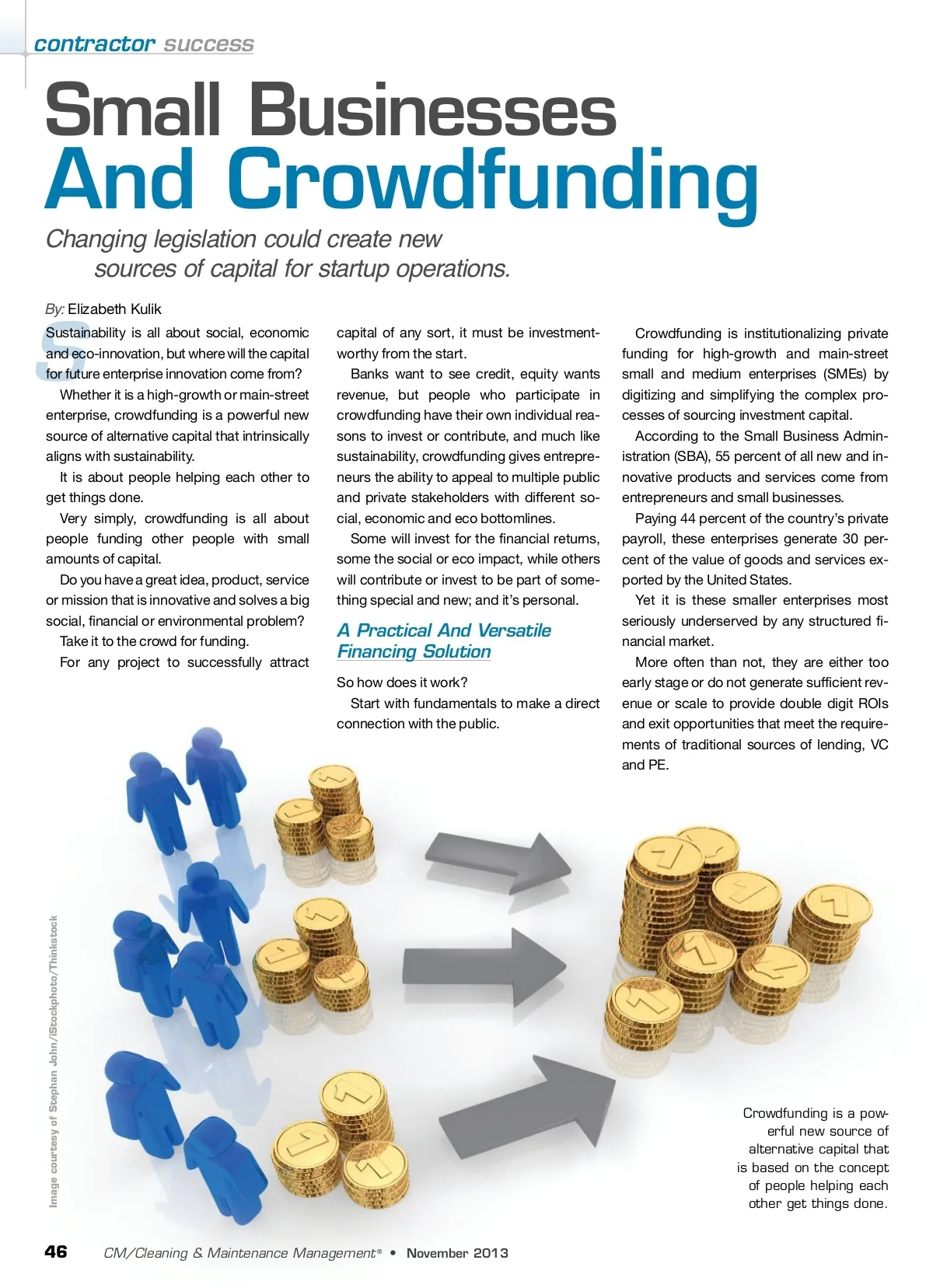
The Heart Of Crowdfunding Shared interests and follow through are at the heart of a successful crowdfunding campaign. Recognizing that many things appeal to many people, in order to attract a larger crowd, there must be a collection of strong touchpoints that make for a rich and ongo-ing story. This lends itself especially well to sustain-ability, as the development process takes years to accomplish, and the asset itself has a many-year life span that can change overtime. To meet the challenges of crowdsourcing funds, the communications strategy would begin with the development of a media-savvy digital story that includes video, nar-rative and pictures that represent not only the project, but the passion of the project creator for the project. A multi-tiered broadcasting strategy will have an overlapping appeal to a variety of audiences that identify with: the project cre-ator, the locale and geography, the purpose of the project, the project brand, potential users and customers, developers, supply chain vendors/contractors and financial re-sources beyond crowdfunding. Combining a tiered broadcast strategy with a tiered financing strategy that includes donations/rewards for various early stages of the project with crowdfunding equity (JOBS Act — 2013) for more institutional-like later stage financing will allow companies with sustainability interests to manage crowd-funding in a manner that will promote project execution from start to finish. Crowdfunding Is An Eco-system Once stymied by efficient access to capi-tal, entrepreneurs and SMEs are embrac-ing crowdfunding in growing numbers as an alternative source of pre-institutional funding. In 2012, the U.S. crowdfunding sector grew 112 percent, raising $1.6 billion over approximately 650,000 campaigns, and $3.7 billion was predicted for 2013, according to experts at Massolutions. Recognizing that the problematic gap in access to pre-institutional capital that cre-ates jobs and fuels economic growth could not be solved within the current capital mar-ket’s eco-system, the JOBS Act ostensibly institutionalizes and extends the already powerful “people-to-people” investment strata of family and friends. Practically speaking, crowdfunding in the U.S. and globally is comprised of four pri-mary types: ■ Donation based crowdfunding contribu-tions to 501(c)(3) organizations, business and personal project contributions are raised from personal funders who do not expect any tangible returns or incentives for their funding. ■ Rewards based crowdfunding is a powerful way to raise funds by offering non-financial rewards in exchange for a contribution. Returns are experiential and exciting, from thank you notes to pre-sell of first run production or V.I.P. status; no ownership in the enterprise is exchanged for funding. Rather, rewards based crowdfunding is fast becoming a way to not only raise funds, but also to test products, spread the word about a new brand and engage contributors to become loyal customers. ■ Equity based crowdfunding will launch in late 2013, subject to pending SEC regula-tion. The general public (accredited and non-accredited) can invest in the securities of small businesses and startups qualified to list on registered BD/Portals with a vari-ety of economic return strategies including stock sales, refinancing exits, dividends and customer-owner discounts. ■ Lending based crowdfunding will launch when the SEC promulgates rules. Micro-finance, peer-to-peer, local bank lend-ing bid models prevail, with conditions for application based on commercial or impact lending that range from a struc-tured payback with and without interest over time. In addition to crowdfunding, the JOBS Act accelerates growth and eases the costly and time-consuming regulatory environment for SMEs with groundbreak-ing legislation: ■ Title I creates a new class of emerging growth company and eases IPO regis-tration requirements for companies with less than $1 billion revenue. ■ Title II lifts the ban on general solicita-tion and advertising for Regulation D, Rule 506 & 144A offerings. On July 10, the SEC lifted the 80 year ban on gen-eral solicitations with a 4/1 vote, as one of the first rulings announced from the JOBS Act. ■ Title III says crowdfunding provides a reg-istration exemption for limited sized offer-ings of $1 million per year per issuer to be sold online via portals and broker/dealers in small amounts to a large number of accredited and non-accredited investors, who will have caps on how much they can invest per year based on non/accredited status verification. Currently, donation/ reward crowdfunding is legal in the U.S., and is an option that does not dilute own-ership for entrepreneurs. ■ Title IV increases the amount of capital that can be raised under Regulation A from $5 million to $50 million. ■ Title V increases the threshold for man-datory registration from 500 to 2,000 shareholders per company. ■ Title VI increases the numbers of share-holders required for mandatory registra-tion from 500 to 2,000 and raises thresh-olds for non-listed banks or bank holding companies to terminate registration from 300 to 1,200 shareholders. But not everything is legal yet. As the crowdfunding market awaits SEC rulemaking for the more complex debt, eq-uity and exemption issues legislated by the JOBS Act, the powerful donation/reward crowdfunding model is legal and gaining immense traction for high-growth and main-street SMEs. Both SMEs and investors have seen crowdfunded businesses make headlines in the past year. Capital markets are being reset and crowdfunding is fast becoming the go to alternative for capital formation for start-ups and SMEs focused on people, planet profit. CM Elizabeth Smith Kulik is the co-founder and chief executive officer (CEO) of ProHatch. Kulik is a business leader and entrepreneur that has earned an international reputation for master-ing complex business problems. She created and executed development, acquisitions, dispositions, repositioning and growth strategies for more than $75 billion of institutional operating company and real estate investments. Kulik’s diverse leadership experience in business and real estate, investment, technology and operations gives her a unique perspective on crowdfunding. www.cmmonline.com 47
CMM – Archives November 2013: 47