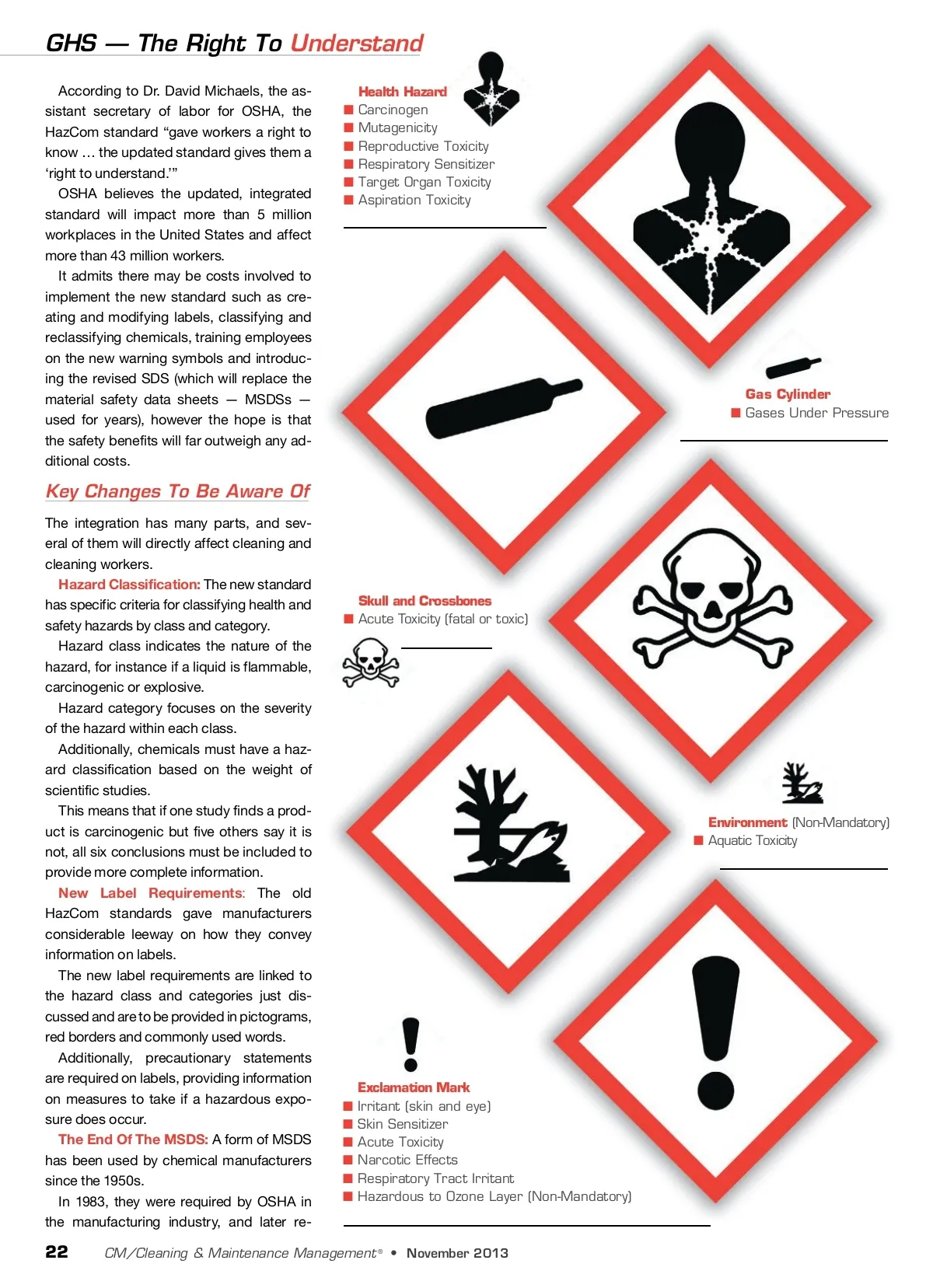
GHS — The Right To Understand According to Dr. David Michaels, the as-sistant secretary of labor for OSHA, the HazCom standard “gave workers a right to know … the updated standard gives them a ‘right to understand.’” OSHA believes the updated, integrated standard will impact more than 5 million workplaces in the United States and affect more than 43 million workers. It admits there may be costs involved to implement the new standard such as cre-ating and modifying labels, classifying and reclassifying chemicals, training employees on the new warning symbols and introduc-ing the revised SDS (which will replace the material safety data sheets — MSDSs — used for years), however the hope is that the safety benefits will far outweigh any ad-ditional costs. ■ ■ ■ ■ ■ ■ Health Hazard Carcinogen Mutagenicity Reproductive Toxicity Respiratory Sensitizer Target Organ Toxicity Aspiration Toxicity Gas Cylinder ■ Gases Under Pressure Key Changes To Be Aware Of The integration has many parts, and sev-eral of them will directly affect cleaning and cleaning workers. Hazard Classification: The new standard has specific criteria for classifying health and safety hazards by class and category. Hazard class indicates the nature of the hazard, for instance if a liquid is flammable, carcinogenic or explosive. Hazard category focuses on the severity of the hazard within each class. Additionally, chemicals must have a haz-ard classification based on the weight of scientific studies. This means that if one study finds a prod-uct is carcinogenic but five others say it is not, all six conclusions must be included to provide more complete information. New Label Requirements : The old HazCom standards gave manufacturers considerable leeway on how they convey information on labels. The new label requirements are linked to the hazard class and categories just dis-cussed and are to be provided in pictograms, red borders and commonly used words. Additionally, precautionary statements are required on labels, providing information on measures to take if a hazardous expo-sure does occur. The End Of The MSDS: A form of MSDS has been used by chemical manufacturers since the 1950s. In 1983, they were required by OSHA in the manufacturing industry, and later re-Skull and Crossbones ■ Acute Toxicity (fatal or toxic) Environment (Non-Mandatory) ■ Aquatic Toxicity ■ ■ ■ ■ ■ ■ Exclamation Mark Irritant (skin and eye) Skin Sensitizer Acute Toxicity Narcotic Effects Respiratory Tract Irritant Hazardous to Ozone Layer (Non-Mandatory) 22 CM/Cleaning & Maintenance Management ® • November 2013
CMM – Archives November 2013: 22