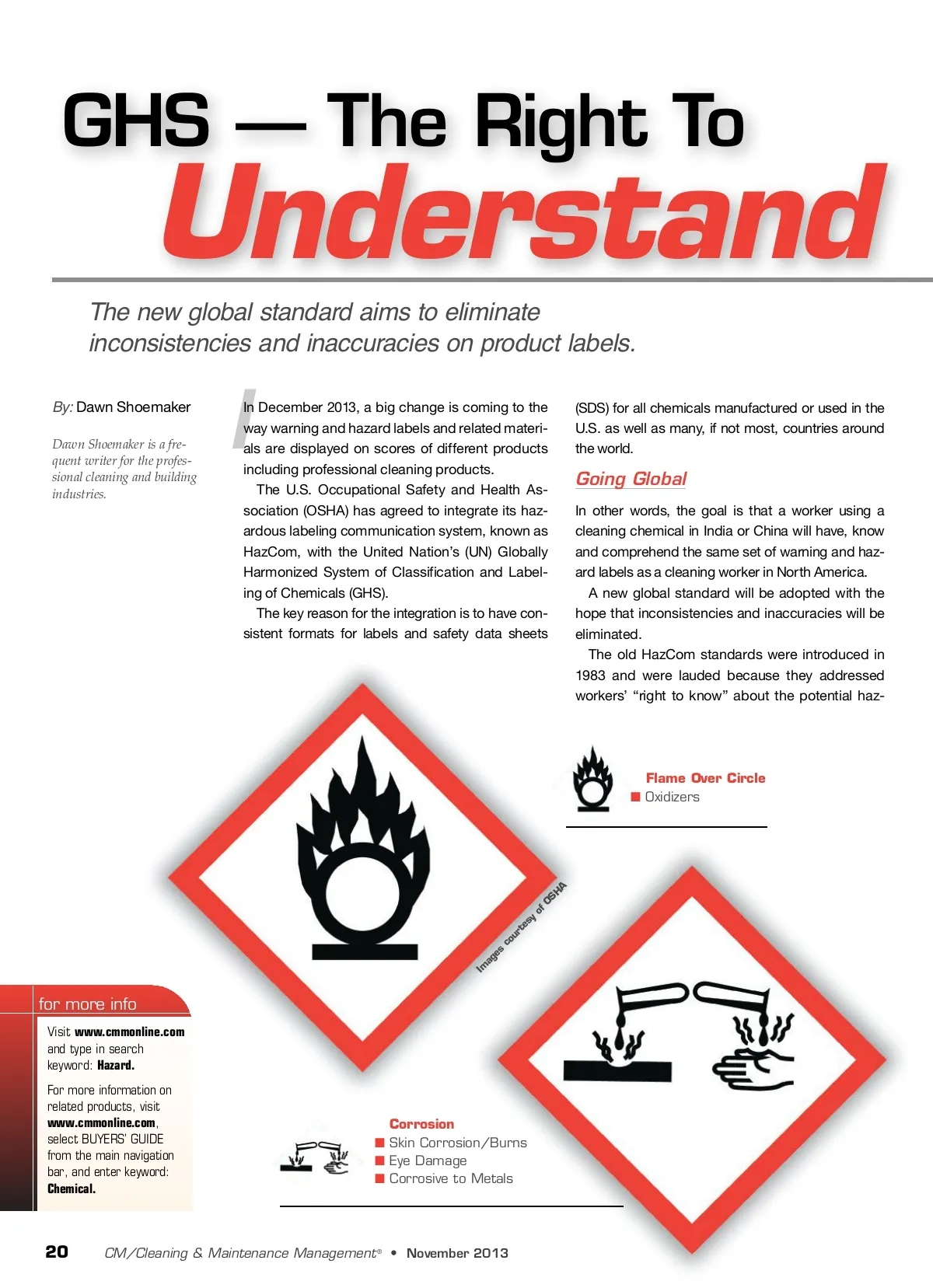
GHS — The Right To Understand The new global standard aims to eliminate inconsistencies and inaccuracies on product labels. By: Dawn Shoemaker Dawn Shoemaker is a fre-quent writer for the profes-sional cleaning and building industries. I In December 2013, a big change is coming to the way warning and hazard labels and related materi-als are displayed on scores of different products including professional cleaning products. The U.S. Occupational Safety and Health As-sociation (OSHA) has agreed to integrate its haz-ardous labeling communication system, known as HazCom, with the United Nation’s (UN) Globally Harmonized System of Classification and Label-ing of Chemicals (GHS). The key reason for the integration is to have con-sistent formats for labels and safety data sheets (SDS) for all chemicals manufactured or used in the U.S. as well as many, if not most, countries around the world. Going Global In other words, the goal is that a worker using a cleaning chemical in India or China will have, know and comprehend the same set of warning and haz-ard labels as a cleaning worker in North America. A new global standard will be adopted with the hope that inconsistencies and inaccuracies will be eliminated. The old HazCom standards were introduced in 1983 and were lauded because they addressed workers’ “right to know” about the potential haz-Flame Over Circle ■ Oxidizers for more info Visit www.cmmonline.com and type in search keyword: Hazard. For more information on related products, visit www.cmmonline.com , select BUYERS’ GUIDE from the main navigation bar, and enter keyword: Chemical. Corrosion ■ Skin Corrosion/Burns ■ Eye Damage ■ Corrosive to Metals 20 CM/Cleaning & Maintenance Management ® • November 2013 Images courtesy of OSHA
CMM – Archives November 2013: 20