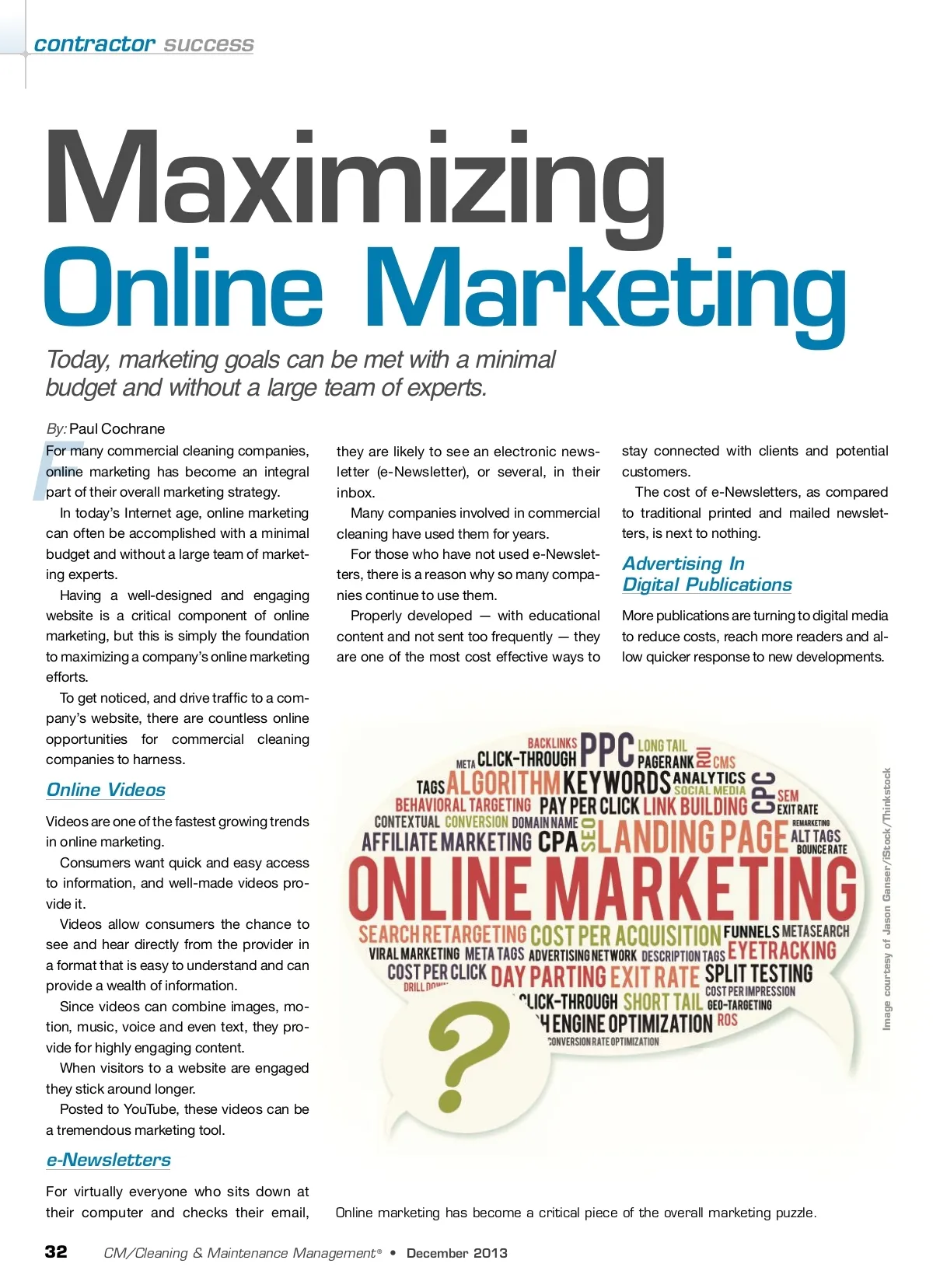
As these publications add an online edition, or switch entirely to a digital for-mat, new advertising opportunities have emerged. Digital advertisements can include actual links, social media connections and videos. These videos can tell a story, provide tes-timonials and showcase how a product or service is used. Digital advertising also allows the adver-tiser to create links that can quickly direct a consumer to more information. These links may connect with a specific landing page that provides targeted con-sumers with direct access to specific in-formation and the ability to inquire about or purchase services. Also, with the use of targeted landing pages, special promotions can be easily created and tracked. at a loss for ideas, develop some edu-cational content. ■ Drive visitors of your social media channels to the company website, and from the website provide links to the company’s social media channels. Press Releases Creating a press release (PR) to garner me-dia attention can be done for very minimal costs with almost immediate results, but there is more to the PR than meets the eye. Virtually all businesses want their PRs to be reprinted, but that is not typically the pri-mary reason to write one. In many circumstances, the number one reason for writing PRs is to increase a website’s organic search engine optimiza-tion (SEO). Whenever you release a PR on one of the many online PR distribution services you have in essence created another Internet presence with links to your company. If the proper keywords were used in the PR then the new web presence created could quite possibly even show up ahead of a company’s main website when people conduct Internet searches using related keywords. When a company sends out a PR through an online PR distribution service, that PR can now be picked up by not only publica-tions, but it will also be picked up by online services such as Google Alerts. If the PR incorporated the correct key-words, it will get picked up and emailed to any number of people that currently get alerts based on those keywords. Webinars A webinar is a type of conferencing event that can be shared through the Internet with virtually anyone. It allows for real-time communications between the webinar host and multiple au-dience members. Webinars provide companies with the op-portunity to interact with clients, and poten-tial clients, for very little cost. These are perfect opportunities to pro-vide live video, interactive forums and slide show presentations with secure ac-cess for educational, marketing and train-ing purposes. Social Media Social media is an ideal tool to share a com-pany’s expertise and develop online com-munities with shared interests. It can be used to interact with custom-ers and educate people about how a company’s products or services can help them. For companies that have not gotten on-board with social media yet, here are some suggestions: ■ Sign up for a Facebook, Twitter, LinkedIn and YouTube account. They are all free. ■ Post news, upcoming events, informa-tion, videos and specials on all the social media channels. ■ Post something at least weekly. When Pay-per-click Advertising Pay-per-click advertising is a form of on-line advertising that allows companies to bid on various keywords and phrases used in Internet searches that allow their paid advertisement to appear in the paid section of Google and other search en-gines, typically on the top and right side of the page. This can be a valuable tool for companies that otherwise are organically appearing on page two or beyond during normal internet searches. engines work and today that primarily means Google. When a potential customer sits at their computer and types in a word or words for a Google search, they are instantly given a huge list of choices by Google. For Google to rank these links, and to ap-pear on page one of the search, they per-form three primary processes. Crawling — This is the process by which the search engine finds new and updated pages to be added to their index. For Google, the program is known as Googlebot, which analyzes billions of web pages. It detects links on pages, new websites, changes to existing pages and dead links. Indexing — Once Googlebot has pro-cessed the pages from crawling, it compiles an index of all the words and their locations on a page. Additionally, it will process information found in content tags and attributes. Serving — During a Google search, the most relevant pages are shown first from a massive index. There are hundreds of factors that de-termine which web pages are most rel-evant. One of the important factors is known as “PageRank” by Google. According to the company, “PageR-ank is the measure of the importance of a page based on the incoming links from other pages. In simple terms, each link to a page on your site from another site adds to your site’s PageRank. Not all links are equal: Google works hard to improve the user experience by identifying spam links and other practices that negatively impact search results. The best types of links are those that are given based on the quality of your content.” CM Paul Cochrane is the president of Cochrane & Associates, www.CochraneAssoc.com, a special-ized marketing and public relations firm focused on helping commercial cleaning, indoor air quality, HVAC and environmental companies maximize their potential. He is also the founder of the IAQ Video Network (www.IAQTV.com), a website portal and video production company for news and information about environmental, health & safety and indoor air quality issues. He can be reached at (602) 510-3179 or [email protected]. www.cmmonline.com Search Engine Optimization Companies have to understand how search 33
CMM – Archives December 2013: 33