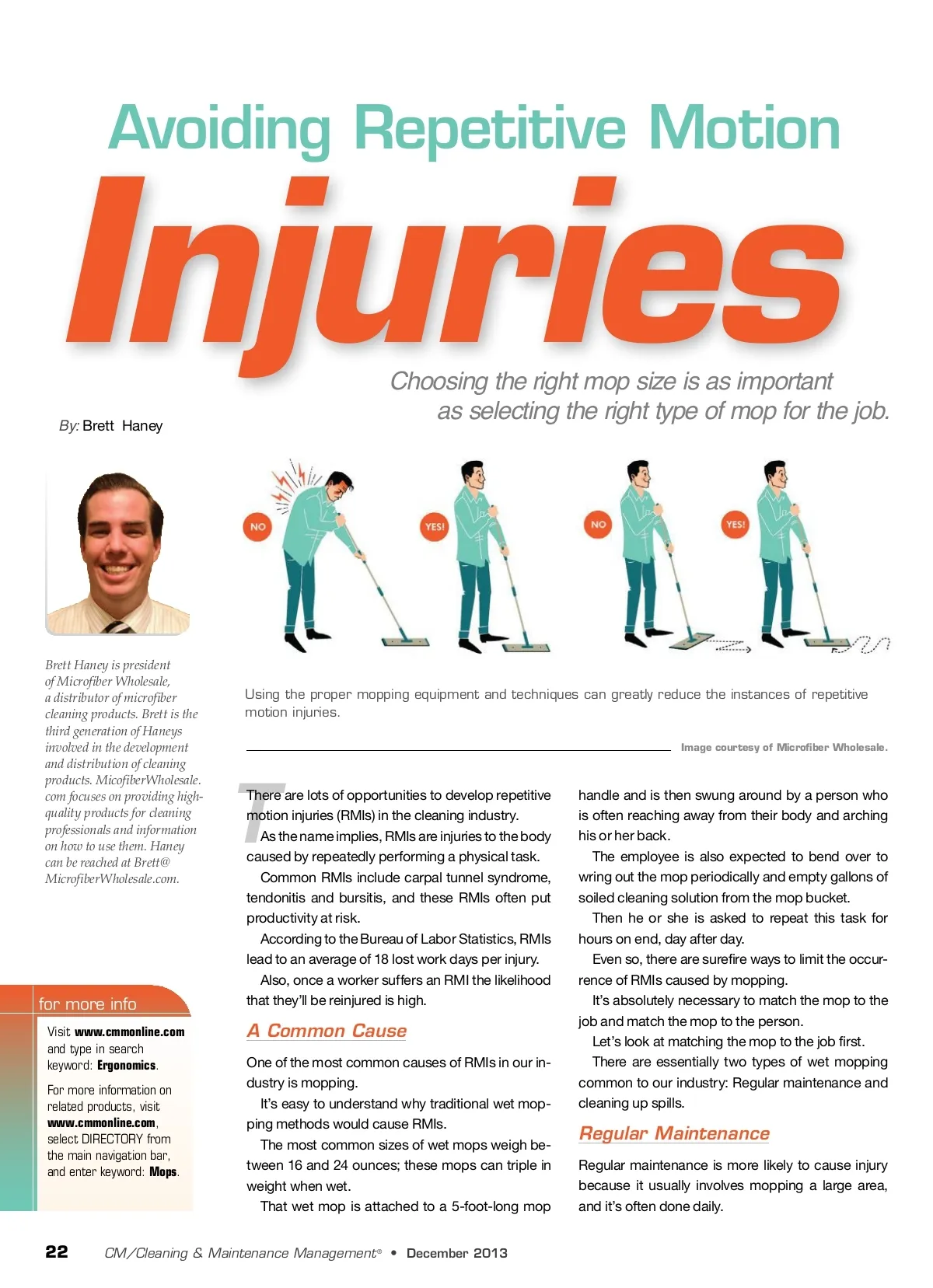
If this task is being performed with a looped-end or cut-end wet mop, a regular mop handle and a bucket and wringer as described previously, it’s no wonder it would cause injury. No matter how ergonomic the mop han-dle or bucket is, no matter how careful the worker is about keeping his or her back straight, elbows in, grip wide and using the lower body to swing the mop around, it’s still a strenuous activity when performed day after day. Injury can be prevented by changing the way we maintain floors, and that brings us to microfiber flat mops. People are rarely injured while dust mop-ping; injuries almost always come from wet mopping because of the physics of swing-ing a mop handle attached to a 5-pound wet mop. Dust mopping is a completely different motion. Cleaners are not swinging around a heavy mop, and they’re not extending the mop out away from their body as people tend to do when wet mopping. When dust mopping, the weight of the mop is resting on the floor and the handle is nearly vertical, close to the body. This is a much more ergonomic method and posture. mop tool so it’s only between 12 inches and 18 inches out from your feet. ■ Put one hand at the top of the handle the other hand on the lower grip. At this point the handle should be almost ver-tical; this will ensure that you’re keeping your back straight. ■ Begin working the mop side to side in almost a figure eight motion while twisting the handle to keep the lead-ing edge of the mop in front. You don’t need to extend the mop to either side very far; you shouldn’t be mopping more than a 3-foot or 4-foot path in any given pass. When you try to extend your path beyond that you’ll have a tendency to over extend your arms and back because you’re trying to reach further than needed with the mop. ■ Work backward through the area you’re mopping so you don’t leave footprints on the still damp floor. ■ Replace your microfiber mop pads often. ■ Use a mop bucket and wringer that has an ergonomic design. There are buck-ets on the market that make it possible to wring out a mop without bending over. ■ Use floor drains to empty your mop bucket rather than lifting up to a sink. If floor drains aren’t available, bail the bucket out with a smaller bucket until it is light enough to safely lift to the height of the sink. Matching The Mop To The Person Making sure a worker uses the right mop for his or her body is as important as choosing the right mop for the job. A person who is small in stature should not be asked to use the same equipment as a person that’s large in stature. A small statured person using a large wet mop is going to be more prone to injury than a larger person using the same mop; how-ever a large person using a small wet mop isn’t being efficient. If he or she is not being efficient then he or she is wasting motion, is taking longer to complete a task and is ultimately more likely to be exposed to injury from repetitive mo-tion. The key is to find the balance between ef-ficiency and ergonomics. Traditional wet mops and microfiber flat mops are available in various sizes. A person who is small in stature should be using 12-to 16-ounce (small, medium) wet mops and 18-inch microfiber flat mops. Average sized people should be using 16-to 24-ounce (medium, large) wet mops and 24-inch microfiber flat mops. Large people can handle 24-ounce wet mops and 24-to 36-inch microfiber flat mops. With microfiber flat mops, the longer they are the harder they are to push across the floor; 36-inch and larger flat mops should only be used for mopping large open areas like gymnasiums. They should be used like a push broom instead of the figure eight motion described above; this will take pressure off of the user’s wrists and back. Following these tips and guidelines will greatly reduce the risk of RMIs for work-ers. CM www.cmmonline.com Cleaning Up Spills When cleaning up spills, it’s still best to use a traditional style wet mop because they have a far greater capacity to absorb liquid and soil than microfiber flat mops. In most environments, the time spent cleaning up spills will be a fraction of the time spent maintaining floors. Because of this, workers can safely use traditional mops without having the kind of exposure to injury they would have using them for both types of mopping. There are certainly best practices that need to be employed when using traditional wet mops. Among them are: ■ Keep your back straight. Posture is important to preventing injury. ■ Use the mop close to your body; avoid extending the mop or your arms out away from your body. Usually when people extend their arms when mop-ping they have a tendency to arch their back. ■ Switch your grip. Alternate which hand is high and low on the mop handle. ■ Use a mop handle that’s comfortable in your hand. Some have a thicker diam-eter handle that is more comfortable to hold than a smaller diameter handle. Using Microfiber Microfiber flat mops are used in exactly the same way, and they are much lighter than conventional mops. A 24-inch microfiber mop frame and han-dle with a damp mop pad attached weighs just over 2 pounds. That’s a great size for an average size per-son (more on that later). A user also doesn’t need to fill, drag around and empty a mop bucket with gallons of cleaning solution in it. With microfiber mops, users can charge the mops ahead of time and replace them rather than wringing them out. Here’s a brief explanation of how to mop with microfiber flat mops: ■ Adjust the mop handle so it’s just below your chin when vertical. ■ If equipped, adjust the lower grip so it’s about 12 inches below the top grip. ■ Place the mop handle/frame on the mop pad. Extend the pad end of the 23
CMM – Archives December 2013: 23