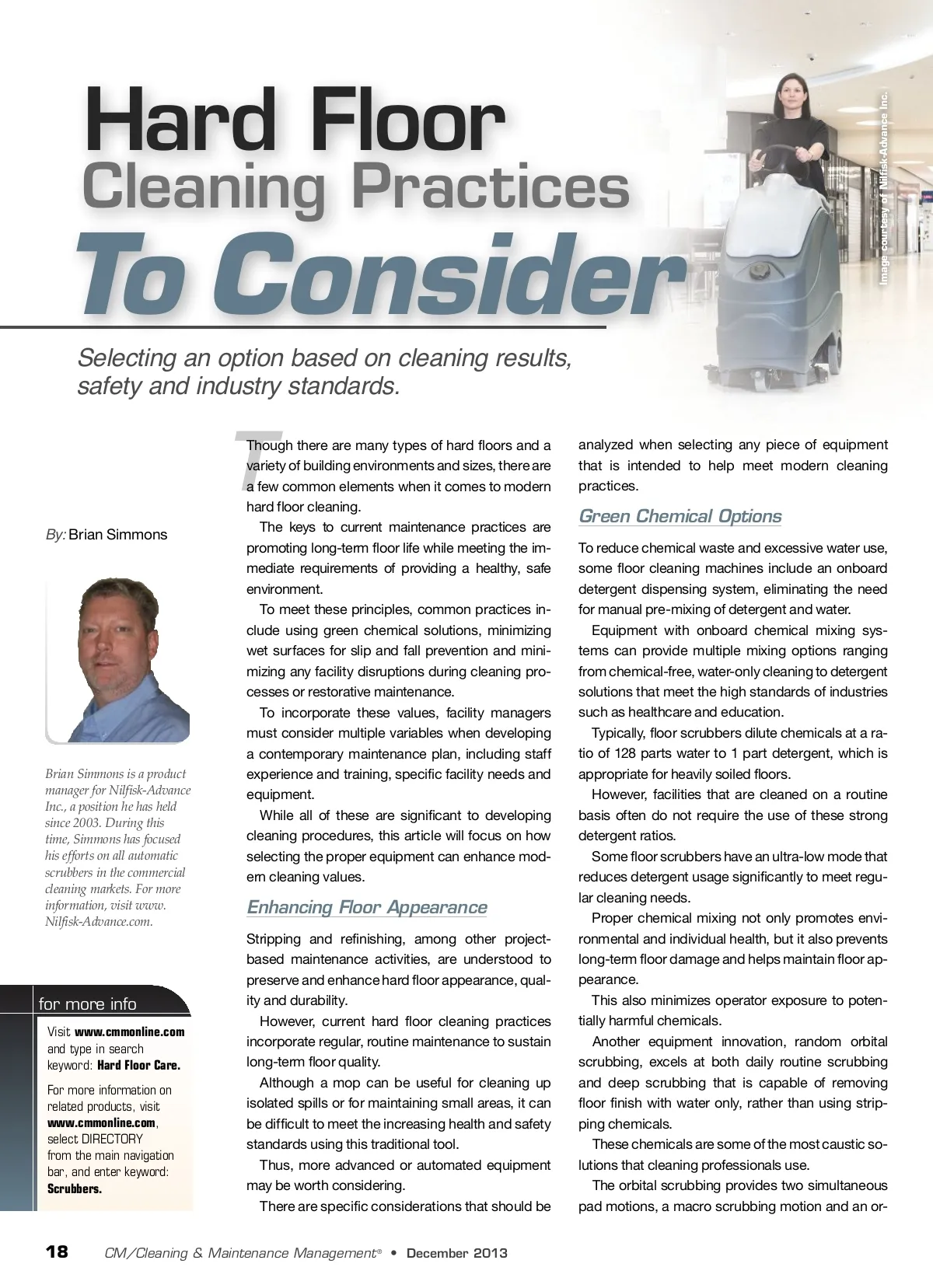
Cleaning Practices To Consider Selecting an option based on cleaning results, safety and industry standards. T By: Brian Simmons Brian Simmons is a product manager for Nilfisk-Advance Inc., a position he has held since 2003. During this time, Simmons has focused his efforts on all automatic scrubbers in the commercial cleaning markets. For more information, visit www. Nilfisk-Advance.com. Though there are many types of hard floors and a variety of building environments and sizes, there are a few common elements when it comes to modern hard floor cleaning. The keys to current maintenance practices are promoting long-term floor life while meeting the im-mediate requirements of providing a healthy, safe environment. To meet these principles, common practices in-clude using green chemical solutions, minimizing wet surfaces for slip and fall prevention and mini-mizing any facility disruptions during cleaning pro-cesses or restorative maintenance. To incorporate these values, facility managers must consider multiple variables when developing a contemporary maintenance plan, including staff experience and training, specific facility needs and equipment. While all of these are significant to developing cleaning procedures, this article will focus on how selecting the proper equipment can enhance mod-ern cleaning values. analyzed when selecting any piece of equipment that is intended to help meet modern cleaning practices. Green Chemical Options To reduce chemical waste and excessive water use, some floor cleaning machines include an onboard detergent dispensing system, eliminating the need for manual pre-mixing of detergent and water. Equipment with onboard chemical mixing sys-tems can provide multiple mixing options ranging from chemical-free, water-only cleaning to detergent solutions that meet the high standards of industries such as healthcare and education. Typically, floor scrubbers dilute chemicals at a ra-tio of 128 parts water to 1 part detergent, which is appropriate for heavily soiled floors. However, facilities that are cleaned on a routine basis often do not require the use of these strong detergent ratios. Some floor scrubbers have an ultra-low mode that reduces detergent usage significantly to meet regu-lar cleaning needs. Proper chemical mixing not only promotes envi-ronmental and individual health, but it also prevents long-term floor damage and helps maintain floor ap-pearance. This also minimizes operator exposure to poten-tially harmful chemicals. Another equipment innovation, random orbital scrubbing, excels at both daily routine scrubbing and deep scrubbing that is capable of removing floor finish with water only, rather than using strip-ping chemicals. These chemicals are some of the most caustic so-lutions that cleaning professionals use. The orbital scrubbing provides two simultaneous pad motions, a macro scrubbing motion and an or-Enhancing Floor Appearance Stripping and refinishing, among other project-based maintenance activities, are understood to preserve and enhance hard floor appearance, qual-ity and durability. However, current hard floor cleaning practices incorporate regular, routine maintenance to sustain long-term floor quality. Although a mop can be useful for cleaning up isolated spills or for maintaining small areas, it can be difficult to meet the increasing health and safety standards using this traditional tool. Thus, more advanced or automated equipment may be worth considering. There are specific considerations that should be for more info Visit www.cmmonline.com and type in search keyword: Hard Floor Care. For more information on related products, visit www.cmmonline.com , select DIRECTORY from the main navigation bar, and enter keyword: Scrubbers. 18 CM/Cleaning & Maintenance Management ® • December 2013 Image courtesy of Nilfisk-Advance Inc. Hard Floor
CMM – Archives December 2013: 18