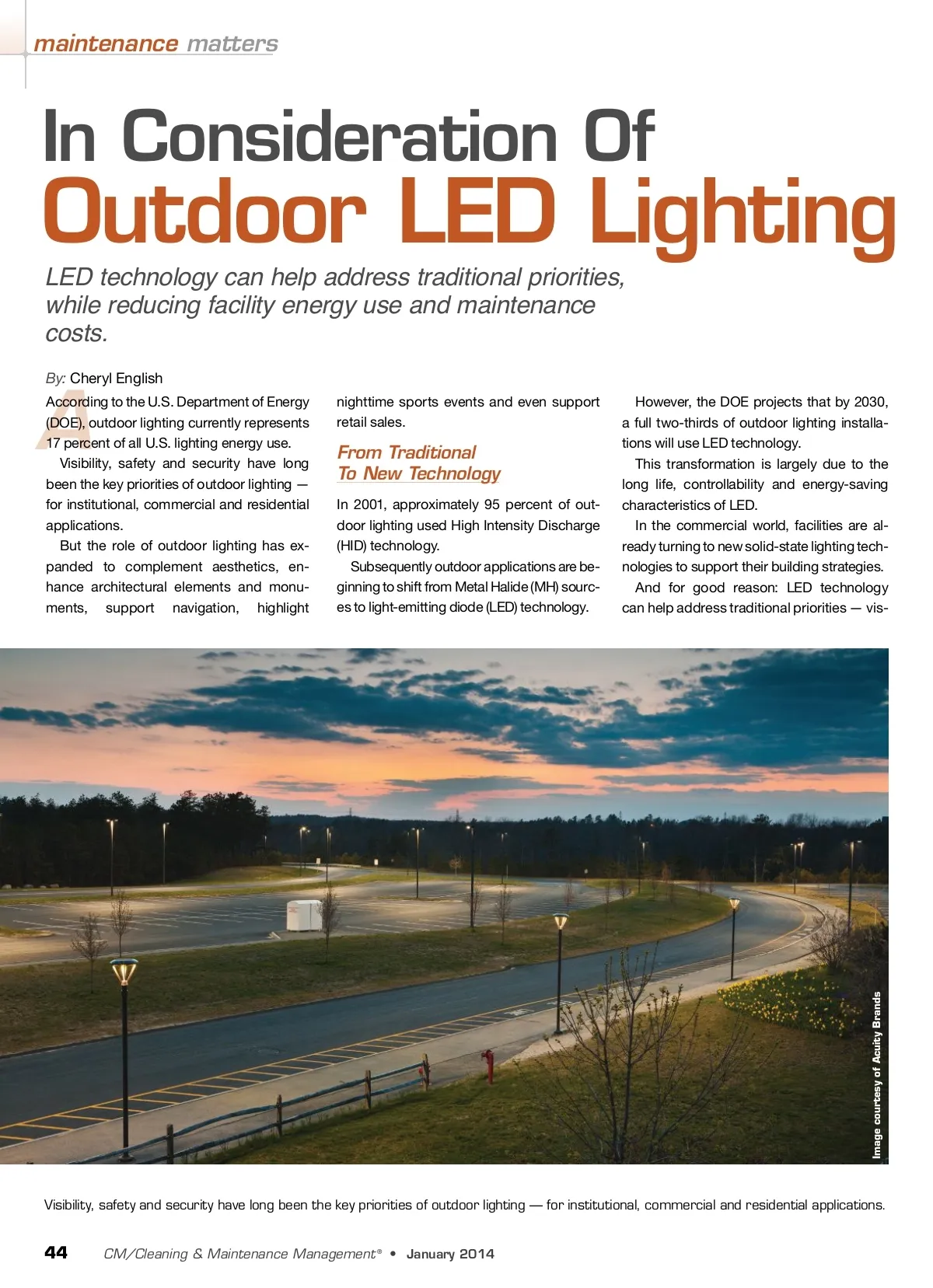
ibility, safety and security — while also sig-nificantly reducing facility energy use and maintenance costs. LED 101 Outdoor lighting equipment with HID light sources relies on reflectors and refractors to direct beams in order to achieve a uniform pattern of light. With solid-state lighting, the use of multi-ple LEDs can result in improved optical con-trol, better uniformity of light and significant energy savings. In addition, LED lighting delivers a much longer life, which helps reduce lamp dispos-al and associated maintenance. In addition, because many existing installa-tions originally specified higher levels of light than the minimum that is actually needed, renovations involving LED replacements may enable building owners to reduce the light levels and the amount of fixtures needed, re-sulting in further energy savings. And, because LEDs are easy to control, users are able to monitor and adapt fixtures to their environments and perform pre-pro-grammed tasks to conserve input power, reduce luminaire maintenance and improve overall system reliability. Potential tasks may include: ■ Managing lumen output actively to deliver consistent light levels over time ■ Monitoring system life ■ Troubleshooting and maintenance. With the development of highly controllable light sources, the lighting controls environ-ment is also experiencing a transformation. Image courtesy of Acuity Brands Advanced sensors may also gradually ramp the light level down over a brief period of time to avoid distractions associated with rapid light level changes. Remote wireless control management systems provide the maximum level of cus-tomization for lighting operation. Wireless controls can establish schedules based on day of the week, the time of night or for special events. The scheduling can be performed on-demand or from a schedule directly from a computer. A wireless system helps manage energy use and provides maintenance diagnostics as well as reports. LED lighting can offer superior light distri-bution and cost-effective solutions within an acceptable payback period. When To Transition Knowing if, when and how to make the tran-sition from traditional to solid-state outdoor LED lighting depends upon your priorities and lighting goals. If your primary objectives, for instance, in-clude energy savings, maintenance reduc-tion and the need to maintain high-quality light, then you will want to design an LED lighting solution focused on those out-comes. Today, LED lighting offers superior light distribution, reliable and cost effective solu-tions within an acceptable payback period. It is also important to consider the total life cycle cost of the solution you are creating. While the initial investment in LED lighting may be higher than traditional sources, the equipment energy and maintenance sav-ings must be taken into account over the life of the system. Determining when and where to incor-porate LED lighting does not have to be complex. Select a location in need of an enhance-ment — parking lot, walkway, building fa-cade, etc. — and evaluate the short-and long-term benefits related to energy reduc-tions, maintenance savings and improved quality. CM Cheryl English is the vice president of government and industry relations for Acuity Brands. She is responsible for energy and sustainability pro-grams, regulatory activities, government relations and industry activities. English is a Fellow in the Illuminating Engineering Society (IES) and has been awarded the IES Distinguished Service Award. She serves on the Board of Managers for the National Electrical Manufacturers Association as well. Maintenance And Energy Savings The use of lighting controls can be one of the most effective strategies to reduce outdoor lighting energy usage and mainte-nance. When paired with today’s advanced digital control technologies, LED lighting systems are leveraged to provide standalone and/or networked control functions. Outdoor lighting was traditionally de-signed to turn on at dusk and off at dawn, delivering the same light level throughout the entire night. However, lighting controls offer a variety of solutions to digitally address outdoor LED lighting, enabling the development of a light-ing system that is more responsive to activi-ties that vary over the course of the night-time hours. Common control technologies include: ■ Trimming: Turning lights on at a preset time after dusk and off at a preset time before dawn. ■ Part Night: Turning lights on at dusk, off or dimmed in the middle of the night and back to full power before dawn. ■ Group Scheduling: Controlling groups, or zones, of lights to adjust to an on, dimmed or off condition at scheduled times. ■ Sensors: Monitoring for times when a space is unoccupied and turning lights to a dimmed state or off. ■ Remote Wireless Control: A wireless communication system to provide indi-vidual or group control through a mesh network. Sensors can be very effective in reduc-ing energy use when full light output is not needed. Under normal conditions, a minimal amount of lighting is desirable to support safety and security considerations. However, the level of light provided when a space is unoccupied can be significantly reduced. Sensors will detect when a space is unoc-cupied. They will also adjust to a reduced light level after a set delay time to avoid constant adjustments. www.cmmonline.com 45
CMM – Archives January 2014: 45