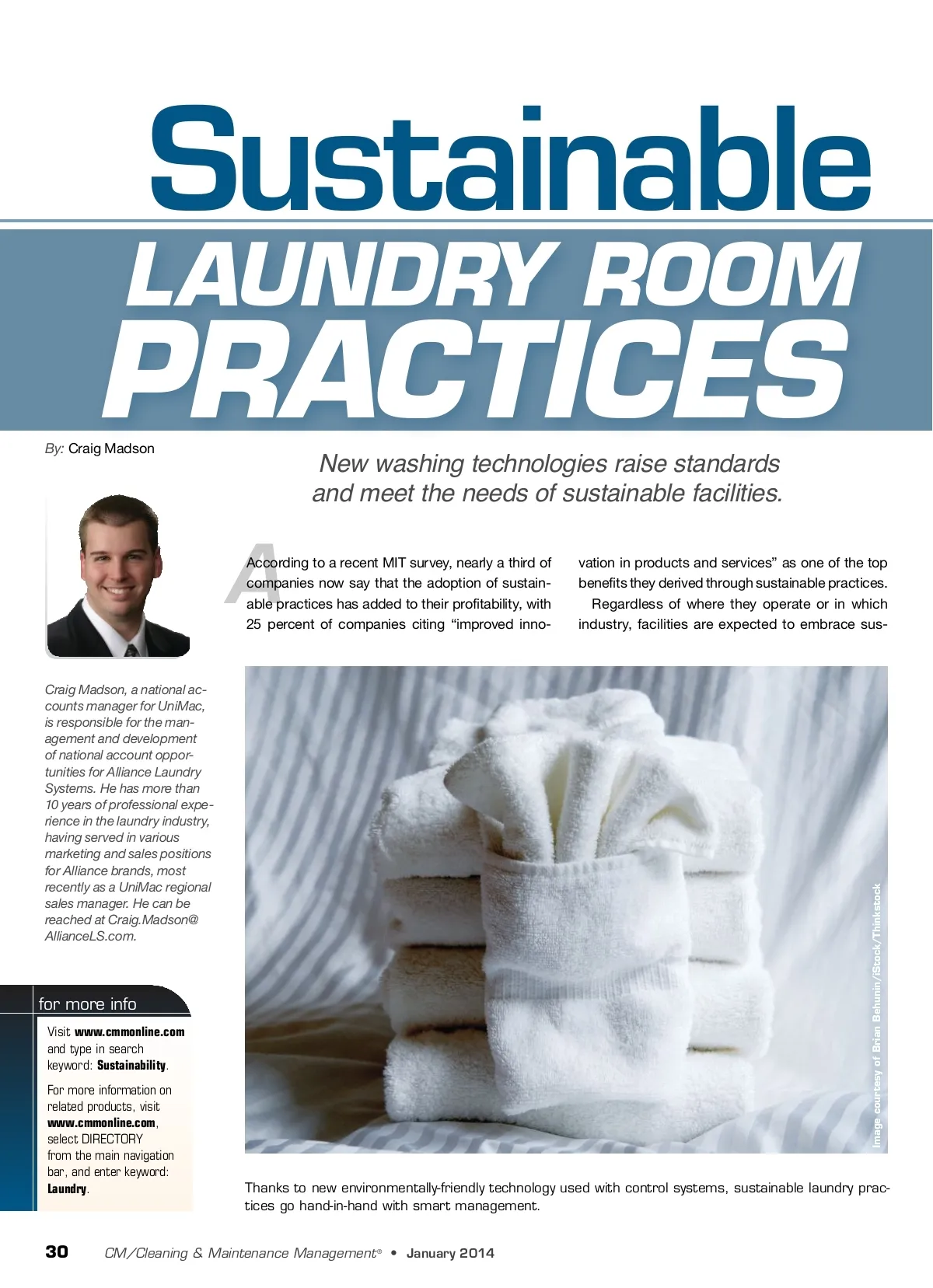
tainable practices in order to “go green.” One place where businesses such as ho-tels and hospitals can make improvements to their sustainability, environmental impact and bottom line is in their on-premises laun-dry rooms. By installing or upgrading to eco-effi-cient laundry operations, managers can positively impact the environment and their bottom line. To help managers achieve this, laundry manufacturers have developed new tech-nology on their washer-extractors and tum-ble dryers to reduce water, gas and energy consumption. New technologies are readily available to raise the standard of laundry operations and meet the needs of sustainable facilities. and gas usage by as much as 35 percent. Tumble Dryers An on-premises laundry room’s greatest source of energy savings can come from tumble dryers equipped with over-dry pre-vention technology. This technology uses sensors to read dry-ness levels throughout the entire load and Washer-extractors A recent commercial washer-extractor up-grade from one manufacturer is a spray rinse technology designed to reduce water and energy use. The feature’s spray rinsing power easily carries away dirt and chemicals compared to the traditional bath-rinse-only method, which simply dilutes wash chemistry. The new technology leaves behind less residue to provide a better rinse and to ex-tend linen life. When facility managers use effective spray rinsing, they are able to minimize the water required to rinse a load and reduce cycle time by 12 percent. The feature can deliver water savings of up to 39 percent compared to conventional rinsing. Additionally, when there is less water used in a cycle, less gas or electricity is needed to heat it. The water and energy savings from spray rinse technology can reduce a facility’s utility costs by more than $2,000 a year. The shorter cycle times also enable in-creased productivity by delivering greater throughput. High extraction speeds are another impor-tant feature of commercial washer-extractors that help achieve optimal sustainability. Increasing the tub’s rotating speed to 400 G-force puts centrifugal force to work by re-moving more water during the wash cycle. Maximizing water removal with high ex-traction speeds can decrease drying times Moisture-sensing capabilities eliminate the issue of over-dry-ing, which is a com-mon occurrence in laundry rooms. shuts the dryer off automatically once the optimal level has been reached. Moisture-sensing capabilities eliminate the issue of over-drying, which is a common occurrence in laundry rooms. Over-dry prevention technology has dem-onstrated a fast return on investment (ROI). A facility with this technology can poten-tially eliminate eight minutes of over-drying per load to save more than $800 a year in gas costs alone. Thus, eco-efficient commercial laundry is more than an environmentally-conscious practice; it is also a sound fiscal practice to support a facility’s bottom line. ficient, and therefore most environmentally-friendly, cycles for a variety of loads. To further meet their sustainability goals, managers can work with their laundry chemi-cal suppliers to program customized temper-ature settings, water fill levels and cycle times. Managers using an advanced control plat-form are also able to tell when a machine has been under-loaded by an employee, which is a significant waste of resources. The control system’s pre-set cycle levels dictate the amount of energy used for a load, so if the machine is not optimally filled with linens, excess resources are being wasted. Employee training about energy efficiency and water conservation may be necessary to ensure the best use of the technology and laundry equipment. Finally, some control systems monitor for specific problems, such as water leaks, and automatically send maintenance notifica-tions when one is detected. If a leak in a hose at the back of the ma-chine goes unnoticed, a facility is literally sending water and money down the drain. Real-time updates alert a manager or operator of issues to ensure maximum ef-ficiency. Smart Management Thanks to new environmentally-friendly technology used with control systems, sus-tainable laundry practices go hand-in-hand with smart management. With increased knowledge, managers can evaluate the effectiveness of technology and how it affects a facility’s sustainability. An advanced control system provides managers with equipment performance and staff operations reports to determine laun-dry room efficiency. Furthermore, management can also quickly calculate the ROI and see the im-pact, both financially and environmentally, of the green technology. Without this information, it is hard to hold technology, equipment and staff account-able for eco-efficient operations. The decision to be more sustainable is a large step for companies. Investing in laundry machines with innova-tive technology and advanced control sys-tems will supply the necessary information to effectively and sustainably manage the laundry room. CM www.cmmonline.com Control Systems The good news is that these recent techno-logical advances of laundry equipment are supported by operating control systems that can audit the environmental impact of effec-tive laundry management. An intelligent control system will monitor machines’ performance and report inef-ficiencies in how the equipment is being used, or send regular maintenance remind-ers, saving managers time and money. The same control system is offered on washer-extractors and tumble dryers to pro-vide ease-of-use across all machines and help achieve maximum efficiency. Some control systems offer more than 40 different wash cycles, making it possible for facility managers to choose the most ef-31
CMM – Archives January 2014: 31