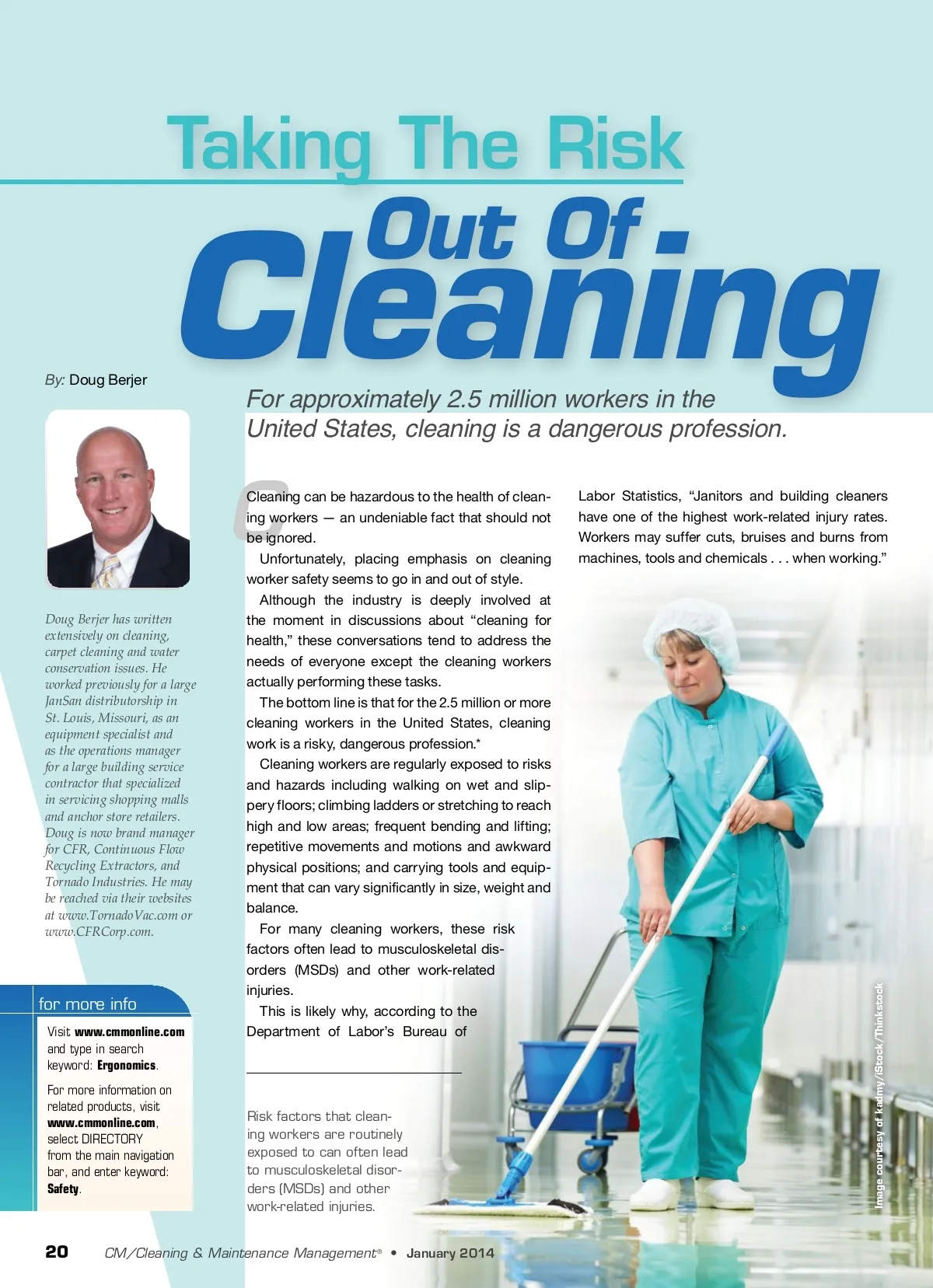
The good news is that proper training and education of cleaning workers makes al-most every cleaning task safer. Manufacturers can also play a key role by manufacturing tools and equipment that “work with the worker” — in other words, tools that are more ergonomically designed. The following discusses how equipment with more advanced designs can make some of the most common cleaning tasks safer. ers, have proven to be easy to learn and easy to use. Mopping Like using a floor machine, mopping floors is also high on the list of risk factors. Most traditional mopping is performed using buckets that can weigh as much as 40 pounds when full of water. In many cases, workers must lower buck-ets from a waist-high sink to the floor for use, and then lift it back up to the sink to dump and refill it. Even if there is a drain area on the floor, in most cases workers must bend or squat to tilt and drain the bucket. All of these motions increase the risk of developing MSDs. In addition, frequently wringing out a wet string mop, as well as the mopping process Floorcare Floorcare has long been the riskiest task when it comes to cleaning worker safety. For one, some rotary-type floor machines have narrow handles that can place the op-erator’s arms and wrists in awkward posi-tions. Further, when starting up some older floorcare equipment, the machine can produce a lot of torque (twisting or turning force), which is then transferred to the oper-ator’s hands, requiring the operator to use a considerable amount of grip force to control the machine. These machines also require a lot of grip force when used for buffing. Torque and vibration can be more of a problem with older machines because they are more likely to become slightly out of bal-ance over time. All of these issues can eventually lead to MSDs. To resolve these issues, facility managers should replace older machines with newer floorcare equipment whenever possible. Almost all cleaning equipment manufac-turers have made considerable progress in recent years in designing lighter equipment that is easier to use and more ergonomic. Many walk-behind or ride-on machines no longer require the grip force necessary to operate a typical rotary machine, so switch-ing to these models can help prevent inju-ries as well. Another development in floorcare is the use of smaller floorcare machines, such as smaller automatic scrubbers. These systems can perform well and are much lighter and easier to use and maneuver than larger, more traditional equipment. Further, cylindrical brush floor machines, now available from different manufactur-FREE INFO: Reader Service 203 or CMMOnline.com/freeinfo www.cmmonline.com 21
CMM – Archives January 2014: 21