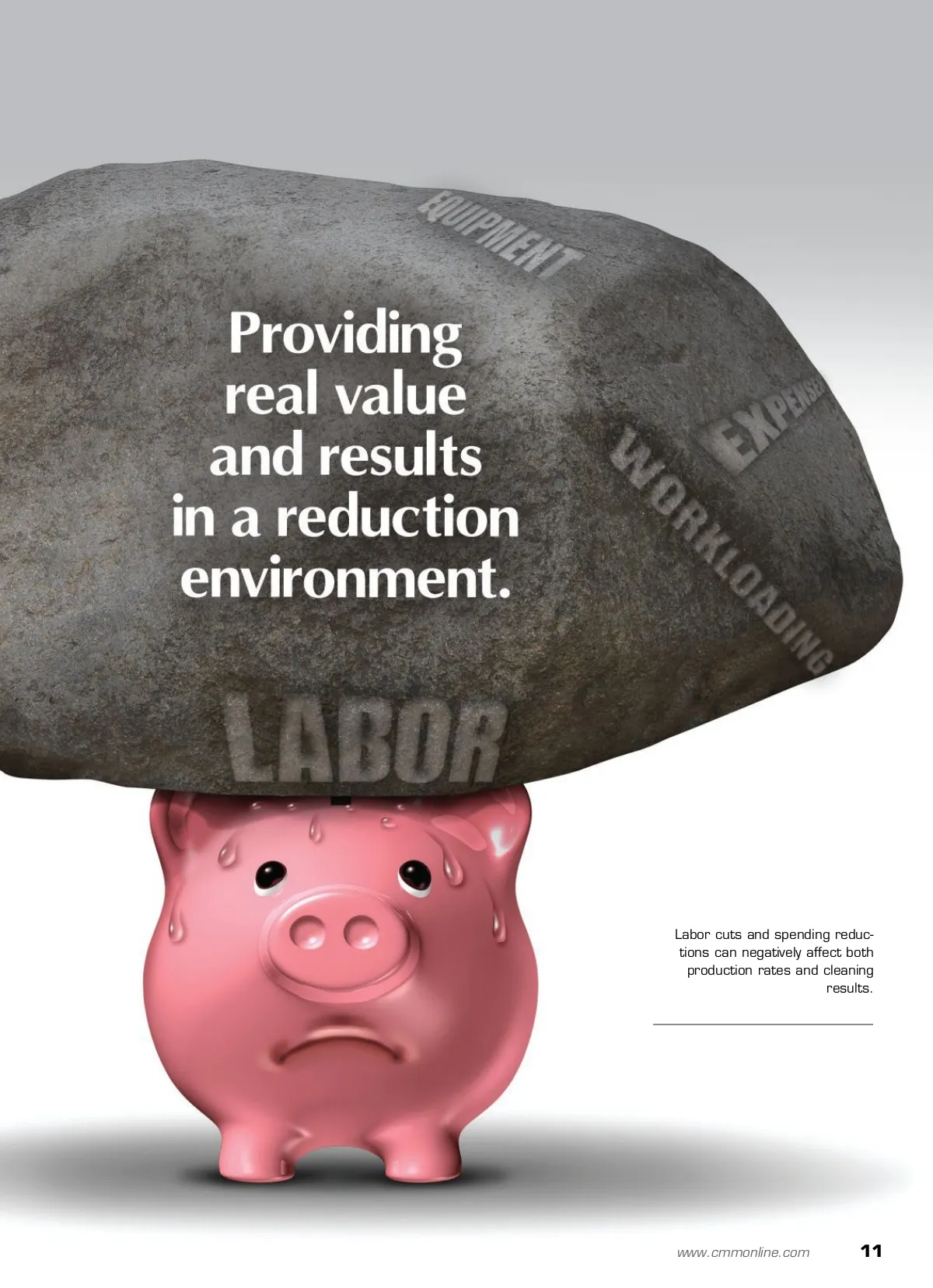
Battling BUDGET PRESSURES Training proves imperative when cleaning budgets plummet. A By: Phillip Lawless As the cleaning and maintenance industry enters a new year, it is faced with a number of intimidating market challenges. One of the most notable — and possibly the most consistent — is the seemingly never ending freefall in operating budgets. Whether a manager or contractor works for an educational facility, a hospital, a government agency or owns a cleaning business, he or she will probably struggle to do more with fewer resources in 2014. Though scientific studies and occupant opin-ions clearly communicate the importance of the cleaning industry, janitorial and maintenance are often the first departments to experience major budget cuts. Phillip Lawless is Editor of Cleaning & Maintenance Management magazine; he can be reached at PLawless@ GrandViewMedia.com. A graduate of the University of Alabama at Birmingham, Lawless has over 13 years of professional writing and editing experience. Common Cuts, Reducing Quality According to Brant Insero with Cleaning Manage-ment Institute (CMI), payroll is the most control-lable expense for many cleaning operations. Thus, many building service contractors (BSCs) that are forced to reduce expenses for a contract will first look to reduce their labor costs. Layoffs occur, mostly from attrition, and the company’s remaining workforce will be left to pick up the existing workload, Insero states. Since other costs are fixed and cannot be cut, employees often feel the brunt of budget pressure, Insero says. Many in-house facility managers, especially those in the education market, have had to reduce their expenses by 30, 40 or even 50 percent, ac-cording to Insero. This has led to an industry trend of facilities out-sourcing their cleaning workload to reduce the ex-penses created by employee benefits and higher salaries. To date, approximately 25 percent of the industry has experienced the threat of their jobs being out-sourced, Insero notes. Some institutions have made significant cutbacks by offering early retirement and not filling the position, and again, other employees have to pick up the extra workload. Finally, many operations reduce budgets by ordering products that are less effective, reducing cleaning fre-quencies or postponing large purchases. Insero points out that none of these op-tions are feasible long-term solutions to shrink-ing budgets. Combined, labor cuts and spending reductions will lead to negative consequences such as high employee turnover, low customer satisfaction and increased facility health concerns. These are all direct results of losing budget dol-lars, and each will directly affect every person in-volved with a facility, including managers, cleaning workers, other employees and building occupants. Proving The Value Of Clean Today, cleaning services are seen as simply an op-erational cost for many facilities or operations. To challenge this notion, managers and con-tractors must prove that there is inherent value in cleaning services conducted by well-trained pro-fessionals. To address this, ISSA completed an informative whitepaper entitled The Value of Clean . The download and other applicable tools can be found on ISSA.com. for more info Visit www.cmmonline.com and type in search keyword: Budgeting . For more information on related products, visit www.cmmonline.com , select DIRECTORY from the main navigation bar, and enter keyword: Training . 10 CM/Cleaning & Maintenance Management ® • January 2014
CMM – Archives January 2014: 10