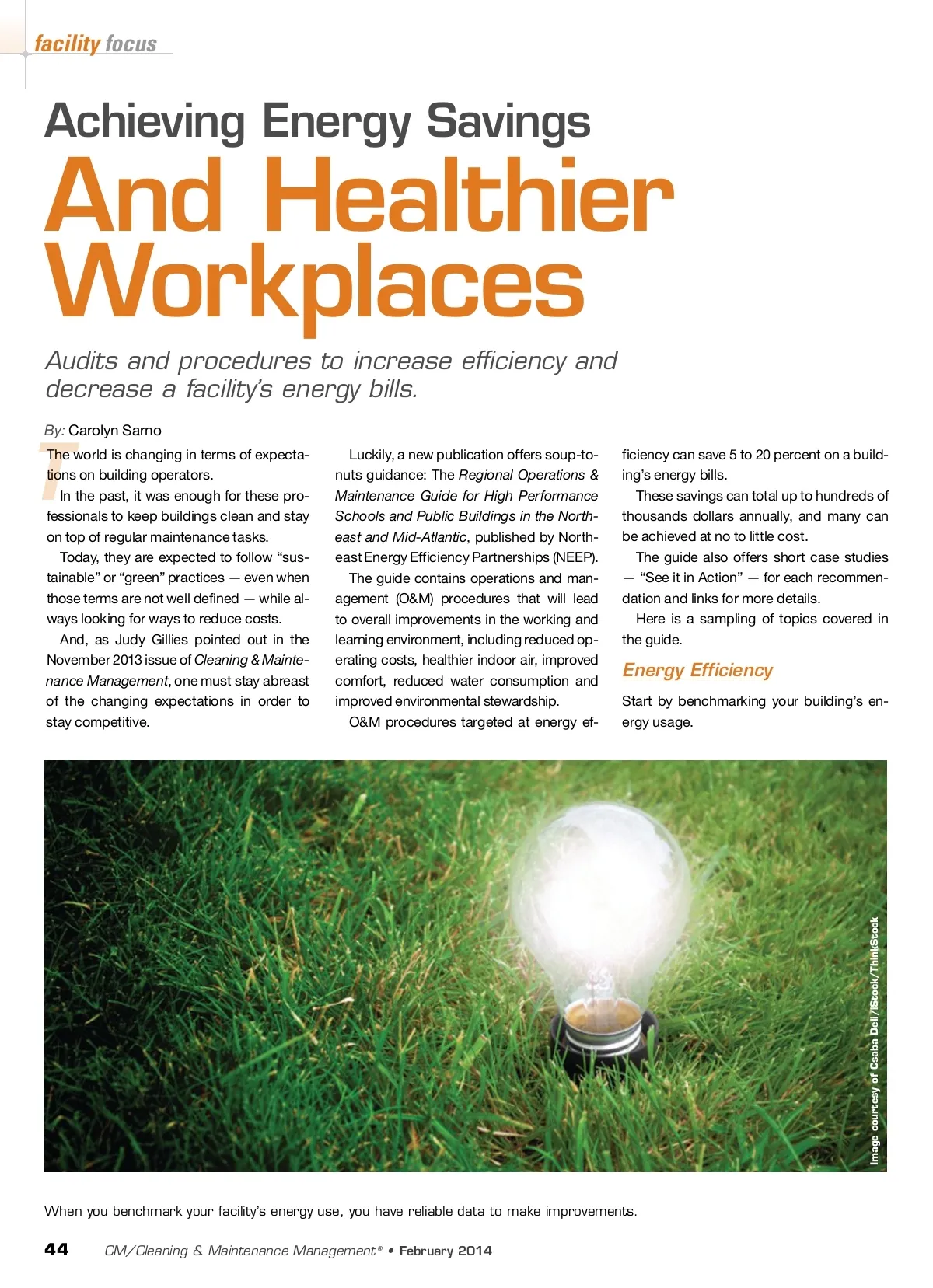
By tracking the usage of current and his-torical consumption through utility bills, you will have a greater understanding of how much energy your building is using. A tool as simple as a spreadsheet or the U.S. Environmental Protection Agency’s (EPA) ENERGY STAR Portfolio Manager can assist building staff in assessing the effec-tiveness of current operations, setting invest-ment priorities and identifying billing errors. Once you know what your energy usage is, a good second step toward increased energy efficiency is a building audit. The most valuable form of these is a third-party comprehensive audit, but they come with an expense. Simple audits can also be performed by a facility’s operation staff. Audits typically cover everything from building occupancy schedules to utility bill-ing data to surveys of plug loads such as computers, copiers, vending machines and more. ■ Lamp recycling policy and a proper storage place for lamps waiting to be recycled. Transportation Municipal fleets, including cars, trucks and buses, can be expensive to operate. However, the investment in regularly scheduled maintenance can reduce costs over the life of the vehicle, while reducing harmful emissions and ensuring the health and safety of passengers. Regular maintenance also prolongs the life of the vehicle, reducing the frequency at which new vehicles will need to be pur-chased. School buses in particular should be tar-geted for routine maintenance due to the fre-quency of their use, but the same principles can be applied to other vehicle types as well. When possible, municipalities should es-tablish a fuel-efficient vehicle purchasing policy. Though typically a greater up-front cost, high-efficiency vehicles cost less to operate and can result in an overall reduced life-cy-cle cost to the owner compared to standard efficiency vehicles. If irrigation is necessary, make arrange-ments to irrigate during morning hours to maximize irrigation benefits and minimize evaporation. Green Cleaners Approximately five billion pounds of chemi-cals are used in the U.S. each year to clean and maintain institutional and commercial buildings. The majority of these products are de-rived from non-renewable natural resourc-es, and for the vast majority of the 70,000-plus ingredients used to make these products, little testing has been conducted to evaluate long-term effects on children or the environment. Next, do research to find out what alterna-tive products are available. Figure out how to perform the same work with fewer chemicals. Initially restrict the use of highest risk chemicals using a sign-out system to con-trol inventories, and be sure to train custodi-ans on how to minimize chemical use. Eliminate highest risk chemicals by shifting from the old products after find-ing, testing and introducing preferable substitutes. NEEP has worked with public sector fa-cility managers all across New England to implement the recommendations in this O&M guide and to help them achieve great-er energy savings and a healthier workplace environment. “The ‘NEEP Operations & Maintenance Guide’ is an excellent resource,” noted Karen Verrengia, energy manager for Cranston, Rhode Island, Public Schools. “It has helped Cranston Public Schools understand and make improvements to our buildings. We knew we were doing a great job in terms of our energy savings, but the guide has helped us identify additional ways to save. The NEEP O&M Guide should be required reading for all maintenance per-sonnel.” CM Maintaining And Retrofitting Lighting Systems Quality lighting is crucial for work and edu-cational environments. Good lighting design and the use of ap-propriate lighting technologies are impor-tant, but proper maintenance is equally im-portant to preserve performance. Proper maintenance will keep lighting sys-tems operating efficiently, keeping lighting levels up and energy costs under control. A good lighting maintenance schedule includes: ■ Periodic cleaning of lamps, lenses and fixture surfaces (annually or more often) ■ Visual inspection for faded or flicker-ing lamps ■ Measurement of light levels with a simple foot-candle meter to address low-light level complaints ■ Inspection of manual and automatic controls for proper function and to make sure controls have not been disabled ■ Cataloging and stocking of proper replacement lamps and ballasts ■ Replacement of all incandescent lamps with the appropriate compact fluorescent lamp or a complete linear fluorescent fixture Outdoor Water Systems Significant amounts of potable water are currently used to irrigate landscaping and playing fields. Expanding development increases the demand for potable water. As more water is withdrawn, aquifers and rivers can be stressed to the point of creat-ing water shortages and ecological changes to rivers and streams. Summer dry spells cause the most stress to underground and surface waters, as wa-ter is withdrawn for irrigation and other out-door activities but not replaced by rainfall. The use of potable water for irrigation can be minimized or eliminated by specifying drought tolerant plants and grasses, col-lecting and using rainwater for irrigation, and/or using highly water-efficient irrigation systems. When specifying water conservative plants, determine soil composition and ensure that existing soils will support the specified plants. Consider all operating and maintenance costs of any irrigation equipment specified. For a free download of the guide, either in whole or divided by chapter, visit http://www.neep.org/ public-policy/energy-efficient-buildings/high-performance-public-buildings/Regional-O&M-Guide. For more information or to answer any questions you may have, please visit www.NEEP. org or contact Carolyn Sarno at CSarno@NEEP. org or (781) 860-9177 ext. 119. www.cmmonline.com 45
CMM – Archives February 2014: 45