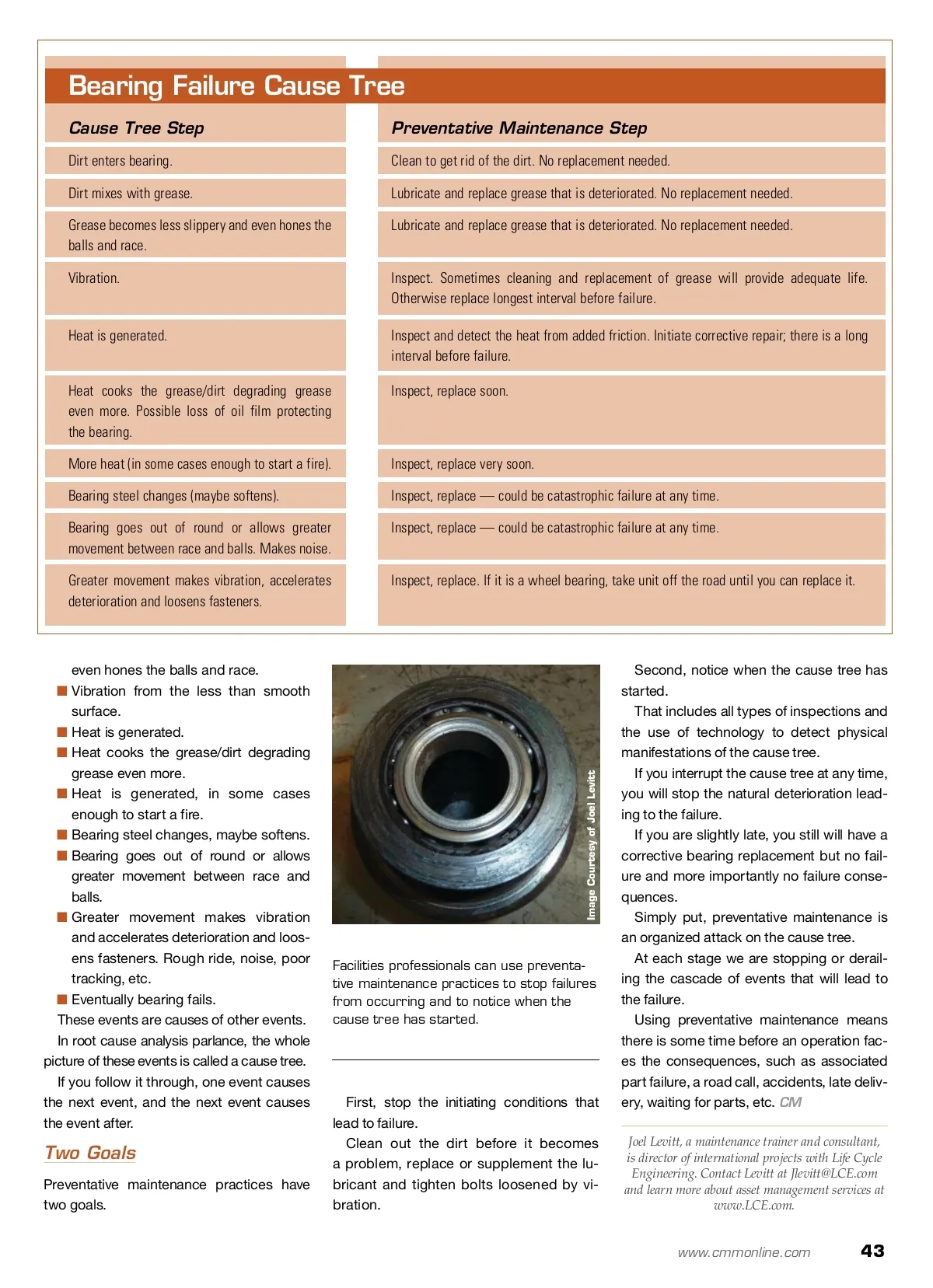
Bearing Failure Cause Tree Cause Tree Step Dirt enters bearing. Dirt mixes with grease. Grease becomes less slippery and even hones the balls and race. Vibration. Preventative Maintenance Step Clean to get rid of the dirt. No replacement needed. Lubricate and replace grease that is deteriorated. No replacement needed. Lubricate and replace grease that is deteriorated. No replacement needed. Inspect. Sometimes cleaning and replacement of grease will provide adequate life. Otherwise replace longest interval before failure. Inspect and detect the heat from added friction. Initiate corrective repair; there is a long interval before failure. Inspect, replace soon. Heat is generated. Heat cooks the grease/dirt degrading grease even more. Possible loss of oil film protecting the bearing. More heat (in some cases enough to start a fire). Bearing steel changes (maybe softens). Bearing goes out of round or allows greater movement between race and balls. Makes noise. Greater movement makes vibration, accelerates deterioration and loosens fasteners. Inspect, replace very soon. Inspect, replace — could be catastrophic failure at any time. Inspect, replace — could be catastrophic failure at any time. Inspect, replace. If it is a wheel bearing, take unit off the road until you can replace it. even hones the balls and race. ■ Vibration from the less than smooth surface. ■ Heat is generated. ■ Heat cooks the grease/dirt degrading grease even more. ■ Heat is generated, in some cases enough to start a fire. ■ Bearing steel changes, maybe softens. ■ Bearing goes out of round or allows greater movement between race and balls. ■ Greater movement makes vibration and accelerates deterioration and loos-ens fasteners. Rough ride, noise, poor tracking, etc. ■ Eventually bearing fails. These events are causes of other events. In root cause analysis parlance, the whole picture of these events is called a cause tree. If you follow it through, one event causes the next event, and the next event causes the event after. Facilities professionals can use preventa-tive maintenance practices to stop failures from occurring and to notice when the cause tree has started. Two Goals Preventative maintenance practices have two goals. First, stop the initiating conditions that lead to failure. Clean out the dirt before it becomes a problem, replace or supplement the lu-bricant and tighten bolts loosened by vi-bration. Second, notice when the cause tree has started. That includes all types of inspections and the use of technology to detect physical manifestations of the cause tree. If you interrupt the cause tree at any time, you will stop the natural deterioration lead-ing to the failure. If you are slightly late, you still will have a corrective bearing replacement but no fail-ure and more importantly no failure conse-quences. Simply put, preventative maintenance is an organized attack on the cause tree. At each stage we are stopping or derail-ing the cascade of events that will lead to the failure. Using preventative maintenance means there is some time before an operation fac-es the consequences, such as associated part failure, a road call, accidents, late deliv-ery, waiting for parts, etc. CM Joel Levitt, a maintenance trainer and consultant, is director of international projects with Life Cycle Engineering. Contact Levitt at [email protected] and learn more about asset management services at www.LCE.com. Image Courtesy of Joel Levitt www.cmmonline.com 43
CMM – Archives February 2014: 43