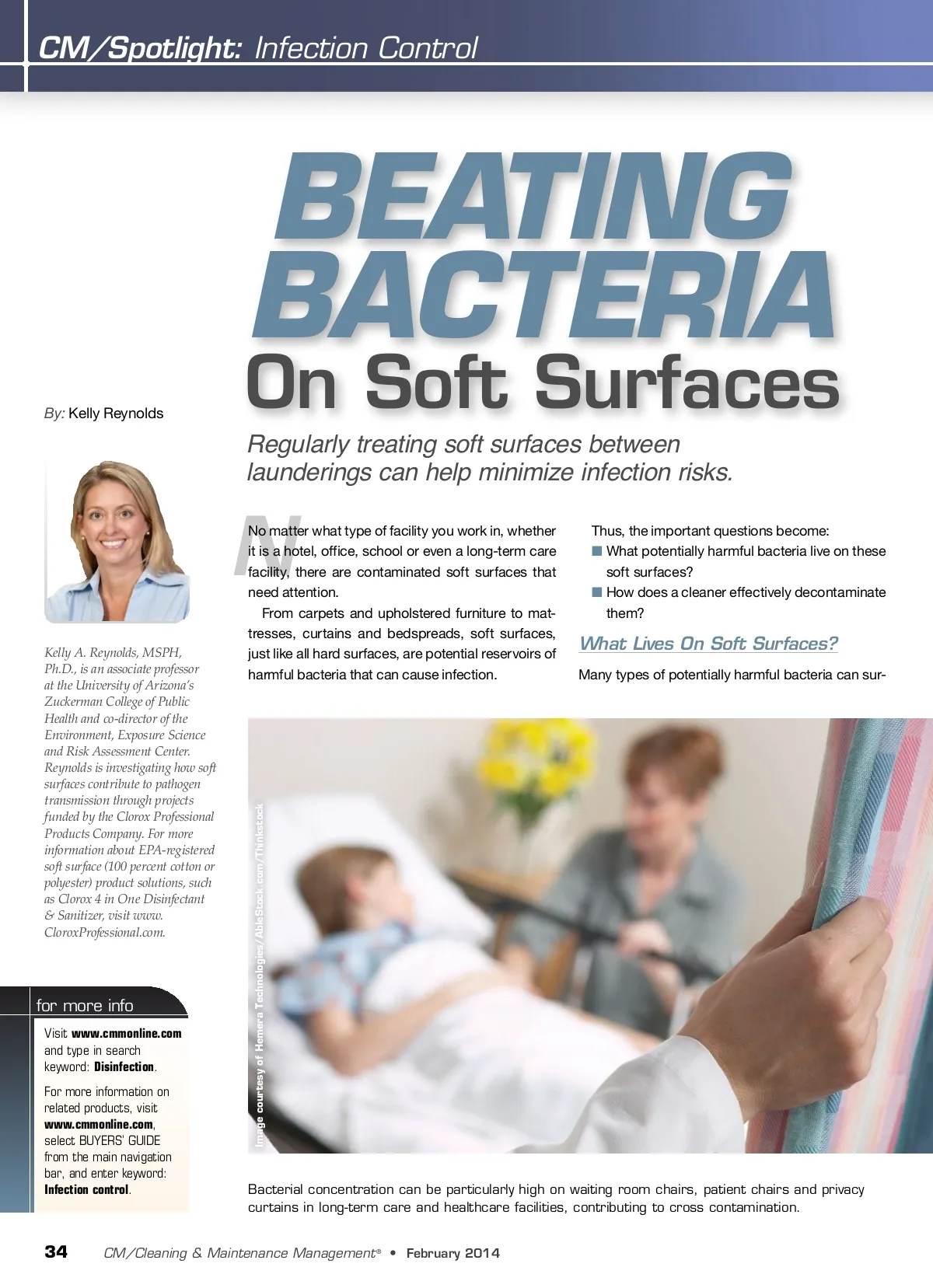
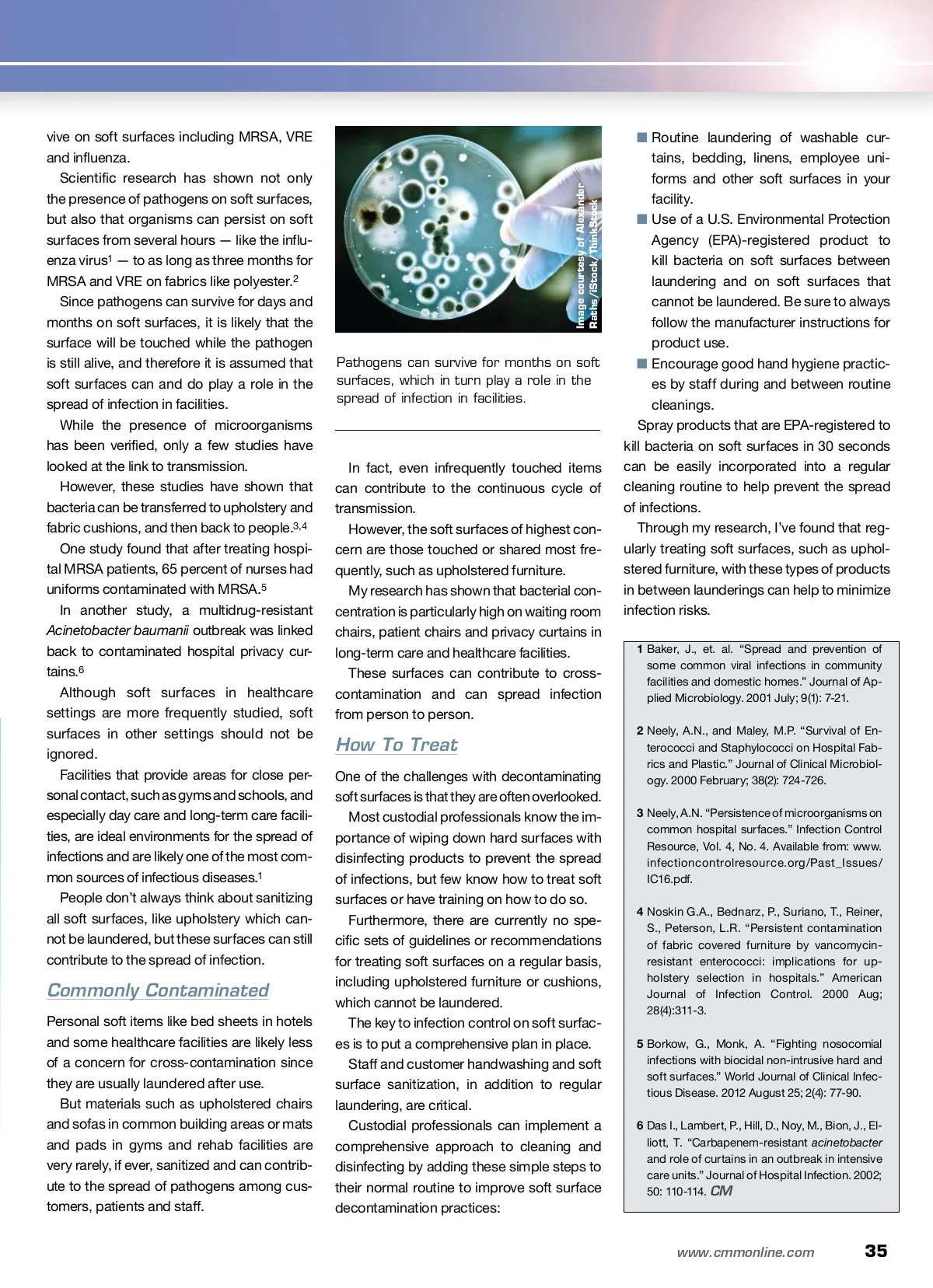
vive on soft surfaces including MRSA, VRE and influenza. Scientific research has shown not only the presence of pathogens on soft surfaces, but also that organisms can persist on soft surfaces from several hours — like the influ-enza virus 1 — to as long as three months for MRSA and VRE on fabrics like polyester. 2 Since pathogens can survive for days and months on soft surfaces, it is likely that the surface will be touched while the pathogen is still alive, and therefore it is assumed that soft surfaces can and do play a role in the spread of infection in facilities. While the presence of microorganisms has been verified, only a few studies have looked at the link to transmission. However, these studies have shown that bacteria can be transferred to upholstery and fabric cushions, and then back to people. 3,4 One study found that after treating hospi-tal MRSA patients, 65 percent of nurses had uniforms contaminated with MRSA. 5 In another study, a multidrug-resistant Acinetobacter baumanii outbreak was linked back to contaminated hospital privacy cur-tains. 6 Although soft surfaces in healthcare settings are more frequently studied, soft surfaces in other settings should not be ignored. Facilities that provide areas for close per-sonal contact, such as gyms and schools, and especially day care and long-term care facili-ties, are ideal environments for the spread of infections and are likely one of the most com-mon sources of infectious diseases. 1 People don’t always think about sanitizing all soft surfaces, like upholstery which can-not be laundered, but these surfaces can still contribute to the spread of infection. Pathogens can survive for months on soft surfaces, which in turn play a role in the spread of infection in facilities. In fact, even infrequently touched items can contribute to the continuous cycle of transmission. However, the soft surfaces of highest con-cern are those touched or shared most fre-quently, such as upholstered furniture. My research has shown that bacterial con-centration is particularly high on waiting room chairs, patient chairs and privacy curtains in long-term care and healthcare facilities. These surfaces can contribute to cross-contamination and can spread infection from person to person. ■ Routine laundering of washable cur-tains, bedding, linens, employee uni-forms and other soft surfaces in your facility. ■ Use of a U.S. Environmental Protection Agency (EPA)-registered product to kill bacteria on soft surfaces between laundering and on soft surfaces that cannot be laundered. Be sure to always follow the manufacturer instructions for product use. ■ Encourage good hand hygiene practic-es by staff during and between routine cleanings. Spray products that are EPA-registered to kill bacteria on soft surfaces in 30 seconds can be easily incorporated into a regular cleaning routine to help prevent the spread of infections. Through my research, I’ve found that reg-ularly treating soft surfaces, such as uphol-stered furniture, with these types of products in between launderings can help to minimize infection risks. 1 Baker, J., et. al. “Spread and prevention of some common viral infections in community facilities and domestic homes.” Journal of Ap-plied Microbiology. 2001 July; 9(1): 7-21. 2 Neely, A.N., and Maley, M.P. “Survival of En-terococci and Staphylococci on Hospital Fab-rics and Plastic.” Journal of Clinical Microbiol-ogy. 2000 February; 38(2): 724-726. 3 Neely, A.N. “Persistence of microorganisms on common hospital surfaces.” Infection Control Resource, Vol. 4, No. 4. Available from: www. infectioncontrolresource.org/Past_Issues/ IC16.pdf. 4 Noskin G.A., Bednarz, P., Suriano, T., Reiner, S., Peterson, L.R. “Persistent contamination of fabric covered furniture by vancomycin-resistant enterococci: implications for up-holstery selection in hospitals.” American Journal of Infection Control. 2000 Aug; 28(4):311-3. 5 Borkow, G., Monk, A. “Fighting nosocomial infections with biocidal non-intrusive hard and soft surfaces.” World Journal of Clinical Infec-tious Disease. 2012 August 25; 2(4): 77-90. 6 Das I., Lambert, P., Hill, D., Noy, M., Bion, J., El-liott, T. “Carbapenem-resistant acinetobacter and role of curtains in an outbreak in intensive care units.” Journal of Hospital Infection. 2002; 50: 110-114. CM How To Treat One of the challenges with decontaminating soft surfaces is that they are often overlooked. Most custodial professionals know the im-portance of wiping down hard surfaces with disinfecting products to prevent the spread of infections, but few know how to treat soft surfaces or have training on how to do so. Furthermore, there are currently no spe-cific sets of guidelines or recommendations for treating soft surfaces on a regular basis, including upholstered furniture or cushions, which cannot be laundered. The key to infection control on soft surfac-es is to put a comprehensive plan in place. Staff and customer handwashing and soft surface sanitization, in addition to regular laundering, are critical. Custodial professionals can implement a comprehensive approach to cleaning and disinfecting by adding these simple steps to their normal routine to improve soft surface decontamination practices: Commonly Contaminated Personal soft items like bed sheets in hotels and some healthcare facilities are likely less of a concern for cross-contamination since they are usually laundered after use. But materials such as upholstered chairs and sofas in common building areas or mats and pads in gyms and rehab facilities are very rarely, if ever, sanitized and can contrib-ute to the spread of pathogens among cus-tomers, patients and staff. Image courtesy of Alexander Raths/iStock/ThinkStock www.cmmonline.com 35
CMM – Archives February 2014: 35