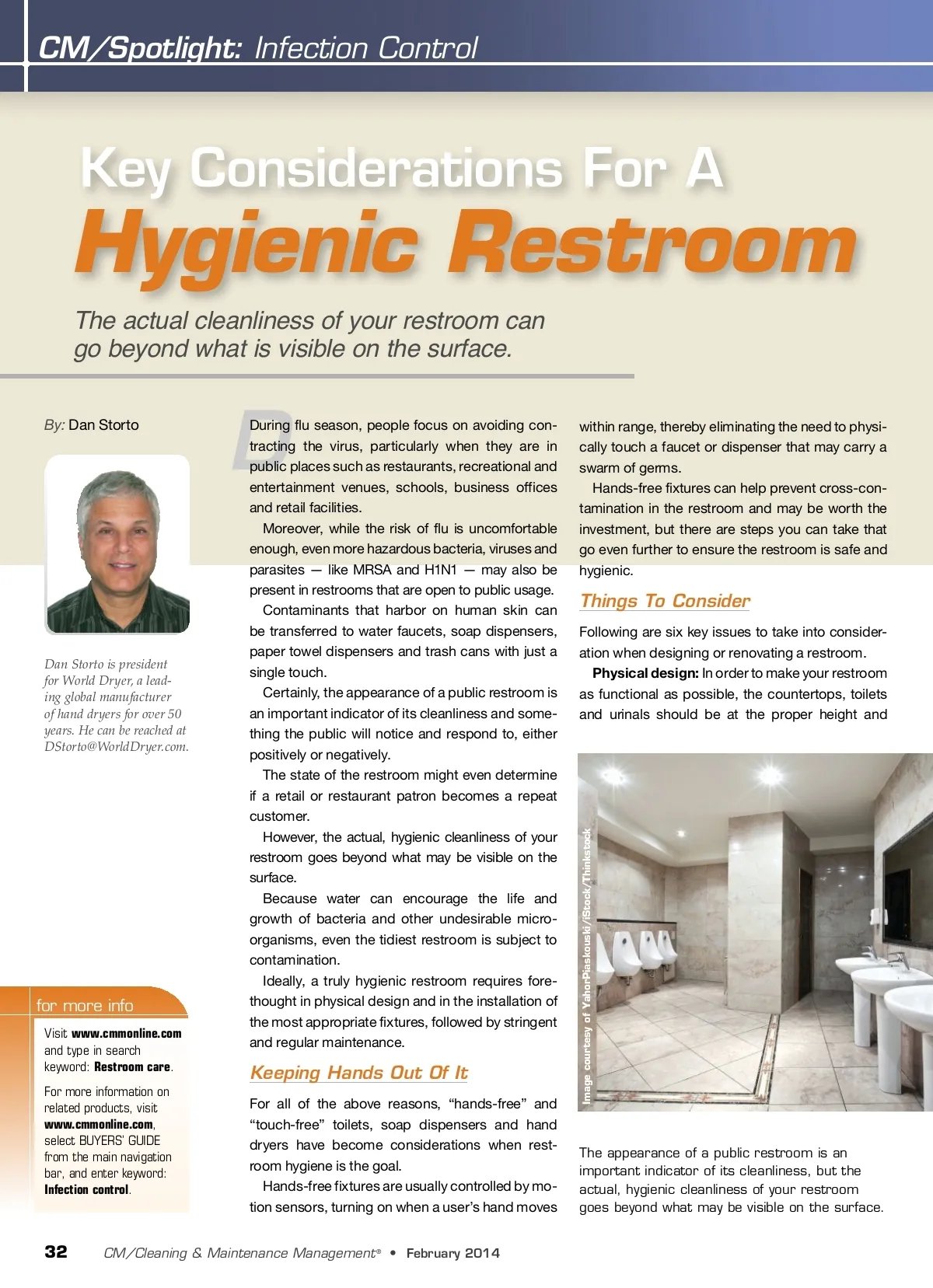
CM/Spotlight: Infection Control Key Considerations For A Hygienic Restroom The actual cleanliness of your restroom can go beyond what is visible on the surface. By: Dan Storto D Dan Storto is president for World Dryer, a lead-ing global manufacturer of hand dryers for over 50 years. He can be reached at [email protected]. for more info Visit www.cmmonline.com and type in search keyword: Restroom care . For more information on related products, visit www.cmmonline.com , select BUYERS’ GUIDE from the main navigation bar, and enter keyword: Infection control . Keeping Hands Out Of It For all of the above reasons, “hands-free” and “touch-free” toilets, soap dispensers and hand dryers have become considerations when rest-room hygiene is the goal. Hands-free fixtures are usually controlled by mo-tion sensors, turning on when a user’s hand moves The appearance of a public restroom is an important indicator of its cleanliness, but the actual, hygienic cleanliness of your restroom goes beyond what may be visible on the surface. 32 CM/Cleaning & Maintenance Management ® • February 2014 Image courtesy of YahorPiaskouski/iStock/Thinkstock During flu season, people focus on avoiding con-tracting the virus, particularly when they are in public places such as restaurants, recreational and entertainment venues, schools, business offices and retail facilities. Moreover, while the risk of flu is uncomfortable enough, even more hazardous bacteria, viruses and parasites — like MRSA and H1N1 — may also be present in restrooms that are open to public usage. Contaminants that harbor on human skin can be transferred to water faucets, soap dispensers, paper towel dispensers and trash cans with just a single touch. Certainly, the appearance of a public restroom is an important indicator of its cleanliness and some-thing the public will notice and respond to, either positively or negatively. The state of the restroom might even determine if a retail or restaurant patron becomes a repeat customer. However, the actual, hygienic cleanliness of your restroom goes beyond what may be visible on the surface. Because water can encourage the life and growth of bacteria and other undesirable micro-organisms, even the tidiest restroom is subject to contamination. Ideally, a truly hygienic restroom requires fore-thought in physical design and in the installation of the most appropriate fixtures, followed by stringent and regular maintenance. within range, thereby eliminating the need to physi-cally touch a faucet or dispenser that may carry a swarm of germs. Hands-free fixtures can help prevent cross-con-tamination in the restroom and may be worth the investment, but there are steps you can take that go even further to ensure the restroom is safe and hygienic. Things To Consider Following are six key issues to take into consider-ation when designing or renovating a restroom. Physical design: In order to make your restroom as functional as possible, the countertops, toilets and urinals should be at the proper height and
CMM – Archives February 2014: 32