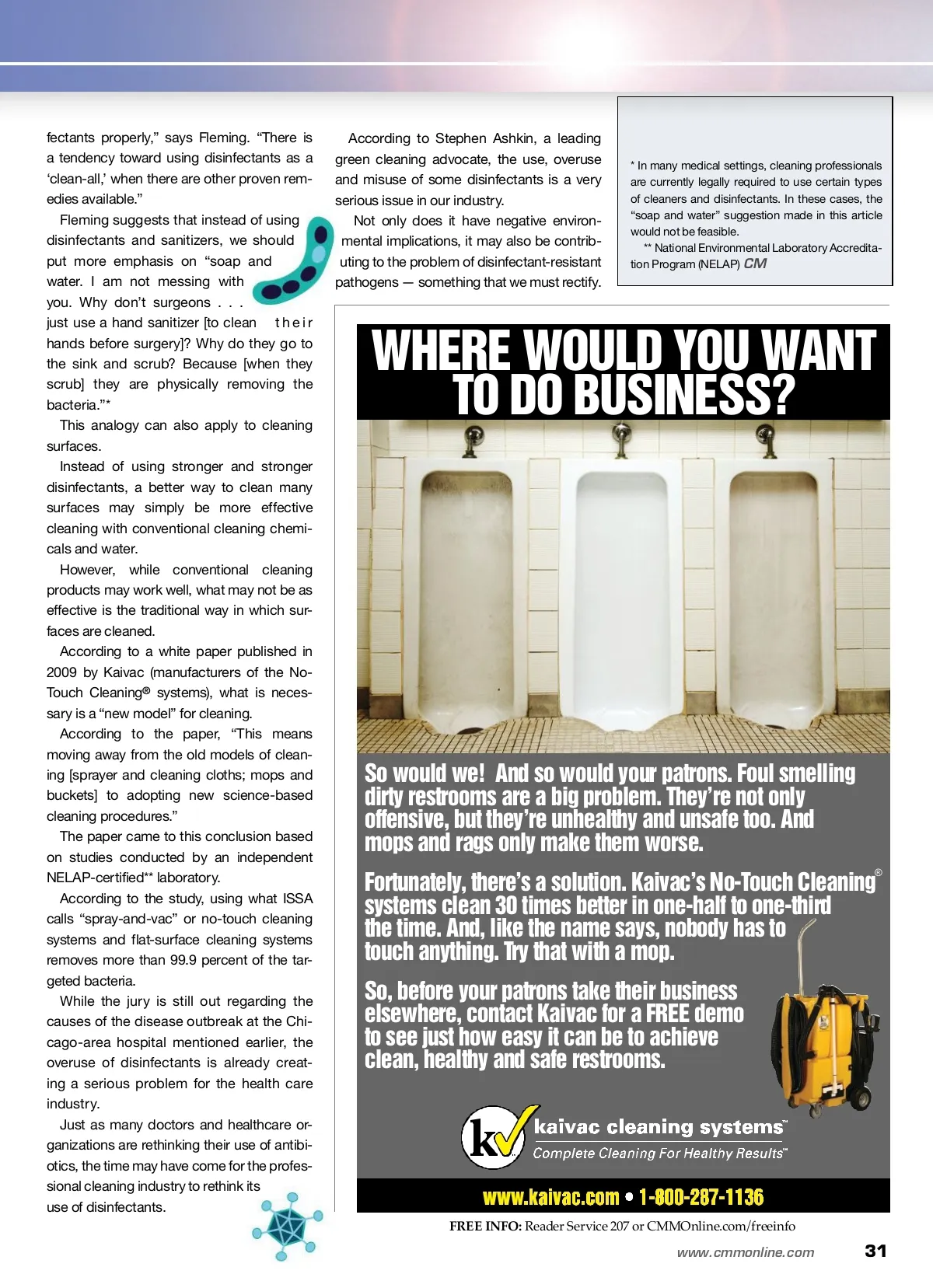
fectants properly,” says Fleming. “There is a tendency toward using disinfectants as a ‘clean-all,’ when there are other proven rem-edies available.” Fleming suggests that instead of using disinfectants and sanitizers, we should put more emphasis on “soap and water. I am not messing with you. Why don’t surgeons . . . just use a hand sanitizer [to clean t h e i r hands before surgery]? Why do they go to the sink and scrub? Because [when they scrub] they are physically removing the bacteria.”* This analogy can also apply to cleaning surfaces. Instead of using stronger and stronger disinfectants, a better way to clean many surfaces may simply be more effective cleaning with conventional cleaning chemi-cals and water. However, while conventional cleaning products may work well, what may not be as effective is the traditional way in which sur-faces are cleaned. According to a white paper published in 2009 by Kaivac (manufacturers of the No-Touch Cleaning ® systems), what is neces-sary is a “new model” for cleaning. According to the paper, “This means moving away from the old models of clean-ing [sprayer and cleaning cloths; mops and buckets] to adopting new science-based cleaning procedures.” The paper came to this conclusion based on studies conducted by an independent NELAP-certified** laboratory. According to the study, using what ISSA calls “spray-and-vac” or no-touch cleaning systems and flat-surface cleaning systems removes more than 99.9 percent of the tar-geted bacteria. While the jury is still out regarding the causes of the disease outbreak at the Chi-cago-area hospital mentioned earlier, the overuse of disinfectants is already creat-ing a serious problem for the health care industry. Just as many doctors and healthcare or-ganizations are rethinking their use of antibi-otics, the time may have come for the profes-sional cleaning industry to rethink its use of disinfectants. According to Stephen Ashkin, a leading green cleaning advocate, the use, overuse and misuse of some disinfectants is a very serious issue in our industry. Not only does it have negative environ-mental implications, it may also be contrib-uting to the problem of disinfectant-resistant pathogens — something that we must rectify. * In many medical settings, cleaning professionals are currently legally required to use certain types of cleaners and disinfectants. In these cases, the “soap and water” suggestion made in this article would not be feasible. ** National Environmental Laboratory Accredita-tion Program (NELAP) CM WHERE WOULD YOU WANT TO DO BUSINESS? So would we! And so would your patrons. Foul smelling dirty restrooms are a big problem. They’re not only offensive, but they’re unhealthy and unsafe too. And mops and rags only make them worse. Fortunately, there’s a solution. Kaivac’s No-Touch Cleaning systems clean 30 times better in one-half to one-third the time. And, like the name says, nobody has to touch anything. Try that with a mop. So, before your patrons take their business elsewhere, contact Kaivac for a FREE demo to see just how easy it can be to achieve clean, healthy and safe restrooms. ® FREE INFO: Reader Service 207 or CMMOnline.com/freeinfo www.cmmonline.com 31
CMM – Archives February 2014: 31