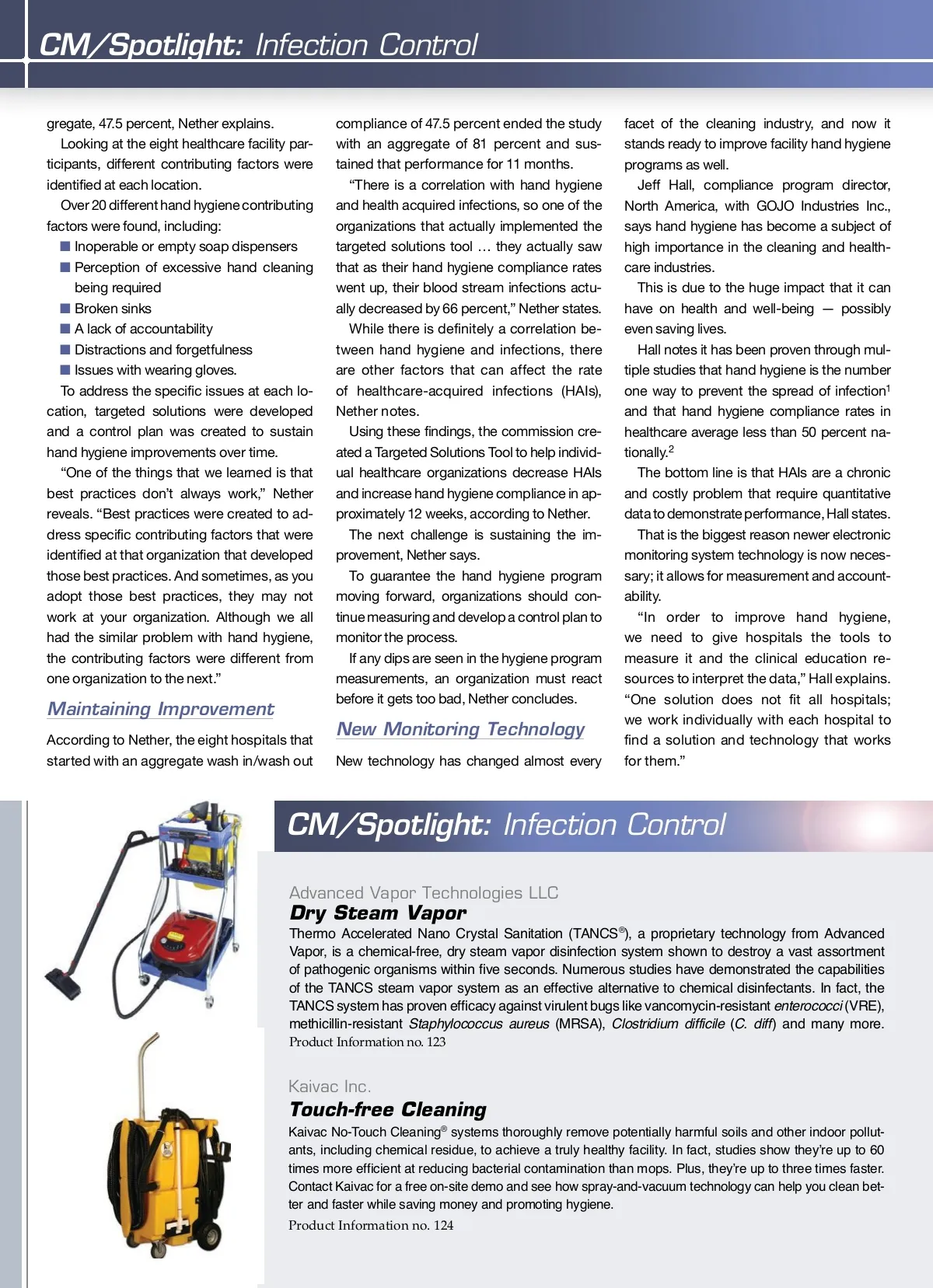
CM/Spotlight: Infection Control gregate, 47.5 percent, Nether explains. Looking at the eight healthcare facility par-ticipants, different contributing factors were identified at each location. Over 20 different hand hygiene contributing factors were found, including: ■ Inoperable or empty soap dispensers ■ Perception of excessive hand cleaning being required ■ Broken sinks ■ A lack of accountability ■ Distractions and forgetfulness ■ Issues with wearing gloves. To address the specific issues at each lo-cation, targeted solutions were developed and a control plan was created to sustain hand hygiene improvements over time. “One of the things that we learned is that best practices don’t always work,” Nether reveals. “Best practices were created to ad-dress specific contributing factors that were identified at that organization that developed those best practices. And sometimes, as you adopt those best practices, they may not work at your organization. Although we all had the similar problem with hand hygiene, the contributing factors were different from one organization to the next.” compliance of 47.5 percent ended the study with an aggregate of 81 percent and sus-tained that performance for 11 months. “There is a correlation with hand hygiene and health acquired infections, so one of the organizations that actually implemented the targeted solutions tool … they actually saw that as their hand hygiene compliance rates went up, their blood stream infections actu-ally decreased by 66 percent,” Nether states. While there is definitely a correlation be-tween hand hygiene and infections, there are other factors that can affect the rate of healthcare-acquired infections (HAIs), Nether notes. Using these findings, the commission cre-ated a Targeted Solutions Tool to help individ-ual healthcare organizations decrease HAIs and increase hand hygiene compliance in ap-proximately 12 weeks, according to Nether. The next challenge is sustaining the im-provement, Nether says. To guarantee the hand hygiene program moving forward, organizations should con-tinue measuring and develop a control plan to monitor the process. If any dips are seen in the hygiene program measurements, an organization must react before it gets too bad, Nether concludes. facet of the cleaning industry, and now it stands ready to improve facility hand hygiene programs as well. Jeff Hall, compliance program director, North America, with GOJO Industries Inc., says hand hygiene has become a subject of high importance in the cleaning and health-care industries. This is due to the huge impact that it can have on health and well-being — possibly even saving lives. Hall notes it has been proven through mul-tiple studies that hand hygiene is the number one way to prevent the spread of infection 1 and that hand hygiene compliance rates in healthcare average less than 50 percent na-tionally. 2 The bottom line is that HAIs are a chronic and costly problem that require quantitative data to demonstrate performance, Hall states. That is the biggest reason newer electronic monitoring system technology is now neces-sary; it allows for measurement and account-ability. “In order to improve hand hygiene, we need to give hospitals the tools to measure it and the clinical education re-sources to interpret the data,” Hall explains. “One solution does not fit all hospitals; we work individually with each hospital to find a solution and technology that works for them.” Maintaining Improvement According to Nether, the eight hospitals that started with an aggregate wash in/wash out New Monitoring Technology New technology has changed almost every CM/Spotlight: Infection Control Advanced Vapor Technologies LLC Dry Steam Vapor Thermo Accelerated Nano Crystal Sanitation (TANCS ® ), a proprietary technology from Advanced Vapor, is a chemical-free, dry steam vapor disinfection system shown to destroy a vast assortment of pathogenic organisms within five seconds. Numerous studies have demonstrated the capabilities of the TANCS steam vapor system as an effective alternative to chemical disinfectants. In fact, the TANCS system has proven efficacy against virulent bugs like vancomycin-resistant enterococci (VRE), methicillin-resistant Staphylococcus aureus (MRSA), Clostridium difficile ( C. diff ) and many more. Product Information no. 123 Kaivac Inc. Touch-free Cleaning Kaivac No-Touch Cleaning ® systems thoroughly remove potentially harmful soils and other indoor pollut-ants, including chemical residue, to achieve a truly healthy facility. In fact, studies show they’re up to 60 times more efficient at reducing bacterial contamination than mops. Plus, they’re up to three times faster. Contact Kaivac for a free on-site demo and see how spray-and-vacuum technology can help you clean bet-ter and faster while saving money and promoting hygiene. Product Information no. 124
CMM – Archives February 2014: 22