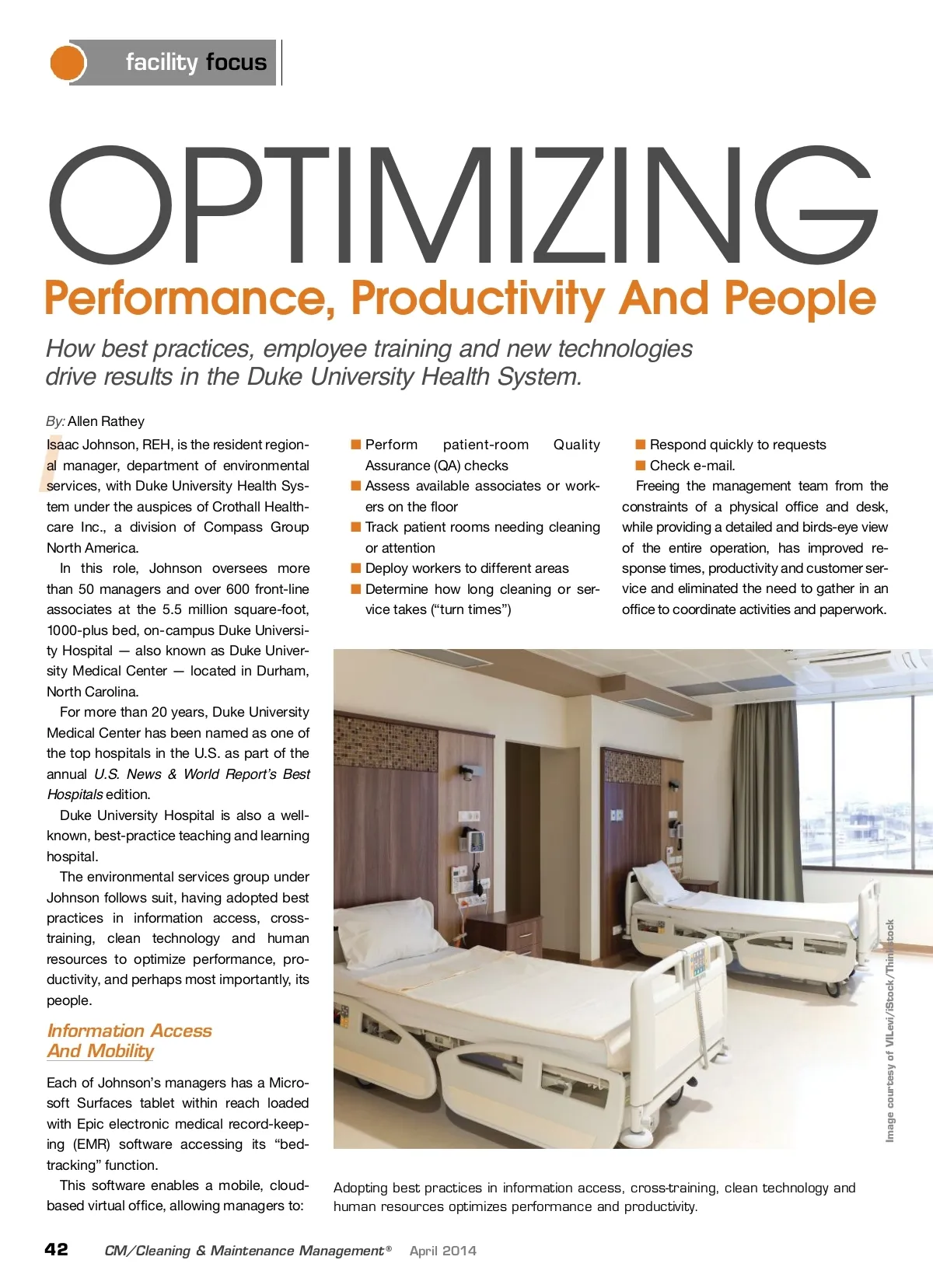
“It’s green, since all of our forms are on the system,” Johnson notes. “It is also web-based, so I can be at home, for example, and see we have 45 ‘unclean beds’ and 32 people available to clean them.” Electronic, precise and in-depth recordkeeping also enables benchmarking with like facilities within the Crothall system of 1,200 healthcare clients across 38 states. Importantly, all calendars, work and training schedules are in the mobile system. phasis on customer choice and service that helps sustain high HCAHPS (Hospital Consumer Assessment of Healthcare Providers and Systems) scores. Human Resources — The Worker As Customer Johnson adds: “Our culture is simple: As a management team, we ensure that our number one customer is our associate — the person that works for us — and in turn our associate makes patients and guests their number one priority, and we provide them whatever they need to help make their customer happy, healthy and protected. When we get complaints, we first seek out our associate and work with them to help their customers.” “We have Crothall ‘patient experience managers’ and visit 95 per-cent of patients every day to see how things are going, interact and handle special needs or requests. We often ask patients what they want or prefer for cleaning and disinfection, and work with Infection Prevention (IP) to ensure requested approaches work. We empha-size customer choice, and it’s reflected in our HCAHPS scores.” CM Allen Rathey wrote this article on special assignment for IEHA’s Media As-sistance Program (MAP). Rathey is president of InstructionLink/JanTrain Inc. of Boise, Idaho. He also serves as president of the Housekeeping Channel (HC), the Healthy House Institute (HHI) and the Healthy Facilities Institute (HFI). Rathey promotes healthy indoor environments, and writes and speaks on healthy cleaning and facility topics. Learn more about REH, Duke and Crothall Healthcare at www.CMMOnline.com/Optimize-Performance. Performance Through Cross-training Training plays a major role in logistics and productivity. Cross-training team leaders to handle whatever tasks come along is important. This training enables rapid response time without calling in a “special-project” person or postponing jobs until staff resources are available to handle jobs like biohazardous waste manage-ment or floorcare, for example. “If a floor needs stripping and recoating, instead of calling in an off-site person who knows how to do it, or postponing until we can assign the right personnel, on-site cross-trained team lead-ers can handle most jobs immediately,” Johnson says. “Our team leaders receive intensive training until they become proficient and skilled in a range of specialties.” During a 16-week pilot, one team leader received concentrated training for the entire week: Monday through Thursday, learning one new discipline each morning and another discipline during the last half of the day, followed by deep review and skills testing. Every six months, cross-trained team members receive re-freshers to stay proficient, also practicing new skillsets as needed in day-to-day operations. “[Both Duke and Crothall] have a very close relationship with the union and view associates as our common customer. Cross-training provides more value to the customer, so they can in turn provide more value to their customer — patients,” Johnson ex-plains. Productivity Through UV Disinfection This enlightened management focus also means providing envi-ronmental services associates with the best technology. Trending now is the testing of remotely controlled UVC technol-ogy as part of a U.S. Centers for Disease Control and Preven-tion (CDC) study of UVC units enabling disinfection of discharge rooms without staff intervention or chemical disinfectants. Associates are also supplied with color-coded microfiber mops and cloths, and Johnson is trialing new products such as dis-posable microfiber wipes to enable faster response and hygienic outcomes without the need for laundering cloths. “They are durable and effective, and each wipe can clean an entire room before disposal, so disposable microfiber can reduce laundering, cloth wear and tear, and downtime,” Johnson states. Integrating disposable microfiber wipes with conventional cloths may permit associates to offer patients the option, or choice, in room-cleaning techniques as part of a service “menu.” This is in keeping with Duke University Medical Center’s em-FREE INFO: Reader Service 211 or CMMOnline.com/freeinfo www.CMMOnline.com 43
CMM – Archives April 2014: 43