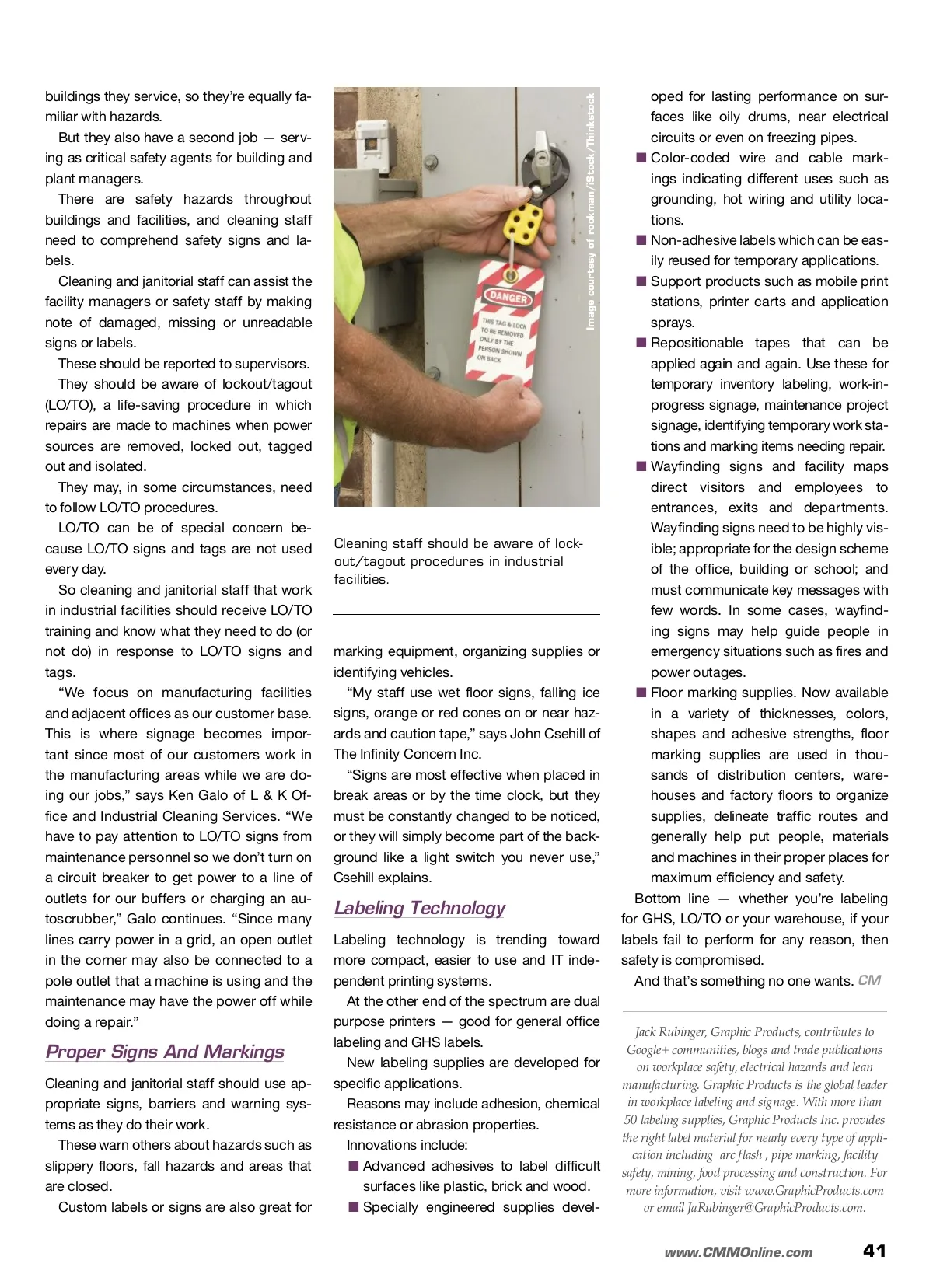
buildings they service, so they’re equally fa-miliar with hazards. But they also have a second job — serv-ing as critical safety agents for building and plant managers. There are safety hazards throughout buildings and facilities, and cleaning staff need to comprehend safety signs and la-bels. Cleaning and janitorial staff can assist the facility managers or safety staff by making note of damaged, missing or unreadable signs or labels. These should be reported to supervisors. They should be aware of lockout/tagout (LO/TO), a life-saving procedure in which repairs are made to machines when power sources are removed, locked out, tagged out and isolated. They may, in some circumstances, need to follow LO/TO procedures. LO/TO can be of special concern be-cause LO/TO signs and tags are not used every day. So cleaning and janitorial staff that work in industrial facilities should receive LO/TO training and know what they need to do (or not do) in response to LO/TO signs and tags. “We focus on manufacturing facilities and adjacent offices as our customer base. This is where signage becomes impor-tant since most of our customers work in the manufacturing areas while we are do-ing our jobs,” says Ken Galo of L & K Of-fice and Industrial Cleaning Services. “We have to pay attention to LO/TO signs from maintenance personnel so we don’t turn on a circuit breaker to get power to a line of outlets for our buffers or charging an au-toscrubber,” Galo continues. “Since many lines carry power in a grid, an open outlet in the corner may also be connected to a pole outlet that a machine is using and the maintenance may have the power off while doing a repair.” Cleaning staff should be aware of lock-out/tagout procedures in industrial facilities. marking equipment, organizing supplies or identifying vehicles. “My staff use wet floor signs, falling ice signs, orange or red cones on or near haz-ards and caution tape,” says John Csehill of The Infinity Concern Inc. “Signs are most effective when placed in break areas or by the time clock, but they must be constantly changed to be noticed, or they will simply become part of the back-ground like a light switch you never use,” Csehill explains. Labeling Technology Labeling technology is trending toward more compact, easier to use and IT inde-pendent printing systems. At the other end of the spectrum are dual purpose printers — good for general office labeling and GHS labels. New labeling supplies are developed for specific applications. Reasons may include adhesion, chemical resistance or abrasion properties. Innovations include: ■ Advanced adhesives to label difficult surfaces like plastic, brick and wood. ■ Specially engineered supplies devel-oped for lasting performance on sur-faces like oily drums, near electrical circuits or even on freezing pipes. ■ Color-coded wire and cable mark-ings indicating different uses such as grounding, hot wiring and utility loca-tions. ■ Non-adhesive labels which can be eas-ily reused for temporary applications. ■ Support products such as mobile print stations, printer carts and application sprays. ■ Repositionable tapes that can be applied again and again. Use these for temporary inventory labeling, work-in-progress signage, maintenance project signage, identifying temporary work sta-tions and marking items needing repair. ■ Wayfinding signs and facility maps direct visitors and employees to entrances, exits and departments. Wayfinding signs need to be highly vis-ible; appropriate for the design scheme of the office, building or school; and must communicate key messages with few words. In some cases, wayfind-ing signs may help guide people in emergency situations such as fires and power outages. ■ Floor marking supplies. Now available in a variety of thicknesses, colors, shapes and adhesive strengths, floor marking supplies are used in thou-sands of distribution centers, ware-houses and factory floors to organize supplies, delineate traffic routes and generally help put people, materials and machines in their proper places for maximum efficiency and safety. Bottom line — whether you’re labeling for GHS, LO/TO or your warehouse, if your labels fail to perform for any reason, then safety is compromised. And that’s something no one wants. CM Image courtesy of rookman/iStock/Thinkstock Proper Signs And Markings Cleaning and janitorial staff should use ap-propriate signs, barriers and warning sys-tems as they do their work. These warn others about hazards such as slippery floors, fall hazards and areas that are closed. Custom labels or signs are also great for Jack Rubinger, Graphic Products, contributes to Google+ communities, blogs and trade publications on workplace safety, electrical hazards and lean manufacturing. Graphic Products is the global leader in workplace labeling and signage. With more than 50 labeling supplies, Graphic Products Inc. provides the right label material for nearly every type of appli-cation including arc flash , pipe marking, facility safety, mining, food processing and construction. For more information, visit www.GraphicProducts.com or email [email protected]. www.CMMOnline.com 41
CMM – Archives April 2014: 41