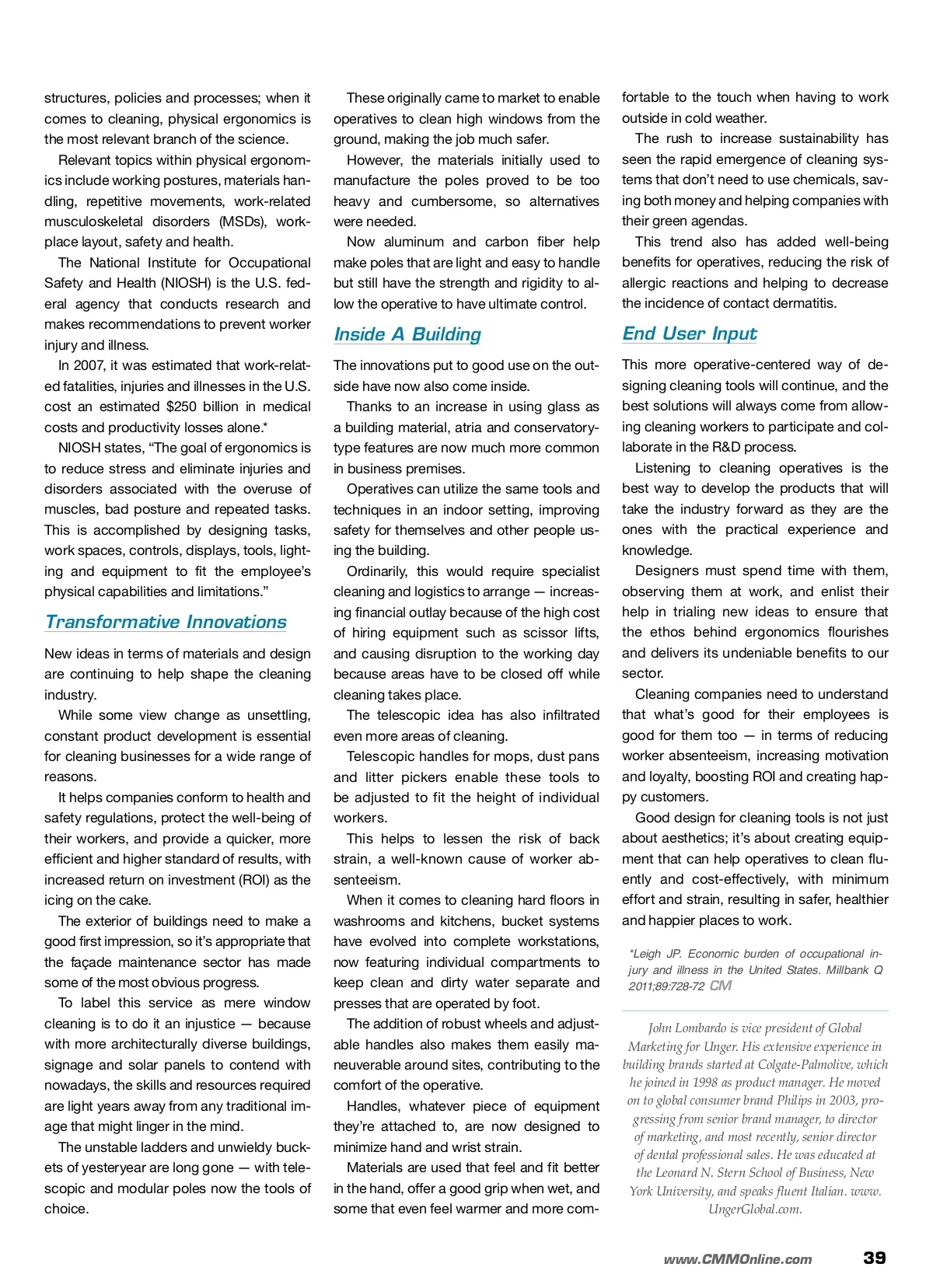
contractor success Raise A Toast To Celebrating the development of cleaning tools that help boost staff health. By: John Lombardo Worker Safety We all have certain products that just “fit right.” Whether it’s a certain type of chair that gives you the support and comfort you need, or a cellphone that fits into the palm of your hand, with a screen layout that helps you text single-handed — items that feel “made to measure” are always going to be market leaders. It’s the same when it comes to cleaning tools and equipment. The best products not only achieve the hygienic results required, they also make the job easier and more cost-effective for operatives and employers, so constant de-velopment in terms of design and technol-ogy is paramount. And that’s where the science bit comes in. W Explaining Ergonomics The International Ergonomics Association (IEA) defines ergonomics — or human fac-tors — as: “the scientific discipline con-cerned with the understanding of the inter-actions among humans and other elements of a system, and the profession that applies theoretical principles, data and methods to design in order to optimize human well-be-ing and overall system performance.” Ergonomists have differing areas of spe-cialization and often work in specific eco-nomic, service or business sectors. While cognitive ergonomics is concerned with mental processes such as perception, memory and motor responses; and orga-nizational ergonomics looks to optimize New ideas in terms of materials and design are continuing to help shape the cleaning industry. While some view change as unset-tling, constant product development is essential for cleaning businesses for many reasons. 38 CM/Cleaning & Maintenance Management ® April 2014 Images courtesy of Sam Robinson/Digital Vision/Thinkstock
CMM – Archives April 2014: 38