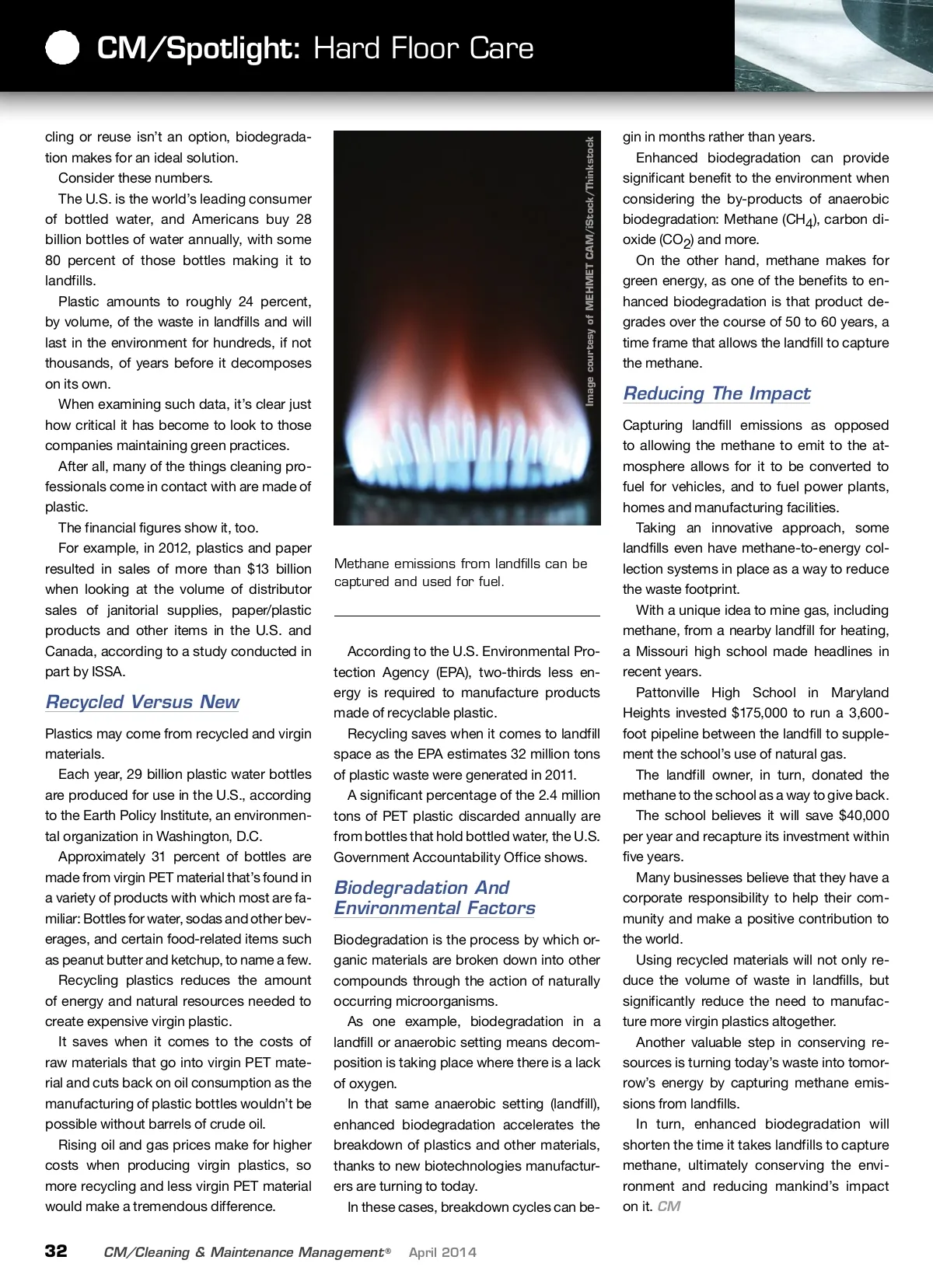
CM/Spotlight: Hard Floor Care cling or reuse isn’t an option, biodegrada-tion makes for an ideal solution. Consider these numbers. The U.S. is the world’s leading consumer of bottled water, and Americans buy 28 billion bottles of water annually, with some 80 percent of those bottles making it to landfills. Plastic amounts to roughly 24 percent, by volume, of the waste in landfills and will last in the environment for hundreds, if not thousands, of years before it decomposes on its own. When examining such data, it’s clear just how critical it has become to look to those companies maintaining green practices. After all, many of the things cleaning pro-fessionals come in contact with are made of plastic. The financial figures show it, too. For example, in 2012, plastics and paper resulted in sales of more than $13 billion when looking at the volume of distributor sales of janitorial supplies, paper/plastic products and other items in the U.S. and Canada, according to a study conducted in part by ISSA. Image courtesy of MEHMET CAM/iStock/Thinkstock gin in months rather than years. Enhanced biodegradation can provide significant benefit to the environment when considering the by-products of anaerobic biodegradation: Methane (CH4), carbon di-oxide (CO2) and more. On the other hand, methane makes for green energy, as one of the benefits to en-hanced biodegradation is that product de-grades over the course of 50 to 60 years, a time frame that allows the landfill to capture the methane. Reducing The Impact Capturing landfill emissions as opposed to allowing the methane to emit to the at-mosphere allows for it to be converted to fuel for vehicles, and to fuel power plants, homes and manufacturing facilities. Taking an innovative approach, some landfills even have methane-to-energy col-lection systems in place as a way to reduce the waste footprint. With a unique idea to mine gas, including methane, from a nearby landfill for heating, a Missouri high school made headlines in recent years. Pattonville High School in Maryland Heights invested $175,000 to run a 3,600-foot pipeline between the landfill to supple-ment the school’s use of natural gas. The landfill owner, in turn, donated the methane to the school as a way to give back. The school believes it will save $40,000 per year and recapture its investment within five years. Many businesses believe that they have a corporate responsibility to help their com-munity and make a positive contribution to the world. Using recycled materials will not only re-duce the volume of waste in landfills, but significantly reduce the need to manufac-ture more virgin plastics altogether. Another valuable step in conserving re-sources is turning today’s waste into tomor-row’s energy by capturing methane emis-sions from landfills. In turn, enhanced biodegradation will shorten the time it takes landfills to capture methane, ultimately conserving the envi-ronment and reducing mankind’s impact on it. CM Methane emissions from landfills can be captured and used for fuel. Recycled Versus New Plastics may come from recycled and virgin materials. Each year, 29 billion plastic water bottles are produced for use in the U.S., according to the Earth Policy Institute, an environmen-tal organization in Washington, D.C. Approximately 31 percent of bottles are made from virgin PET material that’s found in a variety of products with which most are fa-miliar: Bottles for water, sodas and other bev-erages, and certain food-related items such as peanut butter and ketchup, to name a few. Recycling plastics reduces the amount of energy and natural resources needed to create expensive virgin plastic. It saves when it comes to the costs of raw materials that go into virgin PET mate-rial and cuts back on oil consumption as the manufacturing of plastic bottles wouldn’t be possible without barrels of crude oil. Rising oil and gas prices make for higher costs when producing virgin plastics, so more recycling and less virgin PET material would make a tremendous difference. According to the U.S. Environmental Pro-tection Agency (EPA), two-thirds less en-ergy is required to manufacture products made of recyclable plastic. Recycling saves when it comes to landfill space as the EPA estimates 32 million tons of plastic waste were generated in 2011. A significant percentage of the 2.4 million tons of PET plastic discarded annually are from bottles that hold bottled water, the U.S. Government Accountability Office shows. Biodegradation And Environmental Factors Biodegradation is the process by which or-ganic materials are broken down into other compounds through the action of naturally occurring microorganisms. As one example, biodegradation in a landfill or anaerobic setting means decom-position is taking place where there is a lack of oxygen. In that same anaerobic setting (landfill), enhanced biodegradation accelerates the breakdown of plastics and other materials, thanks to new biotechnologies manufactur-ers are turning to today. In these cases, breakdown cycles can be-April 2014 32 CM/Cleaning & Maintenance Management ®
CMM – Archives April 2014: 32