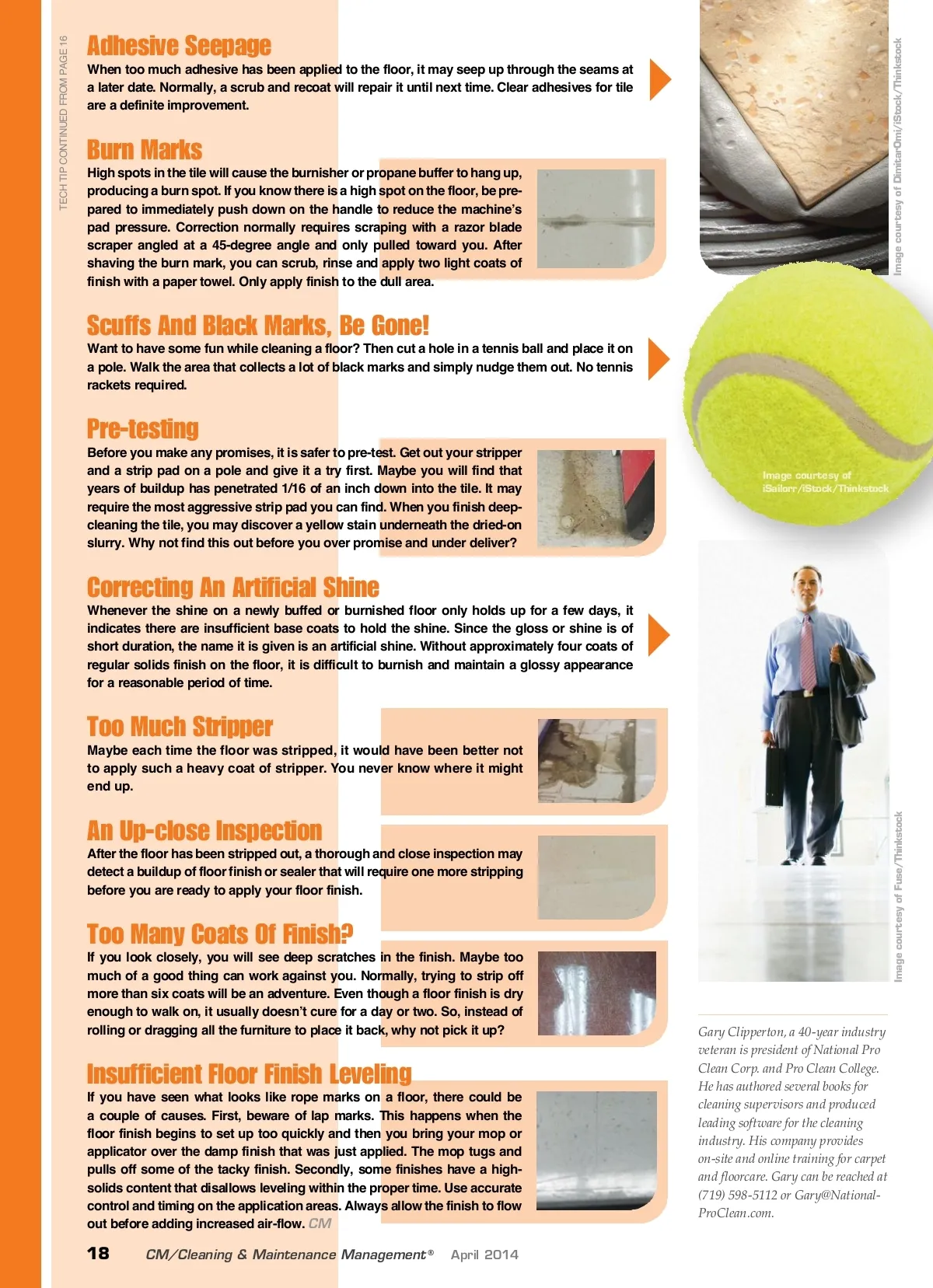
TECH TIP CONTINUED FROM PAGE 16 When too much adhesive has been applied to the floor, it may seep up through the seams at a later date. Normally, a scrub and recoat will repair it until next time. Clear adhesives for tile are a definite improvement. Burn Marks High spots in the tile will cause the burnisher or propane buffer to hang up, producing a burn spot. If you know there is a high spot on the floor, be pre-pared to immediately push down on the handle to reduce the machine’s pad pressure. Correction normally requires scraping with a razor blade scraper angled at a 45-degree angle and only pulled toward you. After shaving the burn mark, you can scrub, rinse and apply two light coats of finish with a paper towel. Only apply finish to the dull area. Scuffs And Black Marks, Be Gone! Want to have some fun while cleaning a floor? Then cut a hole in a tennis ball and place it on a pole. Walk the area that collects a lot of black marks and simply nudge them out. No tennis rackets required. Pre-testing Before you make any promises, it is safer to pre-test. Get out your stripper and a strip pad on a pole and give it a try first. Maybe you will find that years of buildup has penetrated 1/16 of an inch down into the tile. It may require the most aggressive strip pad you can find. When you finish deep-cleaning the tile, you may discover a yellow stain underneath the dried-on slurry. Why not find this out before you over promise and under deliver? Image courtesy of iSailorr/iStock/Thinkstock Correcting An Artificial Shine Whenever the shine on a newly buffed or burnished floor only holds up for a few days, it indicates there are insufficient base coats to hold the shine. Since the gloss or shine is of short duration, the name it is given is an artificial shine. Without approximately four coats of regular solids finish on the floor, it is difficult to burnish and maintain a glossy appearance for a reasonable period of time. Too Much Stripper Maybe each time the floor was stripped, it would have been better not to apply such a heavy coat of stripper. You never know where it might end up. An Up-close Inspection After the floor has been stripped out, a thorough and close inspection may detect a buildup of floor finish or sealer that will require one more stripping before you are ready to apply your floor finish. Too Many Coats Of Finish? If you look closely, you will see deep scratches in the finish. Maybe too much of a good thing can work against you. Normally, trying to strip off more than six coats will be an adventure. Even though a floor finish is dry enough to walk on, it usually doesn’t cure for a day or two. So, instead of rolling or dragging all the furniture to place it back, why not pick it up? Insufficient Floor Finish Leveling If you have seen what looks like rope marks on a floor, there could be a couple of causes. First, beware of lap marks. This happens when the floor finish begins to set up too quickly and then you bring your mop or applicator over the damp finish that was just applied. The mop tugs and pulls off some of the tacky finish. Secondly, some finishes have a high-solids content that disallows leveling within the proper time. Use accurate control and timing on the application areas. Always allow the finish to flow out before adding increased air-flow. CM Gary Clipperton, a 40-year industry veteran is president of National Pro Clean Corp. and Pro Clean College. He has authored several books for cleaning supervisors and produced leading software for the cleaning industry. His company provides on-site and online training for carpet and floorcare. Gary can be reached at (719) 598-5112 or [email protected]. 18 CM/Cleaning & Maintenance Management ® April 2014 Image courtesy of Fuse/Thinkstock Image courtesy of DimitarOmi/iStock/Thinkstock Adhesive Seepage
CMM – Archives April 2014: 18