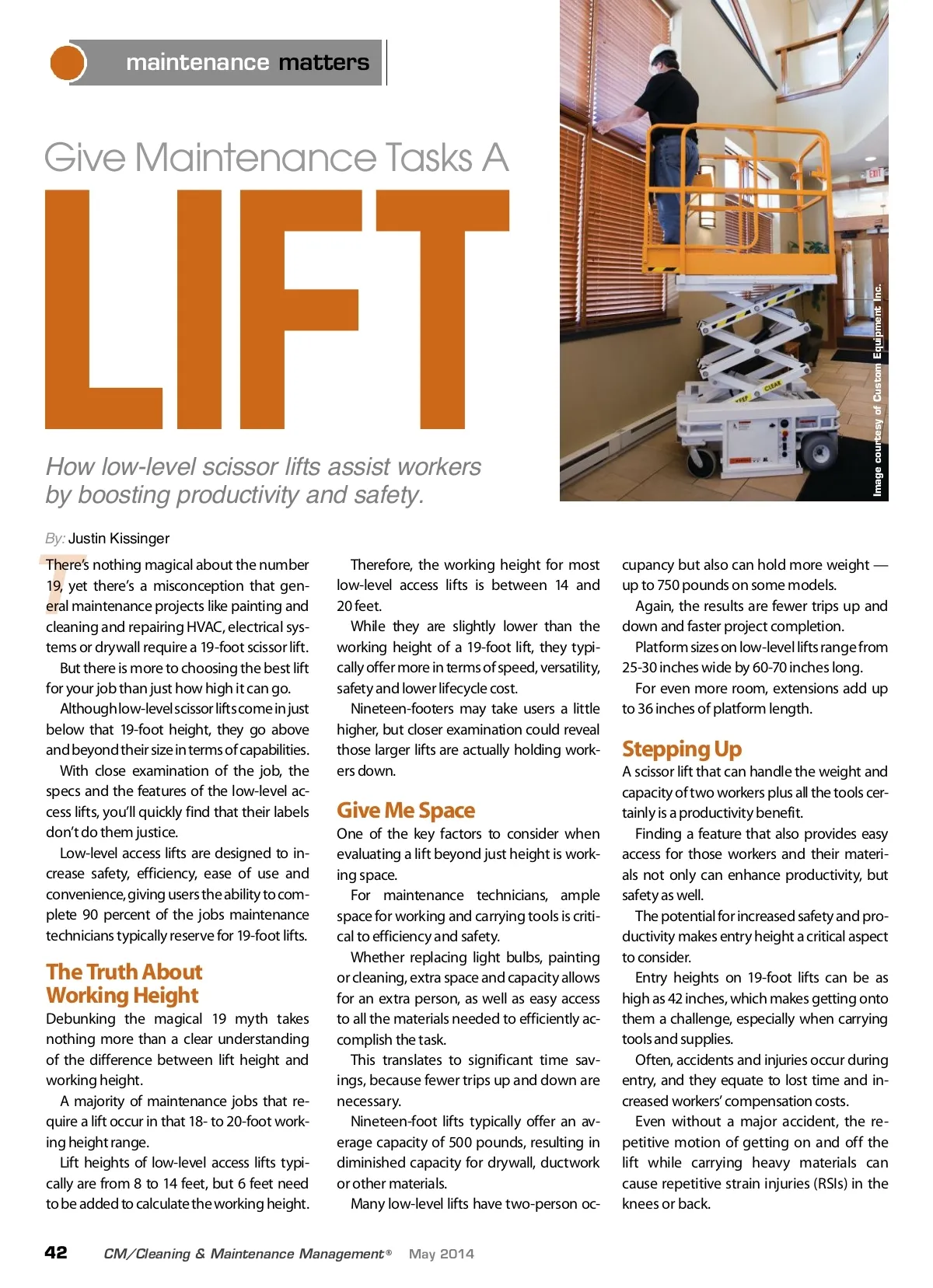
Some lifts feature a small ladder, which increases the danger even more because it makes access challenging and stepping off downright treacherous. Low-level scissor lifts cater to the main-tenance industry with entry heights as low as 20 inches — only one step — which makes getting on and off the platform easier and safer. The lower height reduces the potential for additional injuries and costs. Users get even easier access with full swing gates. They can step onto the platform with tools and materials in hand instead of duck-ing under and moving materials up and over bars or chains, which can lead to neck and back strain. Taking A Load Off Getting jobs done quickly and without causing inadvertent damage is another as-pect users should consider. The last thing anybody wants to do is spend time and money on repairs that eas-ily could have been prevented. Heavier lifts have higher concentrated wheel loads that can damage delicate flooring like tile, mezzanine floors and raised floors. Since taller, 19-foot lifts can weigh as much as 3,300 pounds, the risk of causing damage to floors in finished spaces like hospitals and campuses is greater. Low-level lifts can weigh as little as 600 pounds and some feature dual front wheels that help disperse the weight and reduce wheel-load concentration. Together, those aspects allow operators to access jobs on delicate flooring with minimal risk of damage. To further prevent damage in finished spaces, many units also feature non-mark-ing wheels that prevent scuffs on hard sur-faces. Some low-level lifts also are equipped with counter-rotating wheels; while one wheel rotates down, the other rotates up. This motion reduces the friction point so the lift can maneuver over carpet without causing tears. Hydraulic systems that operate the lift’s steering, driving and lifting have more routing with six to eight connection points. If these points become loose, fluid can leak and damage carpeting, which will re-quire costly replacement. Not only that, but fluid that leaks onto hard surfaces like tile or laminate creates slip hazards. Nineteen-foot lifts feature hydraulic steering, driving and lifting, which means there is an increased risk for damage and safety incidents, which can lead to more workers’ compensation claims. The hydraulic system on low-level lifts typically only powers them up and down, while battery power operates the driving and steering. This configuration has only two connec-tion points, so the chance of a leak is greatly reduced. Some even feature a fully contained hy-draulic system, so even if a leak occurs the fluid does not escape to damage carpeting or create hazards. tors to turn in shorter radiuses, some as low as zero, for easier maneuverability around tight corners and into hallways or small of-fices without assistance from other crew-members. A Tough Climb As mentioned earlier, using low-level lifts in-creases efficiency and productivity. More important than those benefits, how-ever, is the impact these lifts have on worker safety, especially when compared to ladders. According to the U.S. Occupational Safety and Health Administration (OSHA), falls from ladders are one of the leading causes of occupational injuries and fatalities. The risk is so great that some countries have enacted strict regulations on their us-age. Users also can suffer from less serious inju-ries like bruising and tenderness on the soles of their feet from standing on a ladder’s nar-row rungs for extended periods of time. While there are times, places and projects for ladders, maintenance jobs usually aren’t among them. Getting Around Or Under Maneuvering around tight corners or into small spaces can be challenging with a lift. Many are no wider than 32 inches, well within the width of most doorways in commercial, industrial and government buildings. However, those with higher stowed heights can make ducking under door-ways or into elevators with taller materials onboard nearly impossible, and it limits the range of work that can be performed with those lifts. Also, lifts with wider turning radiuses might not be able to maneuver around tight corners. And, finally, there is a risk that inexperi-enced users could raise the lift too high and get caught or even crushed between the lift and ceiling. Low-level scissor lifts, on the other hand, can be as narrow as 25 inches and they fea-ture stowed heights as low as 66 inches. This provides more clearance for getting under doorways and into elevators, even with taller materials on board. Low-level lifts also feature platform lengths as short as 47 inches, so they can easily fit in any elevator in the U.S. that’s built to code. In addition, some models allow opera-The Final Show Nineteen-foot scissor lifts might take you a little higher than low-level lifts, and they are certainly safer than ladders. But when comparing what really matters on a jobsite, it goes beyond simple height capabilities. The benefits of the thoughtful design of low-level scissor lifts aren’t just smoke and mirrors. Whether you’re repairing ductwork, paint-ing or doing electrical work, your lift’s fea-tures should allow you and your employees to get all these jobs done safely and easily. With 14-to 20-foot working heights, low-level lifts are revealing that the “higher is always better” perception is the real illu-sion. Heed The Hydraulics Heavier lifts aren’t the only thing that can damage floors; hydraulic systems can be a culprit as well. Justin Kissinger is the marketing manager for Custom Equipment Inc. He has been with the family-owned business since 1998, gaining knowledge from all areas of the company includ-ing assembly, engineering, service and sales. He also has attended every major tradeshow in the lift industry since 2007. Kissinger earned his bachelor’s degree in business from the Milwaukee School of Engineering. He can be reached at (262) 644-1300 x13 or [email protected]. www.CMMOnline.com 43
CMM – Archives May 2014: 43