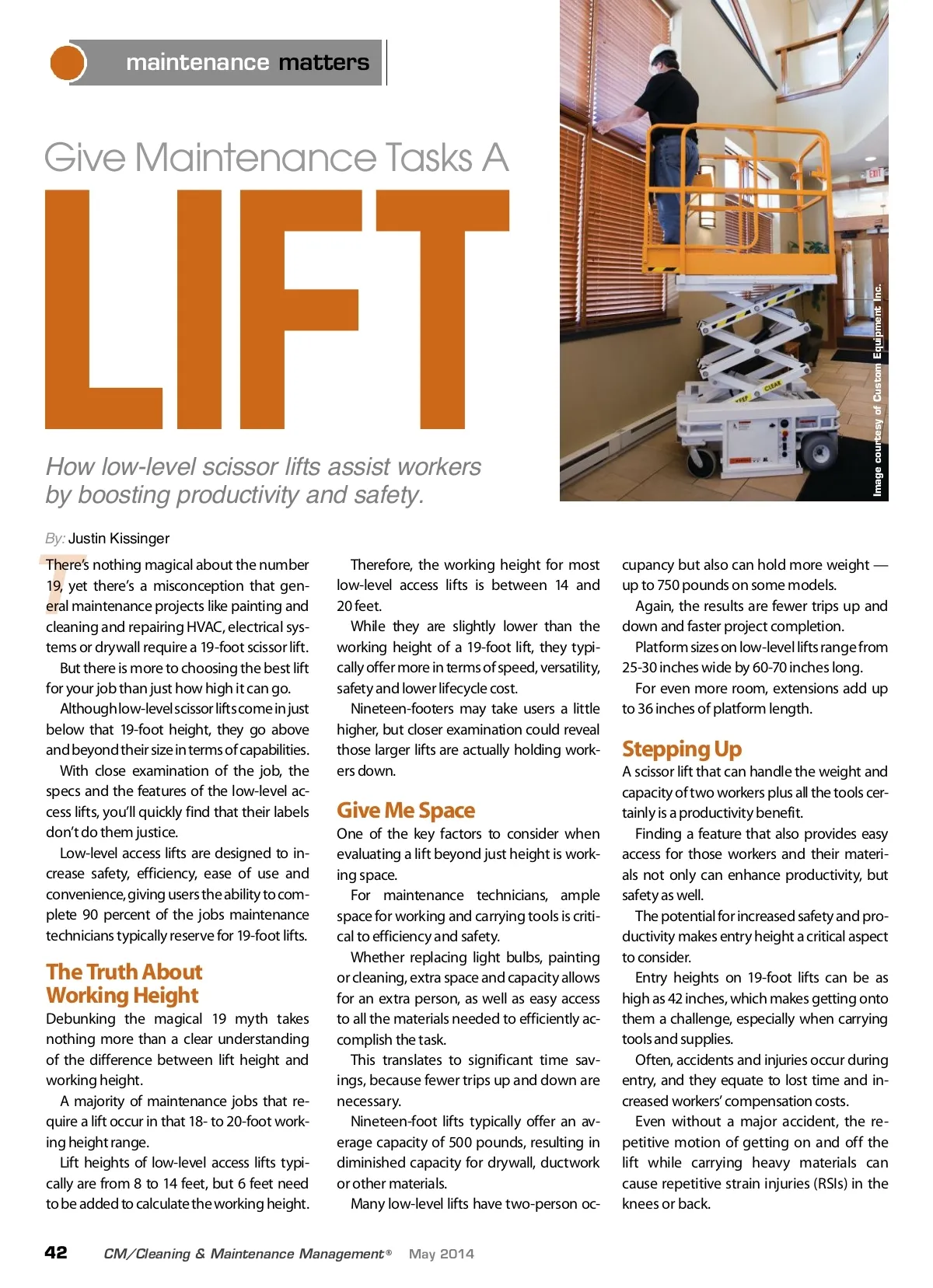
maintenance matters Give Maintenance Tasks A Image courtesy of Custom Equipment Inc. LIFT How low-level scissor lifts assist workers by boosting productivity and safety. By: Justin Kissinger T There’s nothing magical about the number 19, yet there’s a misconception that gen-eral maintenance projects like painting and cleaning and repairing HVAC, electrical sys-tems or drywall require a 19-foot scissor lift. But there is more to choosing the best lift for your job than just how high it can go. Although low-level scissor lifts come in just below that 19-foot height, they go above and beyond their size in terms of capabilities. With close examination of the job, the specs and the features of the low-level ac-cess lifts, you’ll quickly find that their labels don’t do them justice. Low-level access lifts are designed to in-crease safety, efficiency, ease of use and convenience, giving users the ability to com-plete 90 percent of the jobs maintenance technicians typically reserve for 19-foot lifts. Therefore, the working height for most low-level access lifts is between 14 and 20 feet. While they are slightly lower than the working height of a 19-foot lift, they typi-cally offer more in terms of speed, versatility, safety and lower lifecycle cost. Nineteen-footers may take users a little higher, but closer examination could reveal those larger lifts are actually holding work-ers down. cupancy but also can hold more weight — up to 750 pounds on some models. Again, the results are fewer trips up and down and faster project completion. Platform sizes on low-level lifts range from 25-30 inches wide by 60-70 inches long. For even more room, extensions add up to 36 inches of platform length. Stepping Up A scissor lift that can handle the weight and capacity of two workers plus all the tools cer-tainly is a productivity benefit. Finding a feature that also provides easy access for those workers and their materi-als not only can enhance productivity, but safety as well. The potential for increased safety and pro-ductivity makes entry height a critical aspect to consider. Entry heights on 19-foot lifts can be as high as 42 inches, which makes getting onto them a challenge, especially when carrying tools and supplies. Often, accidents and injuries occur during entry, and they equate to lost time and in-creased workers’ compensation costs. Even without a major accident, the re-petitive motion of getting on and off the lift while carrying heavy materials can cause repetitive strain injuries (RSIs) in the knees or back. Give Me Space One of the key factors to consider when evaluating a lift beyond just height is work-ing space. For maintenance technicians, ample space for working and carrying tools is criti-cal to efficiency and safety. Whether replacing light bulbs, painting or cleaning, extra space and capacity allows for an extra person, as well as easy access to all the materials needed to efficiently ac-complish the task. This translates to significant time sav-ings, because fewer trips up and down are necessary. Nineteen-foot lifts typically offer an av-erage capacity of 500 pounds, resulting in diminished capacity for drywall, ductwork or other materials. Many low-level lifts have two-person oc-May 2014 The Truth About Working Height Debunking the magical 19 myth takes nothing more than a clear understanding of the difference between lift height and working height. A majority of maintenance jobs that re-quire a lift occur in that 18-to 20-foot work-ing height range. Lift heights of low-level access lifts typi-cally are from 8 to 14 feet, but 6 feet need to be added to calculate the working height. 42 CM/Cleaning & Maintenance Management ®
CMM – Archives May 2014: 42