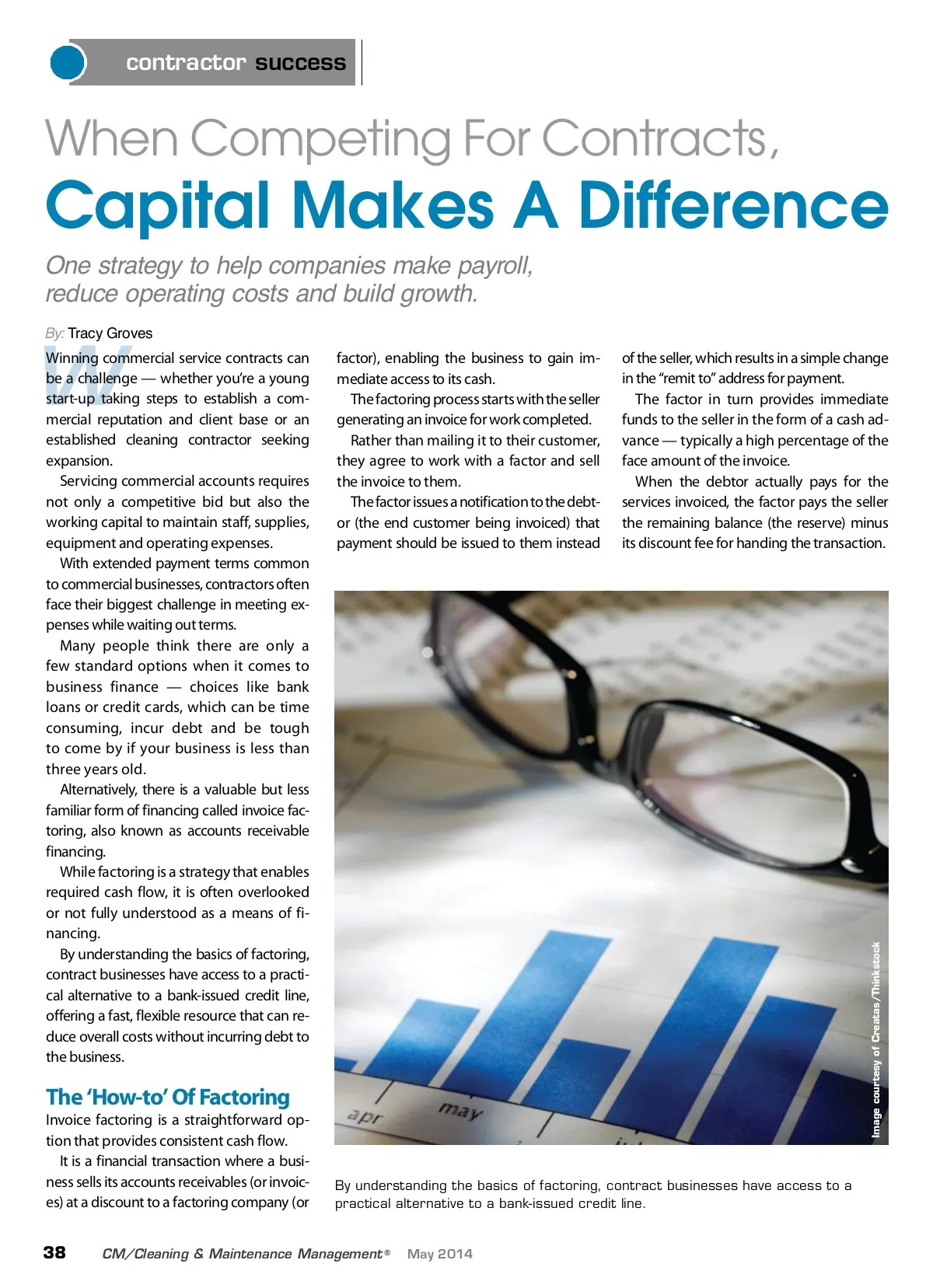
Smart Financing Can Fuel Growth Financial resources and options ensure your contract firm remains competitive and runs smoothly — yet this can be a big hurdle for young businesses. Qualifying for a bank credit line may be difficult, as this type of financing requires fi-nancial review and is defined to a set level of spending and required payment. Further, if your contract business does qualify for bank financing, interest fees will increase company debt. Factoring differs from bank loans in sev-eral well-defined ways. For example, the factor is much more concerned with the credit-worthiness of the debtor; this is in contrast to bank funding, which focuses on the credit-worthiness and total assets of the seller. Factoring is not a loan — it is the purchase of a financial asset (your invoices), by a factor from the seller at a discount. Start-ups qualify for factoring. Because the process is based solely on invoices, it requires no financial review or underwriting and there are no predefined limits to factoring funds. Contractors can choose which customers to factor and the availability of immediate cash remains in step with new contracts, ideal for any firm in expansion mode. No interest accrues and no debt is added to your company balance sheet. Expanding a business requires a strong cash flow and the cycle of good business it supports. Working Capital Relieves Stress And Builds Business Expanding with new service contracts com-pounds these issues exponentially — more crews, more operating expenses, more equipment. It’s a good problem, but it is indeed a problem. Options such as factoring answer the need by enabling cash flow and working capital with every new contract. Invoice-based financing ensures that building your business is no longer depen-dent on what operating capital you can afford to reserve toward winning new cus-tomers. Big expenses become less scary and there is always cash flow for payroll taxes, insur-ance and payroll. Cash in hand offers a broad set of business advantages. Meeting weekly payroll assures the best staff, which helps define your company as one with exceptional employees who al-ways show up and do a good job. Equipment rental is easily managed, and better prices can be negotiated on bulk ex-pendable supplies. Your bids can be more competitive overall; lower costs can be passed along to your cli-entele, differentiating your company in the bidding process. For contract service businesses, under-standing your finance options is essential for business growth. Working capital strategies such as factor-ing are optimized for the contract service in-dustry, bypassing stringent financial review and avoiding debt added to the business. When steady cash flow is tied directly to invoiced business, contractors have a fast, flexible resource for smooth operations and ongoing business growth. Cash Flow Impacts Everything Expanding your business requires cash flow and the cycle of good business it sup-ports. Consider for example the impact of pay-roll requirements on business operations, including the amount and frequency of income paid to your workforce. For 22 years, Tracy Groves, vice president of com-munications for eCapital, has helped businesses grow and reach new heights through leading edge marketing strategies. Through her work with eCapital, she’s on a mission to share innovative financing options for small to medium sized companies, enabling them to have the financial freedom to do more. Reach Tracy via email at [email protected]. www.CMMOnline.com 39 Image courtesy of AbleStock.com/Thinkstock Cash is typically delivered to the business via electronic transfer within 24 hours or less of submitting the invoice. In addition to receiving customer pay-ments quickly, the factor can act as your accounts receivable department and assist with back office support. This can be attractive for smaller contract firms in particular, adding value by creating a larger business image. Your spotless reputation is driven largely by this team of good, happy employees who perform above standards. The incentive of weekly payroll is critical to maintaining the best crews, but can take a big bite out of cash flow. Commercial accounts can be lucra-tive but customers are typically billed monthly after the completion of 30 full days of service; 30-day payment terms are common, which means your contract firm may be carrying payroll for as long as 60 days. Multiply this by the number of crews you may have working any number of commer-cial contracts, and your payroll requirements alone can quickly become staggering. Other expenses beyond payroll also reinforce the need for working capital — things like maintaining storage or adminis-trative space, payroll taxes, workers comp insurance, routine heavy equipment rental and expendable supplies like cleaners and chemicals. When working capital is not available, these basic needs stress business op-erations and may even add unnecessary costs. A cash-strapped contractor may opt out of bulk buying of cleaners and chemicals, either because the working capital is not available or simply to protect the cash flow they do have.
CMM – Archives May 2014: 39