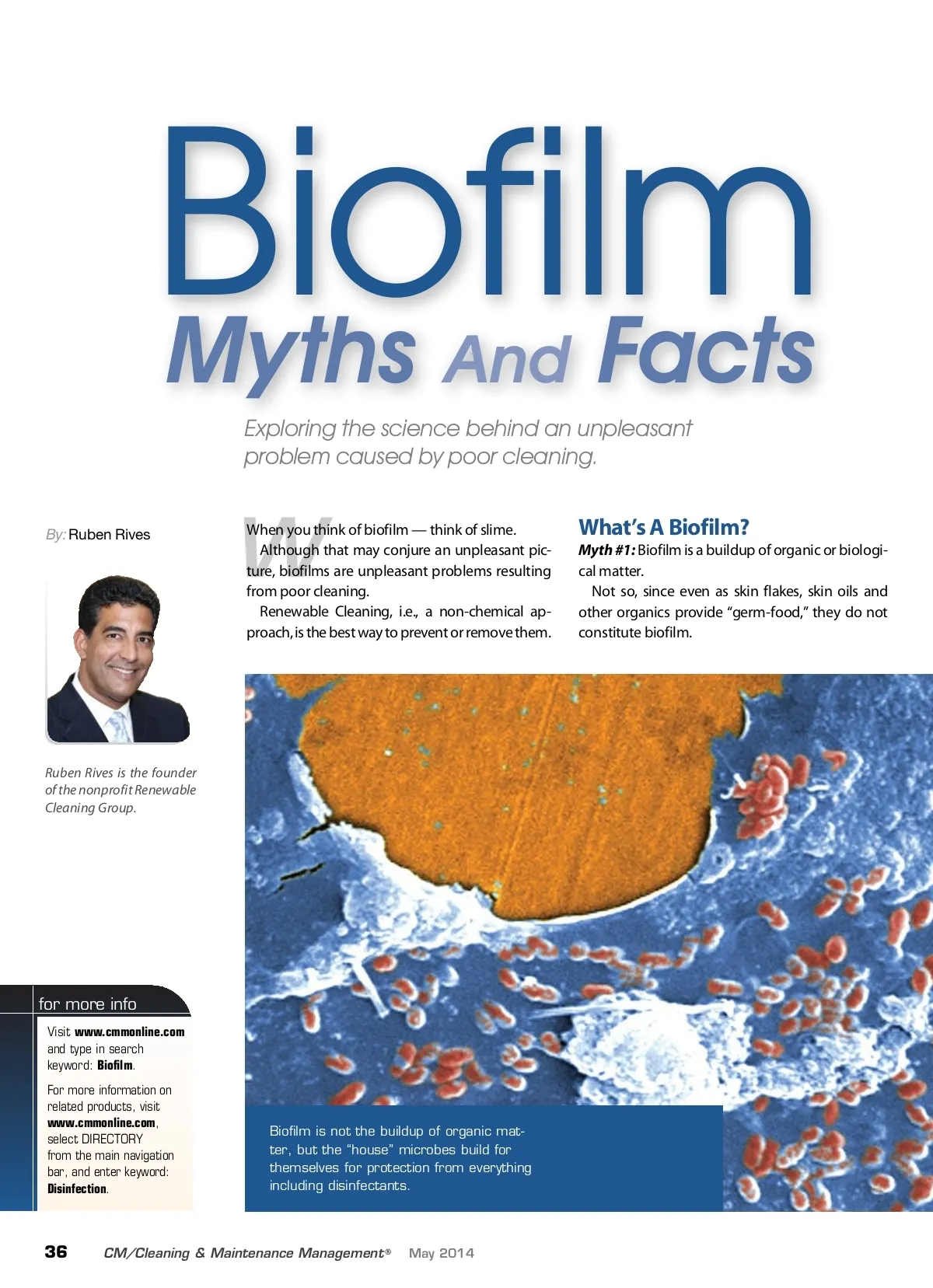
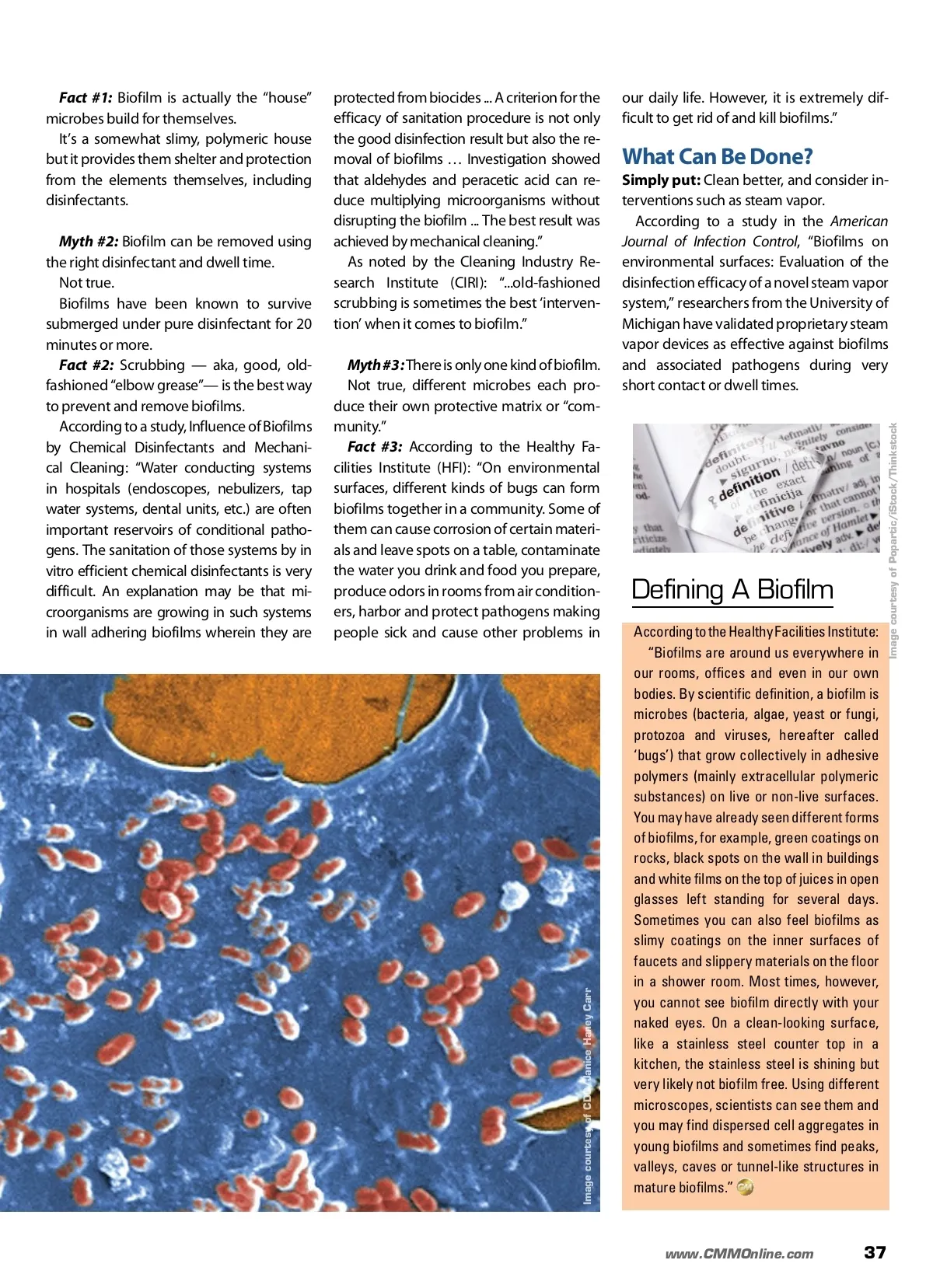
Fact #1: Biofilm is actually the “house” microbes build for themselves. It’s a somewhat slimy, polymeric house but it provides them shelter and protection from the elements themselves, including disinfectants. Myth #2: Biofilm can be removed using the right disinfectant and dwell time. Not true. Biofilms have been known to survive submerged under pure disinfectant for 20 minutes or more. Fact #2: Scrubbing — aka, good, old-fashioned “elbow grease”— is the best way to prevent and remove biofilms. According to a study, Influence of Biofilms by Chemical Disinfectants and Mechani-cal Cleaning: “Water conducting systems in hospitals (endoscopes, nebulizers, tap water systems, dental units, etc.) are often important reservoirs of conditional patho-gens. The sanitation of those systems by in vitro efficient chemical disinfectants is very difficult. An explanation may be that mi-croorganisms are growing in such systems in wall adhering biofilms wherein they are protected from biocides ... A criterion for the efficacy of sanitation procedure is not only the good disinfection result but also the re-moval of biofilms … Investigation showed that aldehydes and peracetic acid can re-duce multiplying microorganisms without disrupting the biofilm ... The best result was achieved by mechanical cleaning.” As noted by the Cleaning Industry Re-search Institute (CIRI): “...old-fashioned scrubbing is sometimes the best ‘interven-tion’ when it comes to biofilm.” Myth #3: There is only one kind of biofilm. Not true, different microbes each pro-duce their own protective matrix or “com-munity.” Fact #3: According to the Healthy Fa-cilities Institute (HFI): “On environmental surfaces, different kinds of bugs can form biofilms together in a community. Some of them can cause corrosion of certain materi-als and leave spots on a table, contaminate the water you drink and food you prepare, produce odors in rooms from air condition-ers, harbor and protect pathogens making people sick and cause other problems in our daily life. However, it is extremely dif-ficult to get rid of and kill biofilms.” What Can Be Done? Simply put: Clean better, and consider in-terventions such as steam vapor. According to a study in the American Journal of Infection Control , “Biofilms on environmental surfaces: Evaluation of the disinfection efficacy of a novel steam vapor system,” researchers from the University of Michigan have validated proprietary steam vapor devices as effective against biofilms and associated pathogens during very short contact or dwell times. Image courtesy of Popartic/iStock/Thinkstock Defining A Biofilm According to the Healthy Facilities Institute: “Biofilms are around us everywhere in our rooms, offices and even in our own bodies. By scientific definition, a biofilm is microbes (bacteria, algae, yeast or fungi, protozoa and viruses, hereafter called ‘bugs’) that grow collectively in adhesive polymers (mainly extracellular polymeric substances) on live or non-live surfaces. You may have already seen different forms of biofilms, for example, green coatings on rocks, black spots on the wall in buildings and white films on the top of juices in open glasses left standing for several days. Sometimes you can also feel biofilms as slimy coatings on the inner surfaces of faucets and slippery materials on the floor in a shower room. Most times, however, you cannot see biofilm directly with your naked eyes. On a clean-looking surface, like a stainless steel counter top in a kitchen, the stainless steel is shining but very likely not biofilm free. Using different microscopes, scientists can see them and you may find dispersed cell aggregates in young biofilms and sometimes find peaks, valleys, caves or tunnel-like structures in mature biofilms.” Image courtesy of CDC/Janice Haney Carr www.CMMOnline.com 37
CMM – Archives May 2014: 37