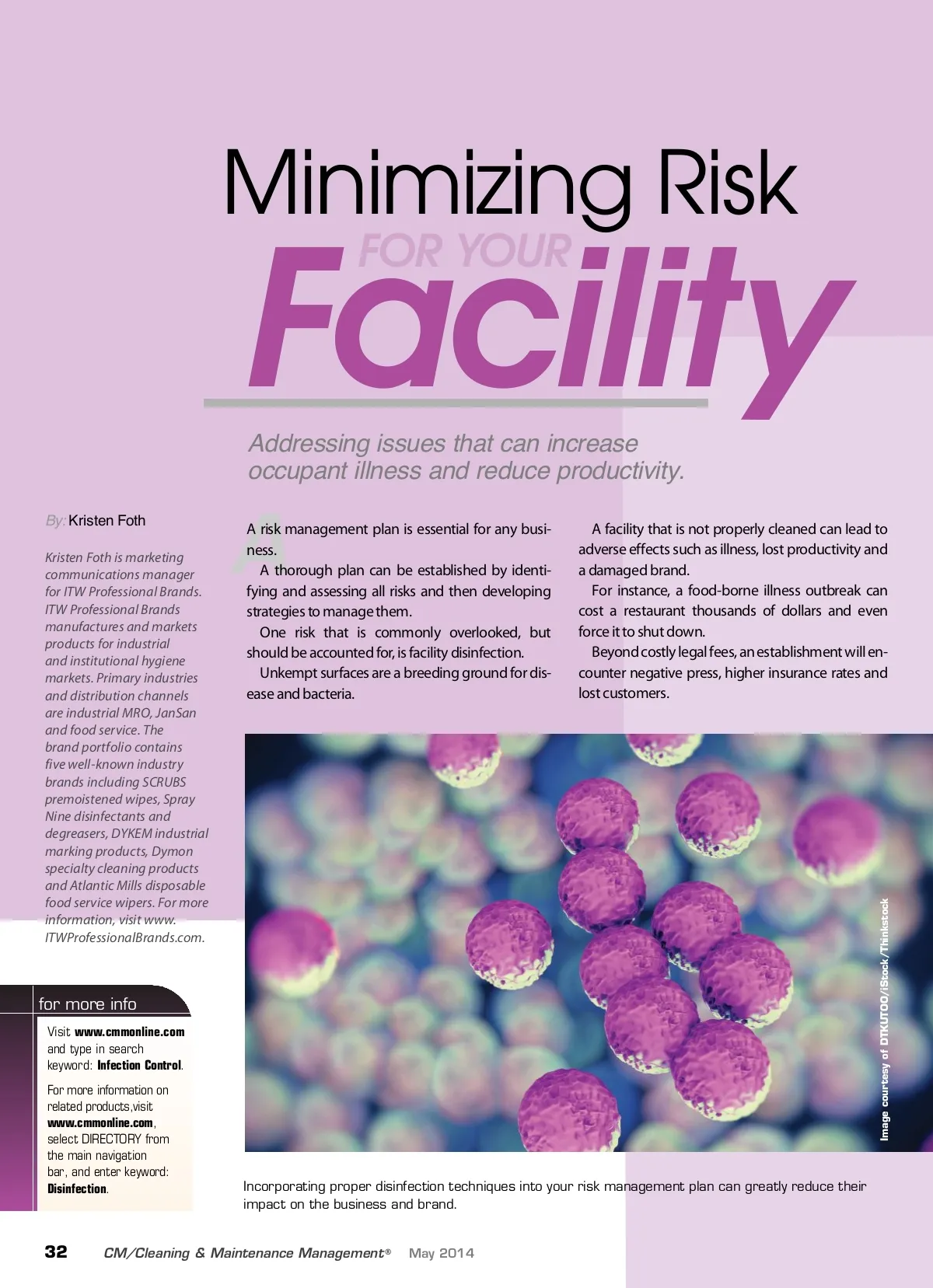
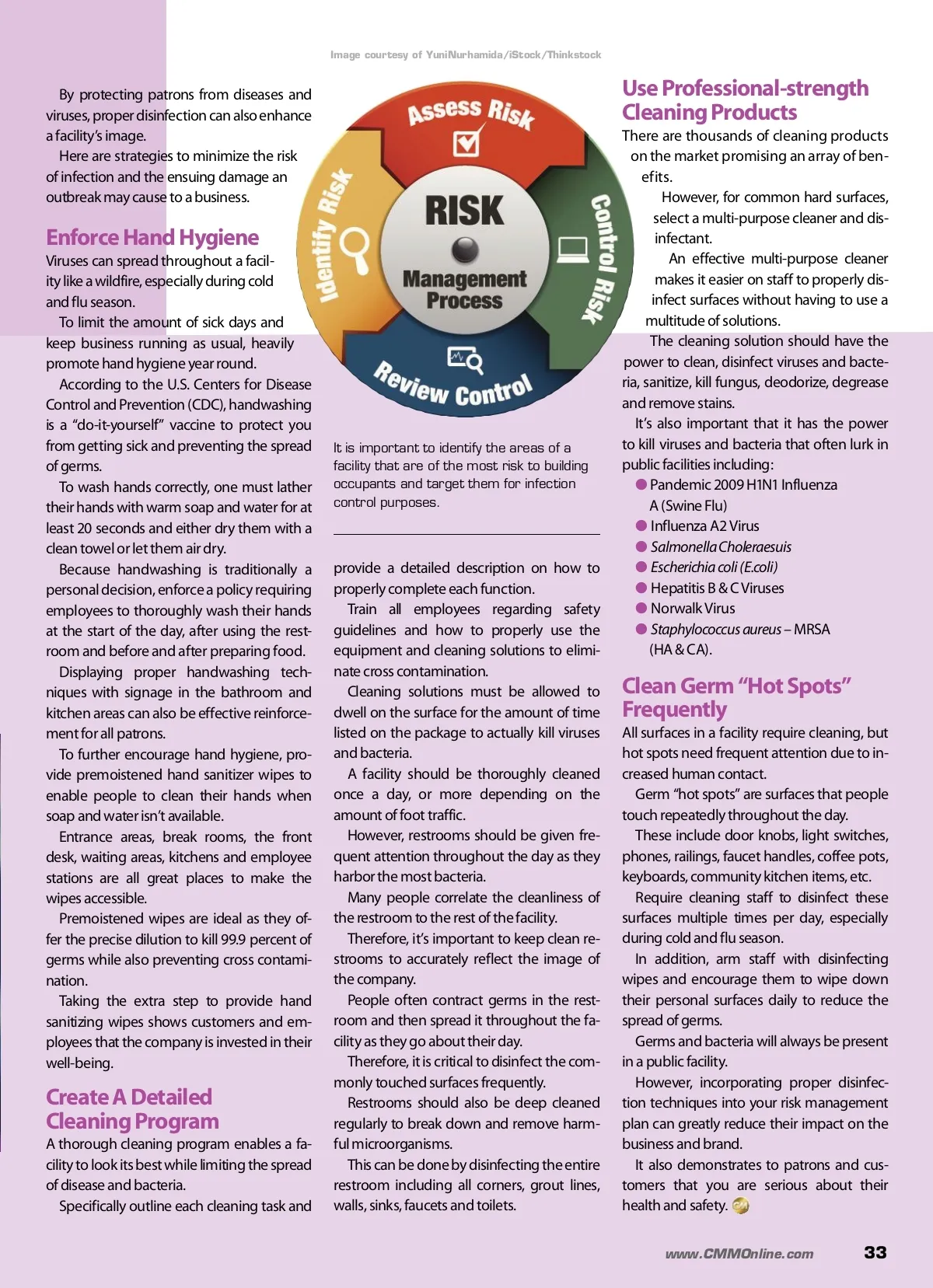
Image courtesy of YuniNurhamida/iStock/Thinkstock By protecting patrons from diseases and viruses, proper disinfection can also enhance a facility’s image. Here are strategies to minimize the risk of infection and the ensuing damage an outbreak may cause to a business. Use Professional-strength Cleaning Products There are thousands of cleaning products on the market promising an array of ben-efits. However, for common hard surfaces, select a multi-purpose cleaner and dis-infectant. An effective multi-purpose cleaner makes it easier on staff to properly dis-infect surfaces without having to use a multitude of solutions. The cleaning solution should have the power to clean, disinfect viruses and bacte-ria, sanitize, kill fungus, deodorize, degrease and remove stains. It’s also important that it has the power to kill viruses and bacteria that often lurk in public facilities including: ● Pandemic 2009 H1N1 Influenza A (Swine Flu) ● Influenza A2 Virus ● Salmonella Choleraesuis ● Escherichia coli (E.coli) ● Hepatitis B & C Viruses ● Norwalk Virus ● Staphylococcus aureus – MRSA (HA & CA). Enforce Hand Hygiene Viruses can spread throughout a facil-ity like a wildfire, especially during cold and flu season. To limit the amount of sick days and keep business running as usual, heavily promote hand hygiene year round. According to the U.S. Centers for Disease Control and Prevention (CDC), handwashing is a “do-it-yourself” vaccine to protect you from getting sick and preventing the spread of germs. To wash hands correctly, one must lather their hands with warm soap and water for at least 20 seconds and either dry them with a clean towel or let them air dry. Because handwashing is traditionally a personal decision, enforce a policy requiring employees to thoroughly wash their hands at the start of the day, after using the rest-room and before and after preparing food. Displaying proper handwashing tech-niques with signage in the bathroom and kitchen areas can also be effective reinforce-ment for all patrons. To further encourage hand hygiene, pro-vide premoistened hand sanitizer wipes to enable people to clean their hands when soap and water isn’t available. Entrance areas, break rooms, the front desk, waiting areas, kitchens and employee stations are all great places to make the wipes accessible. Premoistened wipes are ideal as they of-fer the precise dilution to kill 99.9 percent of germs while also preventing cross contami-nation. Taking the extra step to provide hand sanitizing wipes shows customers and em-ployees that the company is invested in their well-being. It is important to identify the areas of a facility that are of the most risk to building occupants and target them for infection control purposes. Create A Detailed Cleaning Program A thorough cleaning program enables a fa-cility to look its best while limiting the spread of disease and bacteria. Specifically outline each cleaning task and provide a detailed description on how to properly complete each function. Train all employees regarding safety guidelines and how to properly use the equipment and cleaning solutions to elimi-nate cross contamination. Cleaning solutions must be allowed to dwell on the surface for the amount of time listed on the package to actually kill viruses and bacteria. A facility should be thoroughly cleaned once a day, or more depending on the amount of foot traffic. However, restrooms should be given fre-quent attention throughout the day as they harbor the most bacteria. Many people correlate the cleanliness of the restroom to the rest of the facility. Therefore, it’s important to keep clean re-strooms to accurately reflect the image of the company. People often contract germs in the rest-room and then spread it throughout the fa-cility as they go about their day. Therefore, it is critical to disinfect the com-monly touched surfaces frequently. Restrooms should also be deep cleaned regularly to break down and remove harm-ful microorganisms. This can be done by disinfecting the entire restroom including all corners, grout lines, walls, sinks, faucets and toilets. Clean Germ “Hot Spots” Frequently All surfaces in a facility require cleaning, but hot spots need frequent attention due to in-creased human contact. Germ “hot spots” are surfaces that people touch repeatedly throughout the day. These include door knobs, light switches, phones, railings, faucet handles, coffee pots, keyboards, community kitchen items, etc. Require cleaning staff to disinfect these surfaces multiple times per day, especially during cold and flu season. In addition, arm staff with disinfecting wipes and encourage them to wipe down their personal surfaces daily to reduce the spread of germs. Germs and bacteria will always be present in a public facility. However, incorporating proper disinfec-tion techniques into your risk management plan can greatly reduce their impact on the business and brand. It also demonstrates to patrons and cus-tomers that you are serious about their health and safety . www.CMMOnline.com 33
CMM – Archives May 2014: 33