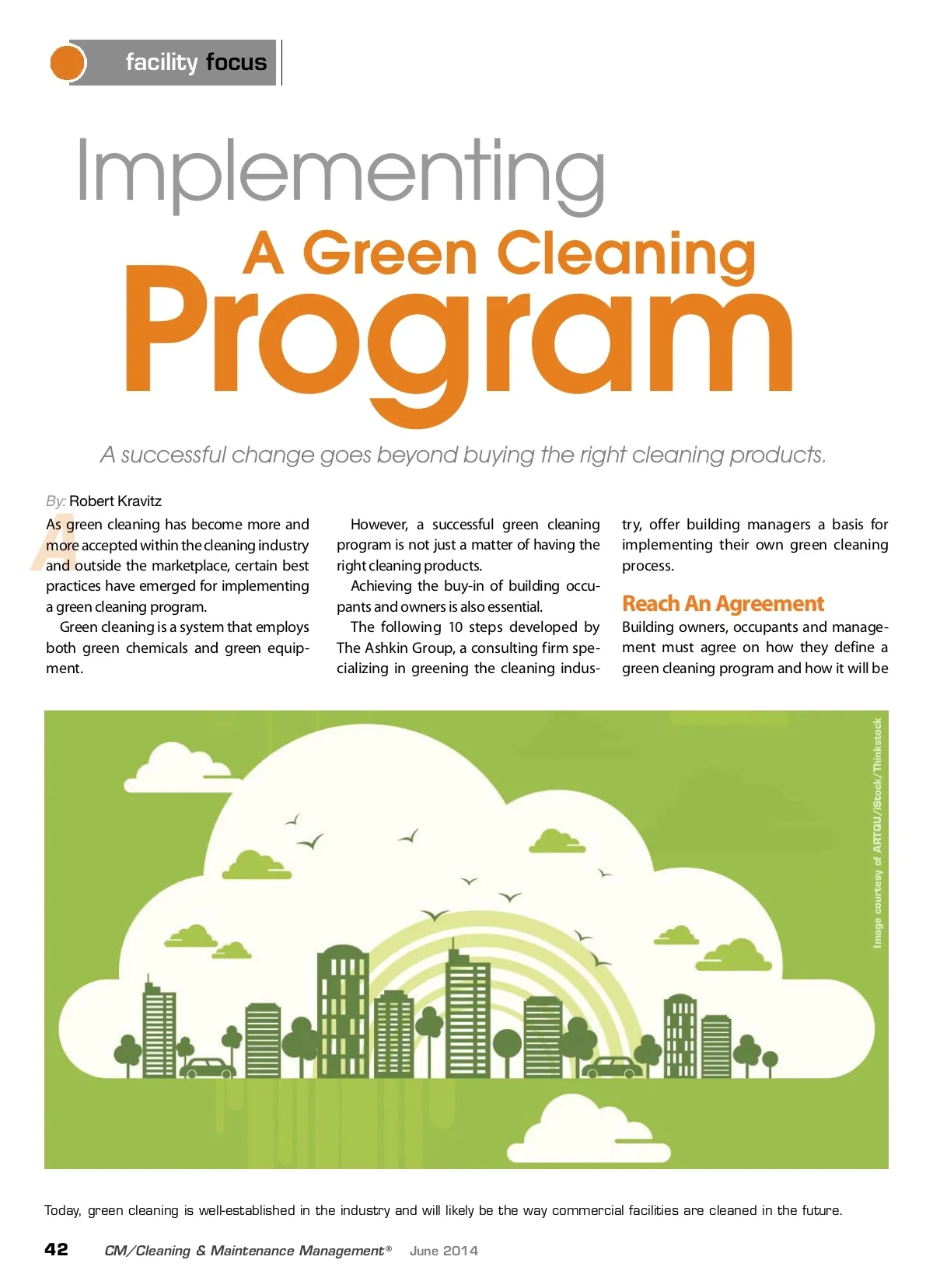
implemented into their facility. To ensure adherence, the agreement must be in writing and written in the form of a concise, easy-to-understand contract. Acquire Green Products And Equipment To begin the process of greening a facility, new cleaning products and equipment may need to be purchased. This may include investing in environ-mentally-preferable cleaning chemicals, vacuum cleaners with high-filtration filters, floor machines with dust-control systems to capture impurities so they don’t pollute the indoor environment, and microfiber clean-ing cloths and mops, which are more ab-sorbent than conventional cloths and mops and reduce the need for cleaning chemicals. Green Cleaning And LEED We really cannot end an article on the im-portance green cleaning without bringing in LEED (Leadership in Engineering and En-vironmental Design). With v4 of LEED, green cleaning is a pre-requisite. This means a green cleaning strategy must be in place in order for a facility to even be considered for LEED certification. With older versions of LEED, facilities were given credits toward certification if a green cleaning program was in place. Further, v4 requires that a much greater percentage of cleaning and cleaning-relat-ed products be green certified. Seventy-five percent of all chemicals, pa-per products and liners must now be certi-fied (up from 30 percent) and 40 percent of equipment must be recognized as environ-mentally preferable (up from 20 percent). “For most cleaning and building profes-sionals,” says Stephen P. Ashkin, president of The Ashkin Group and chief executive offi-cer (CEO) of Sustainability Dashboard Tools, “this tells us green cleaning is now the de facto standard when defining a green build-ing. It also tells us we have come a long, long way in reducing cleaning’s impact on the environment.” Build The Team With the agreement in hand, a team should be organized that includes not just cleaning professionals, but also the building manage-ment and occupants. The team will meet and discuss the green cleaning system, and as a result of these meetings, will generate support for the proj-ect for all building occupants — a pivotal element in its success. Implement Green Procedures Begin new cleaning procedures that help cleaning professionals understand and use the environmentally-preferable products carefully, safely and with the goals of green cleaning in mind. Conduct Baseline Audits One of the team’s first duties is to determine the facility’s current housekeeping status by conducting audits to verify how the facility is being cleaned and maintained. This will establish a baseline to judge fu-ture improvement. For instance, surveys may include an in-ventory and evaluation of existing paper products, liners and cleaning equipment used in the location. It may also include appraisals of the fol-lowing: ● Overall housekeeping quality ● Cleaning procedures, including training and supervision ● Recycling ● Existing indoor air quality (IAQ) problems and complaint records. Implement A Training Program Adopting green cleaning is often an oppor-tunity for all maintenance personnel to learn the most up-to-date cleaning procedures. This often streamlines all cleaning op-erations and improves the appearance and health of the facility. Take Responsibility Through Stewardship Once a green cleaning program has begun, cleaning personnel, building occupants and visitors share the responsibility of maintain-ing a healthy and productive indoor envi-ronment. This is called stewardship. These stakeholders make sure the green cleaning system is successful by reviewing the program’s progress and implementing changes necessary for the health of the fa-cility. The Future Of Green Cleaning Ashkin once compared the evolution of green cleaning to an old locomotive pulling out of a train station. The engine moves slowly, sometimes hesitantly, but over time it gathers more and more speed. When the tipping point arrived with green cleaning — when the professional cleaning industry along with end customers decided they preferred to transfer to green cleaning strategies — is anyone’s guess. However, suffice it to say green cleaning is now well-established in the industry and with few exceptions will likely be the way most commercial facilities are cleaned go-ing forward. Develop A Plan Once the data has been collected, the team must analyze the information to determine the best ways to implement the green cleaning system. They decide which areas need to be ad-dressed first, based on contract require-ments, costs and potential health and envi-ronmental impacts. Get Everyone On Board It is vitally important that everyone is in-volved in the process and supports the team’s plans and goals. This is often best accomplished by includ-ing all necessary parties in the process and making them aware of how and why chang-es are being made. Communicate And Provide Feedback Communication and feedback are vital among chemical suppliers, building occu-pants and management. As with any new process or procedure involving many people, the ultimate goal is continued improvement. Information provided by all parties helps facilitate this goal. Robert Kravitz is a frequent writer for the professional cleaning industry writing on a variety of topics from green cleaning to floorcare. He may be reached via his website at www.AlturaSolutions.com www.CMMOnline.com 43
CMM – Archives June 2014: 43