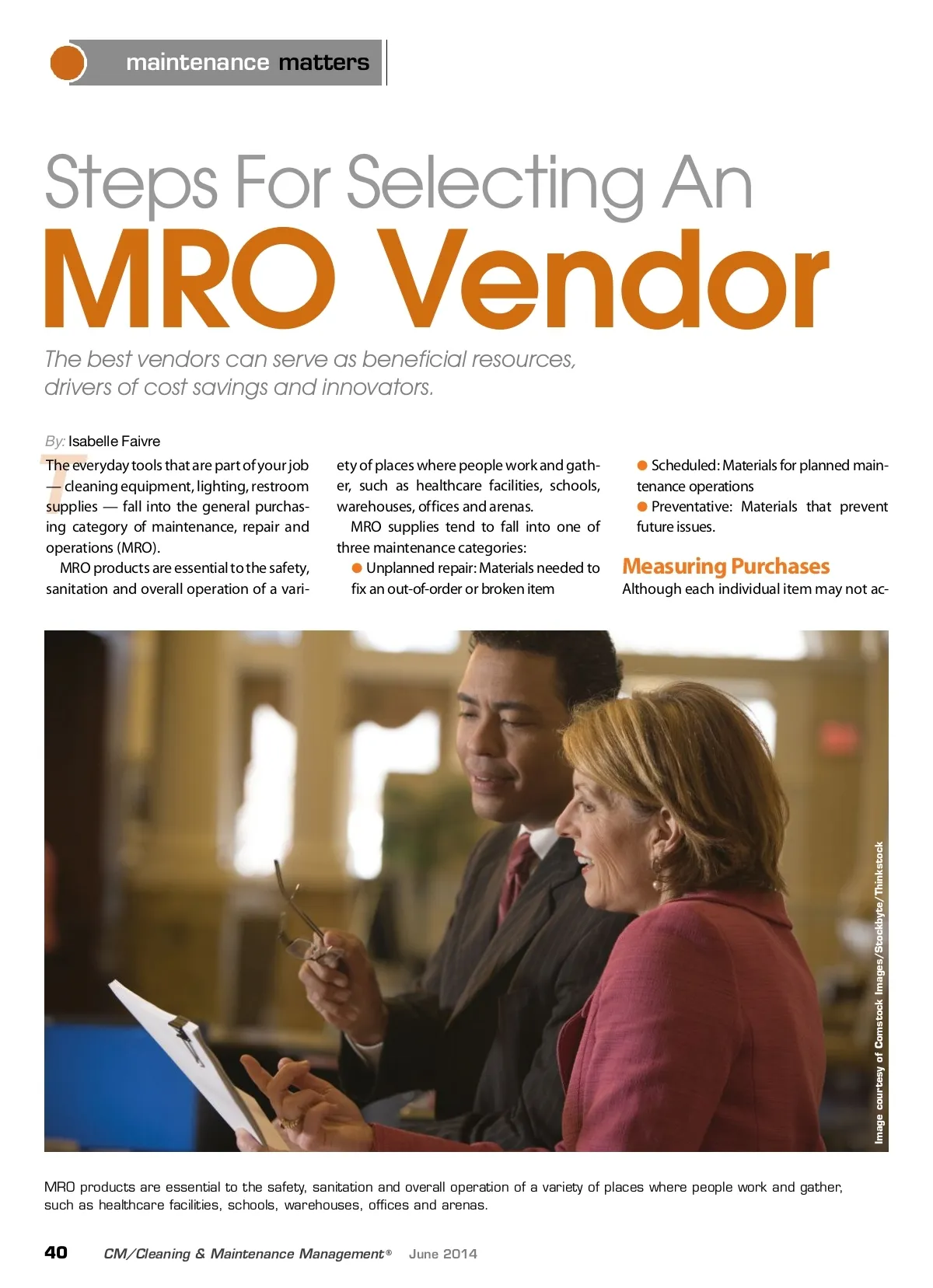
count for a large part of a facility’s overall budget, MRO is no small matter. According to a 2008 study by Frank Lynn & Associates, U.S. manufacturers spend approximately $125 billion a year on MRO purchases. According to a leading global provider of procurement consulting, spot buys — or unplanned purchases — can account for 50 percent of a company’s total MRO spend. The frequency of these unexpected buys only increases the need for a trusted MRO vendor that puts your company’s objec-tives first. Beyond ensuring that the materials they recommend meet key performance indi-cators, a good MRO vendor can serve as a beneficial resource, driver of cost savings and innovator for your company. MRO Recommendations We’ve distilled our years of experience into the following recommendations for choos-ing MRO vendors and analyzing product choices: Don’t overlook these purchases. It can be easy to look at these types of items as commodity buys, but having a great product really makes a difference to workers. Products that touch every person of the company, such as hand cleanser or protec-tive lotions, have the opportunity to posi-tively impact employee experience and morale. Look beyond the cost of the actual product. Don’t make decisions based on the cost of the container; judge by how much prod-uct is actually consumed and determine the cost per use. Additionally, look at total expenditures. For example, with hand cleansers, ex-amine the associated costs of water and energy and incorporate them into the cost analysis, which could result in potential savings overall. Set high standards. Communicate your difficulties and concerns with vendors and choose to work only with helpful providers who offer new and fresh ideas and top-notch service. A true “partner” vendor should welcome the opportunity to better understand your facility and its unique considerations and rise to the challenge. Consider overall quality. It’s not enough for just the product to be effective. Test the quality of any dispensers, hold-ers, required tools or applicators as well to eliminate future issues. Depend on data. Whenever possible, work with vendors that have the data to back up their recom-mendations, can answer specific questions about the products (e.g., where the prod-uct is manufactured, what the average lifespan of the product is) and are able to share results from other companies cur-rently using the product. Be analytical. Working closely with your MRO vendor, you can begin to analyze those unplanned purchases and look for opportunities to either work them into your scheduled or-ders or have an action plan that allows you to place an order only once you need the product. Industry experts name this “buy-as-you-go” strategy as a way to reduce costs and minimize overhead. Conduct a field test. Many vendors will promise the moon, so make sure the product is a good fit for your company before making a final de-cision. Verify that the products will work in your environment and for your unique needs, and validate the cost savings promised. A Good Example For example, for a large manufacturing plant located near Charlotte, North Caro-lina, MRO purchases are handled by an on-site project manager. The 1 million-square-foot facility em-ploys roughly 2,000 employees in two production shifts and three maintenance shifts, and the manager relies on vendors to keep him abreast of new products and market solutions. Through one such vendor relationship, the project manager and his team were approached about conducting a trial of a product at the plant — a new industrial hand cleanser specifically designed to han-dle tough cleaning requirements without the damage and irritation caused by other heavy-duty cleansers. Based on the fact that the foam format requires less product, the vendor was con-fident that it could save up to 45 percent of their annual hand cleanser consumption and could provide a far superior product at a lower price than what the facility was currently using. They were also experiencing clogged drains from current pumice-based prod-uct and needed a solution, and associates were assured that the new product would be much easier on their hands and the en-vironment. “While we are always looking to find product options that will provide a better experience for employees and help meet sustainability goals, cost containment is a big driver for us and our customers,” said the on-site project manager. “We were using a fairly inexpensive product with okay results, and we thought it was the best we could do at that price point until this company offered their unique solu-tion.” In this situation, the vendor provided added value by suggesting an alternative product and providing the facility the op-portunity to actually test it themselves. The associate feedback was over-whelmingly positive, and the facility converted to using the vendor’s recom-mended product. Faced with myriad pressing decisions on staffing, finance, operations and produc-tion, it can be easy for businesses to think of MRO supplies as a trivial matter, or for the need to fall off the radar screens com-pletely. However, developing relationships with trusted MRO vendors can help positively affect your purchasing decisions, employ-ee morale and your company’s bottom line. Isabelle Faivre is vice president of marketing at Deb Group, the world’s leading away-from-home skin care company. She holds extensive away-from-home market experience and a bachelor of science in international market-ing from McGill University and ESSCA. Faivre works with customers to provide innovative skin care programs that improve employee health and safety and environmental impact while reducing costs. Deb’s most recent innovation is GrittyFOAM®, the first heavy-duty foam hand cleanser. For more information, visit www. DebGroup.com. www.CMMOnline.com 41
CMM – Archives June 2014: 41