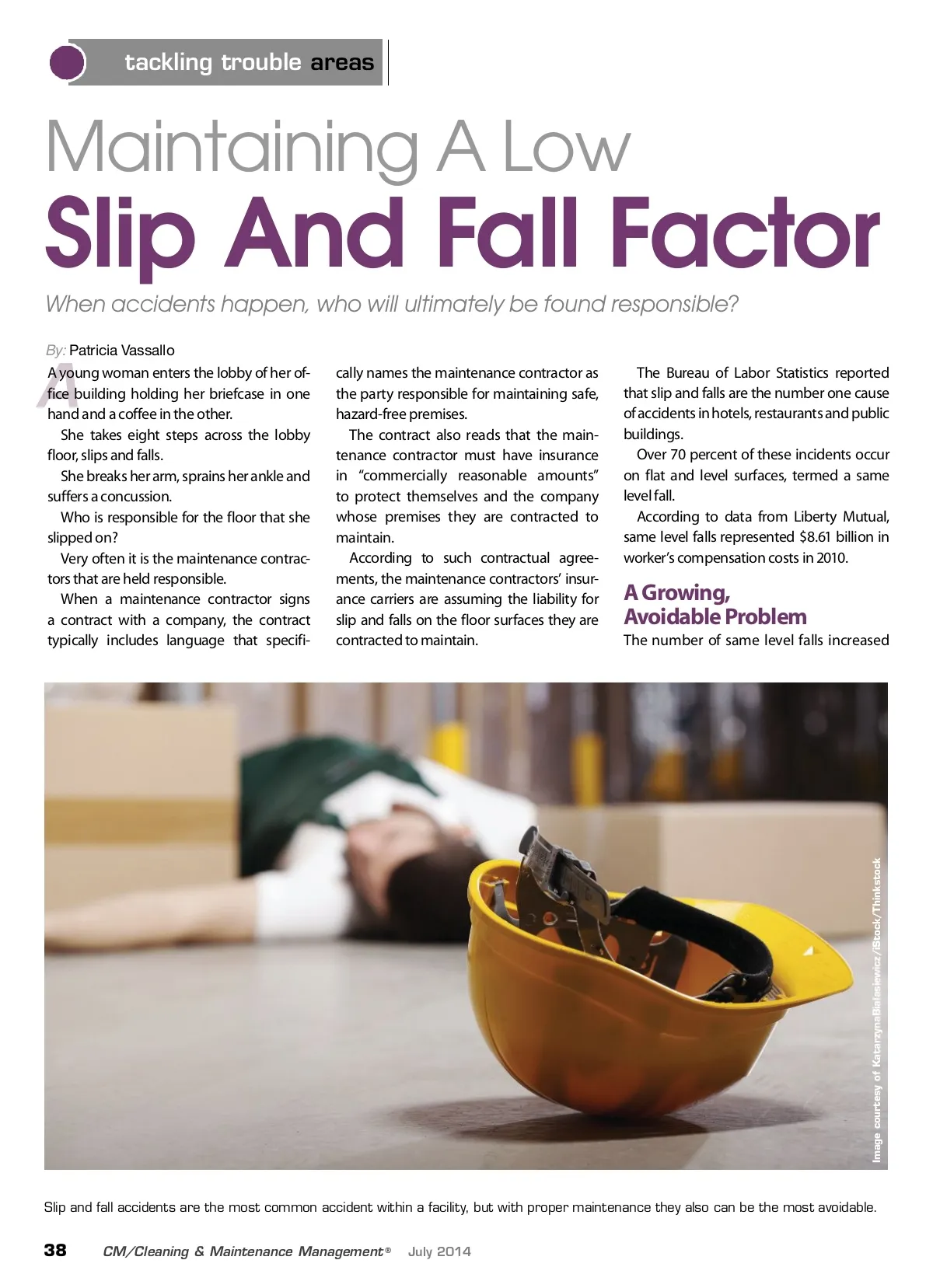
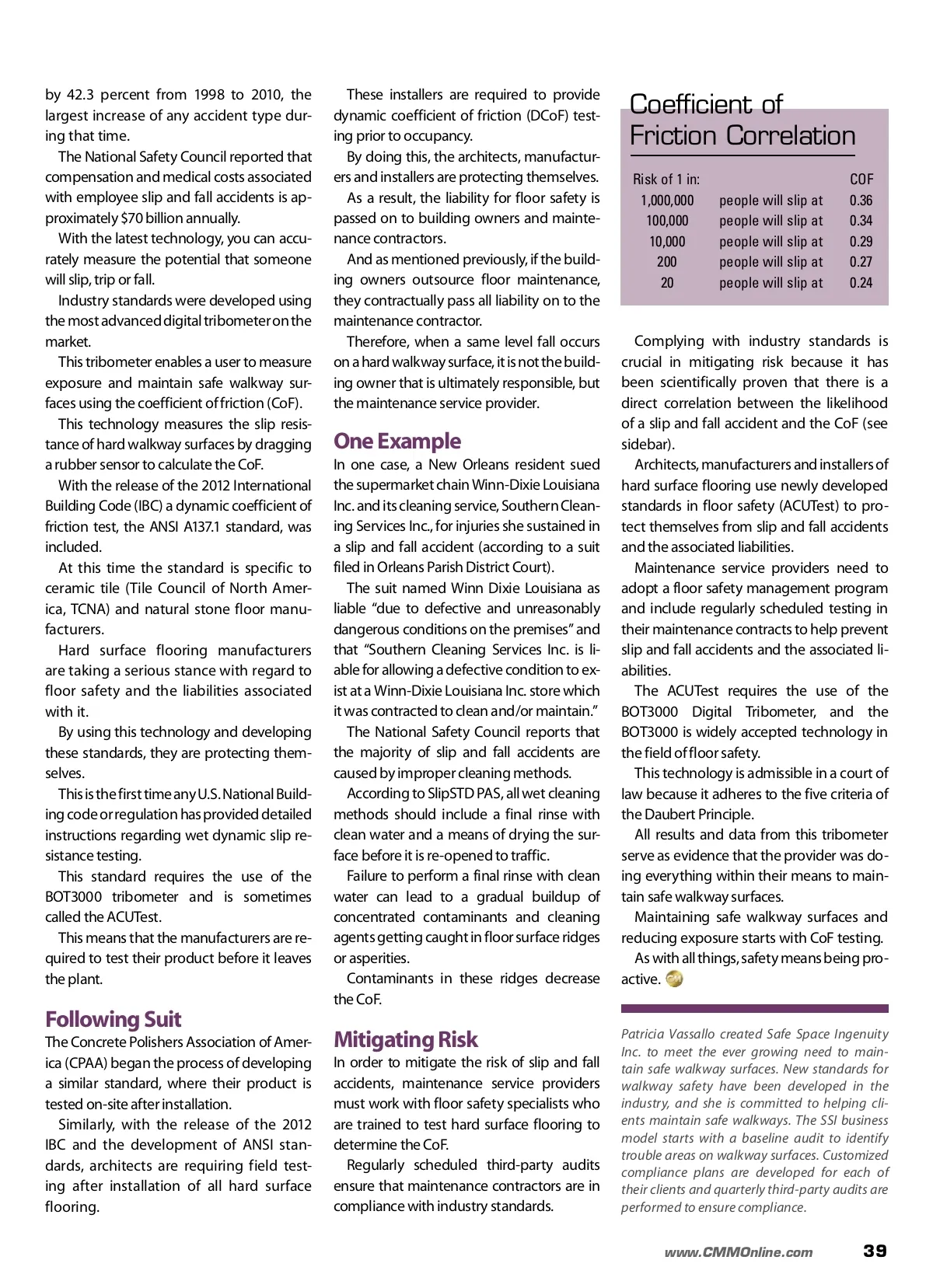
by 42.3 percent from 1998 to 2010, the largest increase of any accident type dur-ing that time. The National Safety Council reported that compensation and medical costs associated with employee slip and fall accidents is ap-proximately $70 billion annually. With the latest technology, you can accu-rately measure the potential that someone will slip, trip or fall. Industry standards were developed using the most advanced digital tribometer on the market. This tribometer enables a user to measure exposure and maintain safe walkway sur-faces using the coefficient of friction (CoF). This technology measures the slip resis-tance of hard walkway surfaces by dragging a rubber sensor to calculate the CoF. With the release of the 2012 International Building Code (IBC) a dynamic coefficient of friction test, the ANSI A137.1 standard, was included. At this time the standard is specific to ceramic tile (Tile Council of North Amer-ica, TCNA) and natural stone floor manu-facturers. Hard surface flooring manufacturers are taking a serious stance with regard to floor safety and the liabilities associated with it. By using this technology and developing these standards, they are protecting them-selves. This is the first time any U.S. National Build-ing code or regulation has provided detailed instructions regarding wet dynamic slip re-sistance testing. This standard requires the use of the BOT3000 tribometer and is sometimes called the ACUTest. This means that the manufacturers are re-quired to test their product before it leaves the plant. These installers are required to provide dynamic coefficient of friction (DCoF) test-ing prior to occupancy. By doing this, the architects, manufactur-ers and installers are protecting themselves. As a result, the liability for floor safety is passed on to building owners and mainte-nance contractors. And as mentioned previously, if the build-ing owners outsource floor maintenance, they contractually pass all liability on to the maintenance contractor. Therefore, when a same level fall occurs on a hard walkway surface, it is not the build-ing owner that is ultimately responsible, but the maintenance service provider. Coefficient of Friction Correlation Risk of 1 in: 1,000,000 100,000 10,000 200 20 people will slip at people will slip at people will slip at people will slip at people will slip at COF 0.36 0.34 0.29 0.27 0.24 One Example In one case, a New Orleans resident sued the supermarket chain Winn-Dixie Louisiana Inc. and its cleaning service, Southern Clean-ing Services Inc., for injuries she sustained in a slip and fall accident (according to a suit filed in Orleans Parish District Court). The suit named Winn Dixie Louisiana as liable “due to defective and unreasonably dangerous conditions on the premises” and that “Southern Cleaning Services Inc. is li-able for allowing a defective condition to ex-ist at a Winn-Dixie Louisiana Inc. store which it was contracted to clean and/or maintain.” The National Safety Council reports that the majority of slip and fall accidents are caused by improper cleaning methods. According to SlipSTD PAS, all wet cleaning methods should include a final rinse with clean water and a means of drying the sur-face before it is re-opened to traffic. Failure to perform a final rinse with clean water can lead to a gradual buildup of concentrated contaminants and cleaning agents getting caught in floor surface ridges or asperities. Contaminants in these ridges decrease the CoF. Complying with industry standards is crucial in mitigating risk because it has been scientifically proven that there is a direct correlation between the likelihood of a slip and fall accident and the CoF (see sidebar). Architects, manufacturers and installers of hard surface flooring use newly developed standards in floor safety (ACUTest) to pro-tect themselves from slip and fall accidents and the associated liabilities. Maintenance service providers need to adopt a floor safety management program and include regularly scheduled testing in their maintenance contracts to help prevent slip and fall accidents and the associated li-abilities. The ACUTest requires the use of the BOT3000 Digital Tribometer, and the BOT3000 is widely accepted technology in the field of floor safety. This technology is admissible in a court of law because it adheres to the five criteria of the Daubert Principle. All results and data from this tribometer serve as evidence that the provider was do-ing everything within their means to main-tain safe walkway surfaces. Maintaining safe walkway surfaces and reducing exposure starts with CoF testing. As with all things, safety means being pro-active. Following Suit The Concrete Polishers Association of Amer-ica (CPAA) began the process of developing a similar standard, where their product is tested on-site after installation. Similarly, with the release of the 2012 IBC and the development of ANSI stan-dards, architects are requiring field test-ing after installation of all hard surface flooring. Mitigating Risk In order to mitigate the risk of slip and fall accidents, maintenance service providers must work with floor safety specialists who are trained to test hard surface flooring to determine the CoF. Regularly scheduled third-party audits ensure that maintenance contractors are in compliance with industry standards. Patricia Vassallo created Safe Space Ingenuity Inc. to meet the ever growing need to main-tain safe walkway surfaces. New standards for walkway safety have been developed in the industry, and she is committed to helping cli-ents maintain safe walkways. The SSI business model starts with a baseline audit to identify trouble areas on walkway surfaces. Customized compliance plans are developed for each of their clients and quarterly third-party audits are performed to ensure compliance. www.CMMOnline.com 39
CMM – Archives July 2014: 39