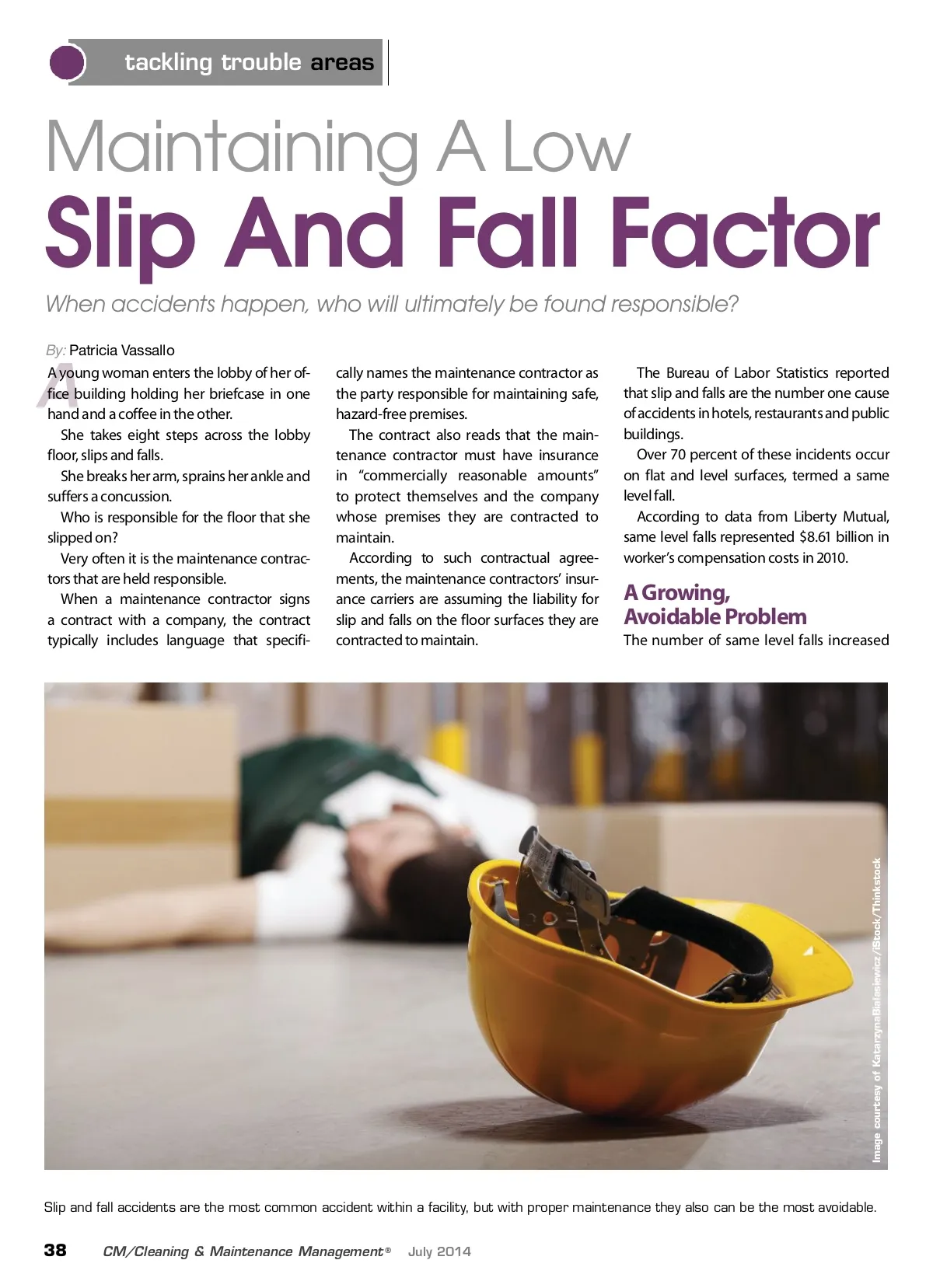
tackling trouble areas Maintaining A Low Slip And Fall Factor When accidents happen, who will ultimately be found responsible? By: Patricia Vassallo A A young woman enters the lobby of her of-fice building holding her briefcase in one hand and a coffee in the other. She takes eight steps across the lobby floor, slips and falls. She breaks her arm, sprains her ankle and suffers a concussion. Who is responsible for the floor that she slipped on? Very often it is the maintenance contrac-tors that are held responsible. When a maintenance contractor signs a contract with a company, the contract typically includes language that specifi-cally names the maintenance contractor as the party responsible for maintaining safe, hazard-free premises. The contract also reads that the main-tenance contractor must have insurance in “commercially reasonable amounts” to protect themselves and the company whose premises they are contracted to maintain. According to such contractual agree-ments, the maintenance contractors’ insur-ance carriers are assuming the liability for slip and falls on the floor surfaces they are contracted to maintain. The Bureau of Labor Statistics reported that slip and falls are the number one cause of accidents in hotels, restaurants and public buildings. Over 70 percent of these incidents occur on flat and level surfaces, termed a same level fall. According to data from Liberty Mutual, same level falls represented $8.61 billion in worker’s compensation costs in 2010. A Growing, Avoidable Problem The number of same level falls increased Slip and fall accidents are the most common accident within a facility, but with proper maintenance they also can be the most avoidable. 38 CM/Cleaning & Maintenance Management ® July 2014 Image courtesy of KatarzynaBialasiewicz/iStock/Thinkstock
CMM – Archives July 2014: 38