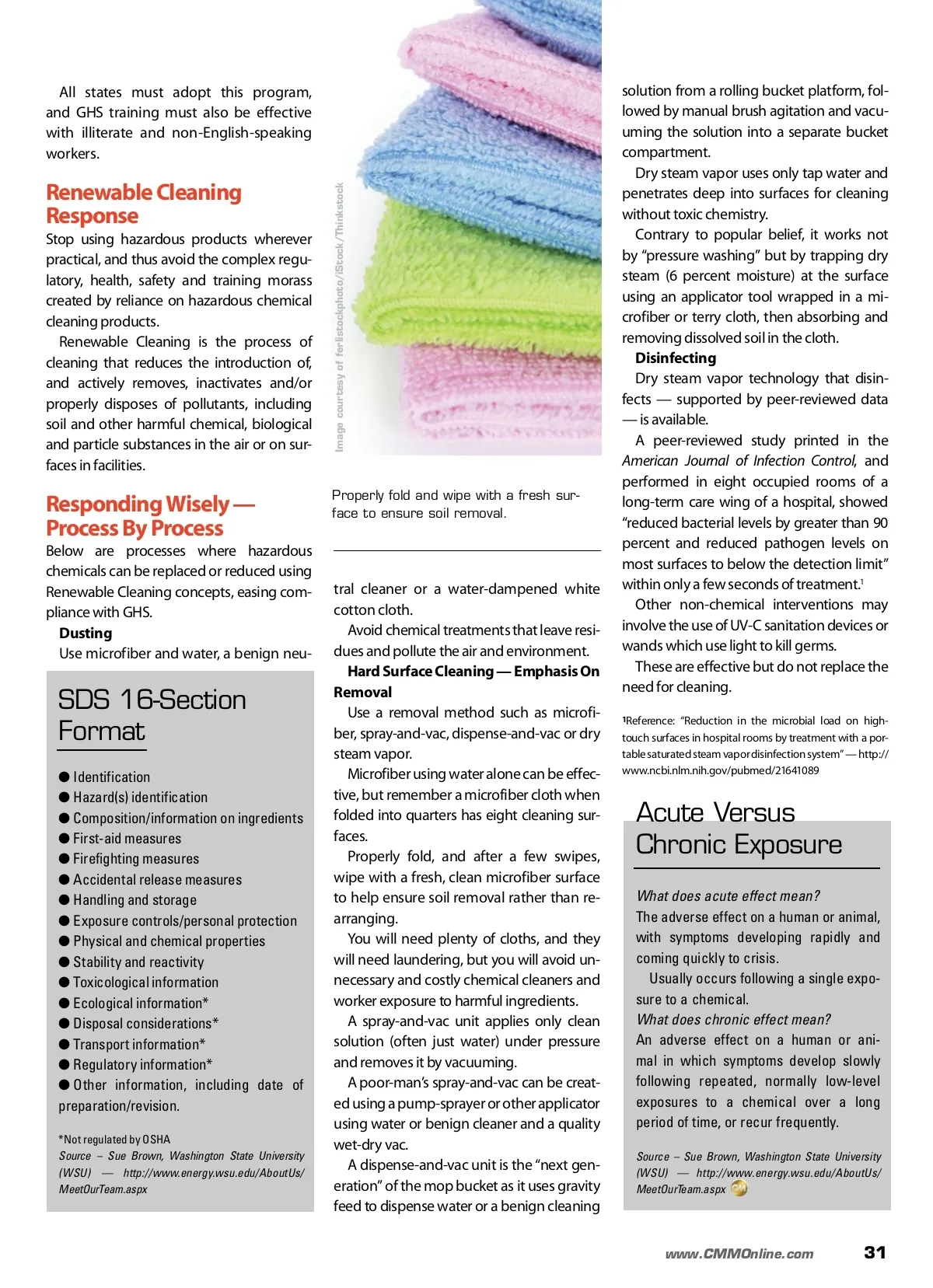
All states must adopt this program, and GHS training must also be effective with illiterate and non-English-speaking workers. Renewable Cleaning Response Stop using hazardous products wherever practical, and thus avoid the complex regu-latory, health, safety and training morass created by reliance on hazardous chemical cleaning products. Renewable Cleaning is the process of cleaning that reduces the introduction of, and actively removes, inactivates and/or properly disposes of pollutants, including soil and other harmful chemical, biological and particle substances in the air or on sur-faces in facilities. Responding Wisely — Process By Process Below are processes where hazardous chemicals can be replaced or reduced using Renewable Cleaning concepts, easing com-pliance with GHS. Dusting Use microfiber and water, a benign neu-Properly fold and wipe with a fresh sur-face to ensure soil removal. SDS 16-Section Format ● Identification ● Hazard(s) identification ● Composition/information on ingredients ● First-aid measures ● Firefighting measures ● Accidental release measures ● Handling and storage ● Exposure controls/personal protection ● Physical and chemical properties ● Stability and reactivity ● Toxicological information ● Ecological information* ● Disposal considerations* ● Transport information* ● Regulatory information* ● Other information, including date of preparation/revision. *Not regulated by OSHA Source – Sue Brown, Washington State University (WSU) — http://www.energy.wsu.edu/AboutUs/ MeetOurTeam.aspx tral cleaner or a water-dampened white cotton cloth. Avoid chemical treatments that leave resi-dues and pollute the air and environment. Hard Surface Cleaning — Emphasis On Removal Use a removal method such as microfi-ber, spray-and-vac, dispense-and-vac or dry steam vapor. Microfiber using water alone can be effec-tive, but remember a microfiber cloth when folded into quarters has eight cleaning sur-faces. Properly fold, and after a few swipes, wipe with a fresh, clean microfiber surface to help ensure soil removal rather than re-arranging. You will need plenty of cloths, and they will need laundering, but you will avoid un-necessary and costly chemical cleaners and worker exposure to harmful ingredients. A spray-and-vac unit applies only clean solution (often just water) under pressure and removes it by vacuuming. A poor-man’s spray-and-vac can be creat-ed using a pump-sprayer or other applicator using water or benign cleaner and a quality wet-dry vac. A dispense-and-vac unit is the “next gen-eration” of the mop bucket as it uses gravity feed to dispense water or a benign cleaning solution from a rolling bucket platform, fol-lowed by manual brush agitation and vacu-uming the solution into a separate bucket compartment. Dry steam vapor uses only tap water and penetrates deep into surfaces for cleaning without toxic chemistry. Contrary to popular belief, it works not by “pressure washing” but by trapping dry steam (6 percent moisture) at the surface using an applicator tool wrapped in a mi-crofiber or terry cloth, then absorbing and removing dissolved soil in the cloth. Disinfecting Dry steam vapor technology that disin-fects — supported by peer-reviewed data — is available. A peer-reviewed study printed in the American Journal of Infection Control , and performed in eight occupied rooms of a long-term care wing of a hospital, showed “reduced bacterial levels by greater than 90 percent and reduced pathogen levels on most surfaces to below the detection limit” within only a few seconds of treatment. 1 Other non-chemical interventions may involve the use of UV-C sanitation devices or wands which use light to kill germs. These are effective but do not replace the need for cleaning. 1 Reference: Image courtesy of ferlistockphoto/iStock/Thinkstock “Reduction in the microbial load on high-touch surfaces in hospital rooms by treatment with a por-table saturated steam vapor disinfection system” — http:// www.ncbi.nlm.nih.gov/pubmed/21641089 Acute Versus Chronic Exposure What does acute effect mean? The adverse effect on a human or animal, with symptoms developing rapidly and coming quickly to crisis. Usually occurs following a single expo-sure to a chemical. What does chronic effect mean? An adverse effect on a human or ani-mal in which symptoms develop slowly following repeated, normally low-level exposures to a chemical over a long period of time, or recur frequently. Source – Sue Brown, Washington State University (WSU) — http://www.energy.wsu.edu/AboutUs/ MeetOurTeam.aspx www.CMMOnline.com 31
CMM – Archives July 2014: 31