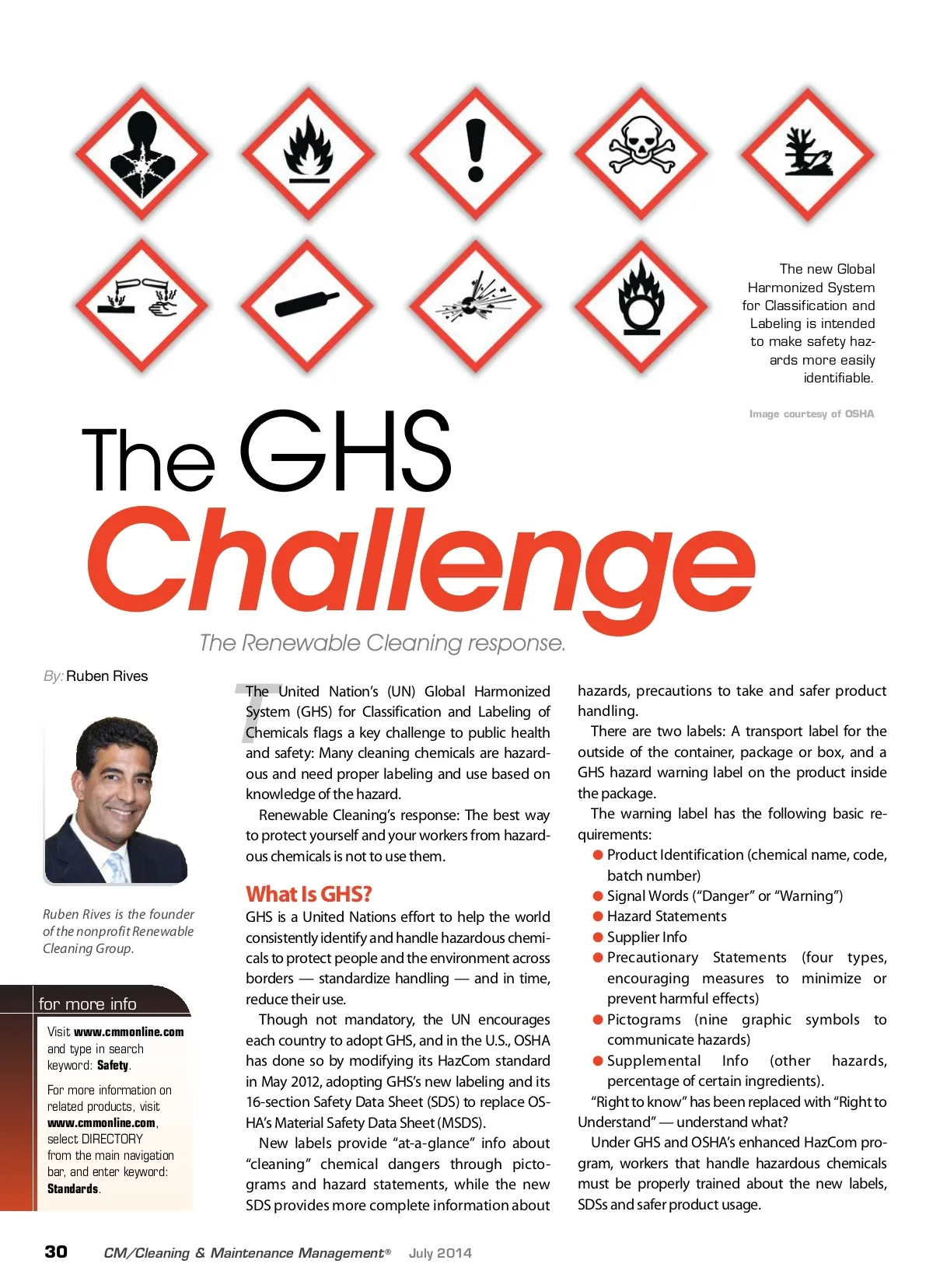
The new Global Harmonized System for Classification and Labeling is intended to make safety haz-ards more easily identifiable. Image courtesy of OSHA The GHS Challenge The Renewable Cleaning response. By: Ruben Rives T The United Nation’s (UN) Global Harmonized System (GHS) for Classification and Labeling of Chemicals flags a key challenge to public health and safety: Many cleaning chemicals are hazard-ous and need proper labeling and use based on knowledge of the hazard. Renewable Cleaning’s response: The best way to protect yourself and your workers from hazard-ous chemicals is not to use them. What Is GHS? Ruben Rives is the founder of the nonprofit Renewable Cleaning Group. for more info Visit www.cmmonline.com and type in search keyword: Safety . For more information on related products, visit www.cmmonline.com , select DIRECTORY from the main navigation bar, and enter keyword: Standards . GHS is a United Nations effort to help the world consistently identify and handle hazardous chemi-cals to protect people and the environment across borders — standardize handling — and in time, reduce their use. Though not mandatory, the UN encourages each country to adopt GHS, and in the U.S., OSHA has done so by modifying its HazCom standard in May 2012, adopting GHS’s new labeling and its 16-section Safety Data Sheet (SDS) to replace OS-HA’s Material Safety Data Sheet (MSDS). New labels provide “at-a-glance” info about “cleaning” chemical dangers through picto-grams and hazard statements, while the new SDS provides more complete information about July 2014 hazards, precautions to take and safer product handling. There are two labels: A transport label for the outside of the container, package or box, and a GHS hazard warning label on the product inside the package. The warning label has the following basic re-quirements: ● Product Identification (chemical name, code, batch number) ● Signal Words (“Danger” or “Warning”) ● Hazard Statements ● Supplier Info ● Precautionary Statements (four types, encouraging measures to minimize or prevent harmful effects) ● Pictograms (nine graphic symbols to communicate hazards) ● Supplemental Info (other hazards, percentage of certain ingredients). “Right to know” has been replaced with “Right to Understand” — understand what? Under GHS and OSHA’s enhanced HazCom pro-gram, workers that handle hazardous chemicals must be properly trained about the new labels, SDSs and safer product usage. 30 CM/Cleaning & Maintenance Management ®
CMM – Archives July 2014: 30