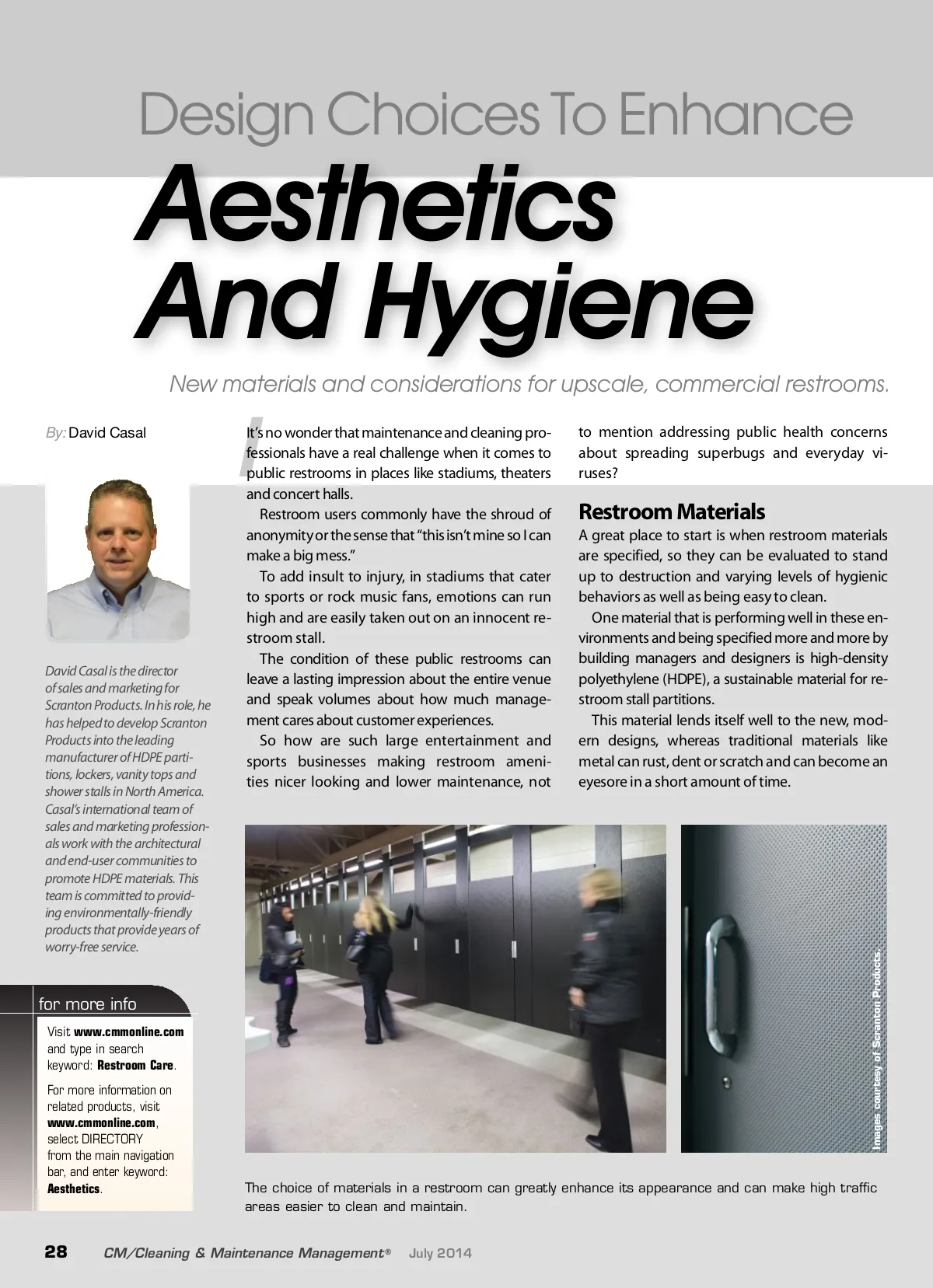
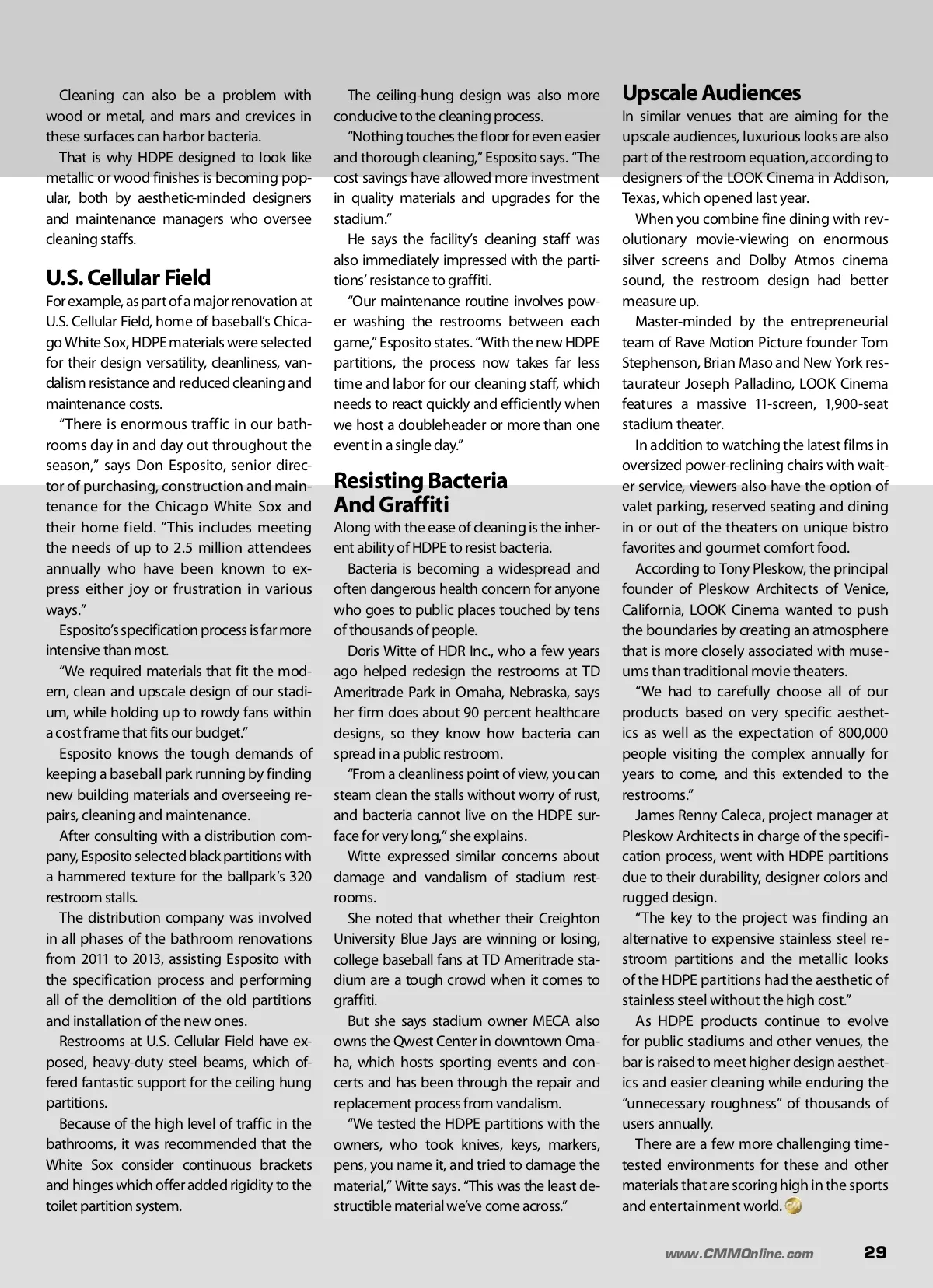
Cleaning can also be a problem with wood or metal, and mars and crevices in these surfaces can harbor bacteria. That is why HDPE designed to look like metallic or wood finishes is becoming pop-ular, both by aesthetic-minded designers and maintenance managers who oversee cleaning staffs. U.S. Cellular Field For example, as part of a major renovation at U.S. Cellular Field, home of baseball’s Chica-go White Sox, HDPE materials were selected for their design versatility, cleanliness, van-dalism resistance and reduced cleaning and maintenance costs. “There is enormous traffic in our bath-rooms day in and day out throughout the season,” says Don Esposito, senior direc-tor of purchasing, construction and main-tenance for the Chicago White Sox and their home field. “This includes meeting the needs of up to 2.5 million attendees annually who have been known to ex-press either joy or frustration in various ways.” Esposito’s specification process is far more intensive than most. “We required materials that fit the mod-ern, clean and upscale design of our stadi-um, while holding up to rowdy fans within a cost frame that fits our budget.” Esposito knows the tough demands of keeping a baseball park running by finding new building materials and overseeing re-pairs, cleaning and maintenance. After consulting with a distribution com-pany, Esposito selected black partitions with a hammered texture for the ballpark’s 320 restroom stalls. The distribution company was involved in all phases of the bathroom renovations from 2011 to 2013, assisting Esposito with the specification process and performing all of the demolition of the old partitions and installation of the new ones. Restrooms at U.S. Cellular Field have ex-posed, heavy-duty steel beams, which of-fered fantastic support for the ceiling hung partitions. Because of the high level of traffic in the bathrooms, it was recommended that the White Sox consider continuous brackets and hinges which offer added rigidity to the toilet partition system. The ceiling-hung design was also more conducive to the cleaning process. “Nothing touches the floor for even easier and thorough cleaning,” Esposito says. “The cost savings have allowed more investment in quality materials and upgrades for the stadium.” He says the facility’s cleaning staff was also immediately impressed with the parti-tions’ resistance to graffiti. “Our maintenance routine involves pow-er washing the restrooms between each game,” Esposito states. “With the new HDPE partitions, the process now takes far less time and labor for our cleaning staff, which needs to react quickly and efficiently when we host a doubleheader or more than one event in a single day.” Upscale Audiences In similar venues that are aiming for the upscale audiences, luxurious looks are also part of the restroom equation, according to designers of the LOOK Cinema in Addison, Texas, which opened last year. When you combine fine dining with rev-olutionary movie-viewing on enormous silver screens and Dolby Atmos cinema sound, the restroom design had better measure up. Master-minded by the entrepreneurial team of Rave Motion Picture founder Tom Stephenson, Brian Maso and New York res-taurateur Joseph Palladino, LOOK Cinema features a massive 11-screen, 1,900-seat stadium theater. In addition to watching the latest films in oversized power-reclining chairs with wait-er service, viewers also have the option of valet parking, reserved seating and dining in or out of the theaters on unique bistro favorites and gourmet comfort food. According to Tony Pleskow, the principal founder of Pleskow Architects of Venice, California, LOOK Cinema wanted to push the boundaries by creating an atmosphere that is more closely associated with muse-ums than traditional movie theaters. “We had to carefully choose all of our products based on very specific aesthet-ics as well as the expectation of 800,000 people visiting the complex annually for years to come, and this extended to the restrooms.” James Renny Caleca, project manager at Pleskow Architects in charge of the specifi-cation process, went with HDPE partitions due to their durability, designer colors and rugged design. “The key to the project was finding an alternative to expensive stainless steel re-stroom partitions and the metallic looks of the HDPE partitions had the aesthetic of stainless steel without the high cost.” As HDPE products continue to evolve for public stadiums and other venues, the bar is raised to meet higher design aesthet-ics and easier cleaning while enduring the “unnecessary roughness” of thousands of users annually. There are a few more challenging time-tested environments for these and other materials that are scoring high in the sports and entertainment world. www.CMMOnline.com Resisting Bacteria And Graffiti Along with the ease of cleaning is the inher-ent ability of HDPE to resist bacteria. Bacteria is becoming a widespread and often dangerous health concern for anyone who goes to public places touched by tens of thousands of people. Doris Witte of HDR Inc., who a few years ago helped redesign the restrooms at TD Ameritrade Park in Omaha, Nebraska, says her firm does about 90 percent healthcare designs, so they know how bacteria can spread in a public restroom. “From a cleanliness point of view, you can steam clean the stalls without worry of rust, and bacteria cannot live on the HDPE sur-face for very long,” she explains. Witte expressed similar concerns about damage and vandalism of stadium rest-rooms. She noted that whether their Creighton University Blue Jays are winning or losing, college baseball fans at TD Ameritrade sta-dium are a tough crowd when it comes to graffiti. But she says stadium owner MECA also owns the Qwest Center in downtown Oma-ha, which hosts sporting events and con-certs and has been through the repair and replacement process from vandalism. “We tested the HDPE partitions with the owners, who took knives, keys, markers, pens, you name it, and tried to damage the material,” Witte says. “This was the least de-structible material we’ve come across.” 29
CMM – Archives July 2014: 29