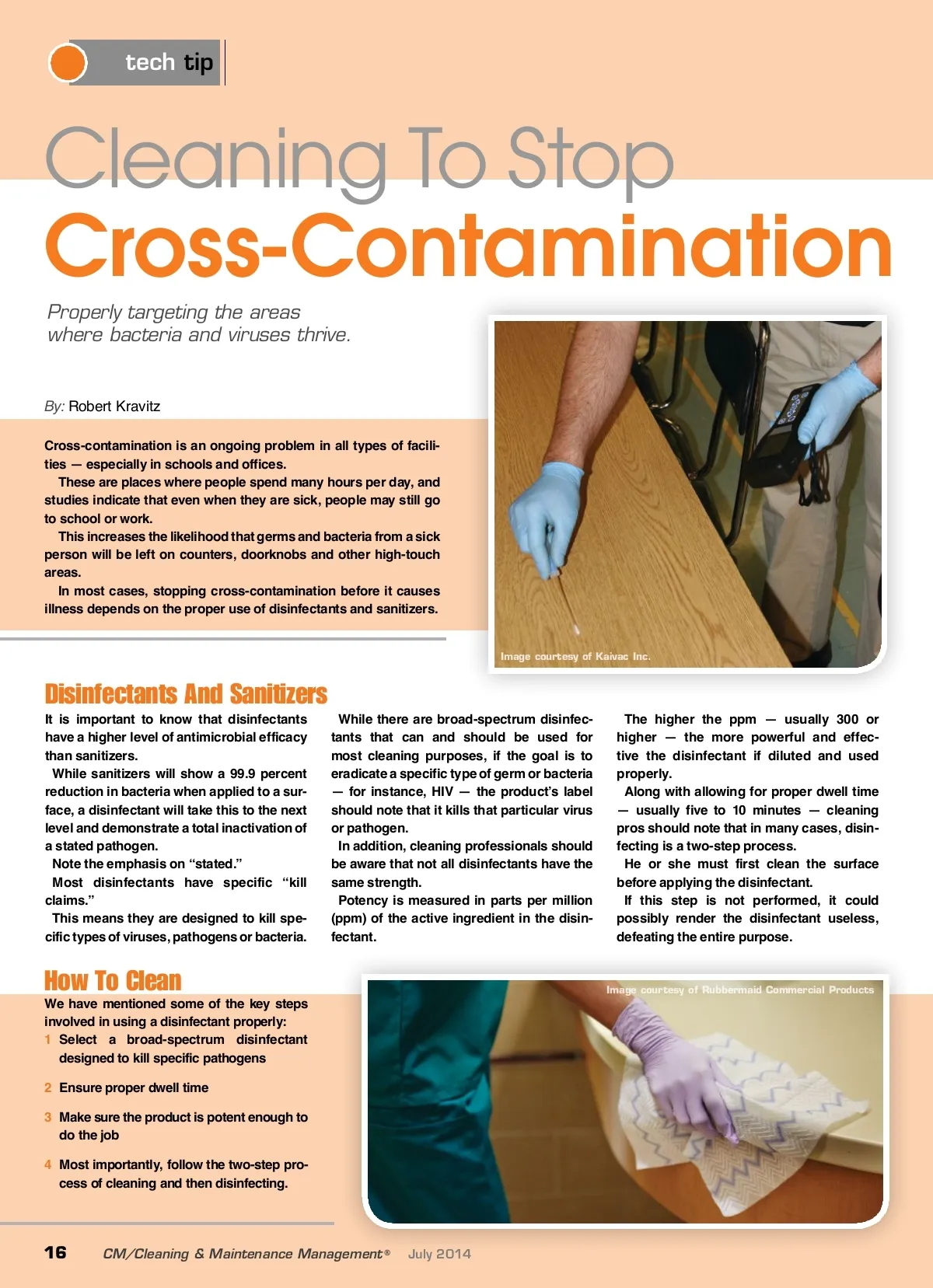
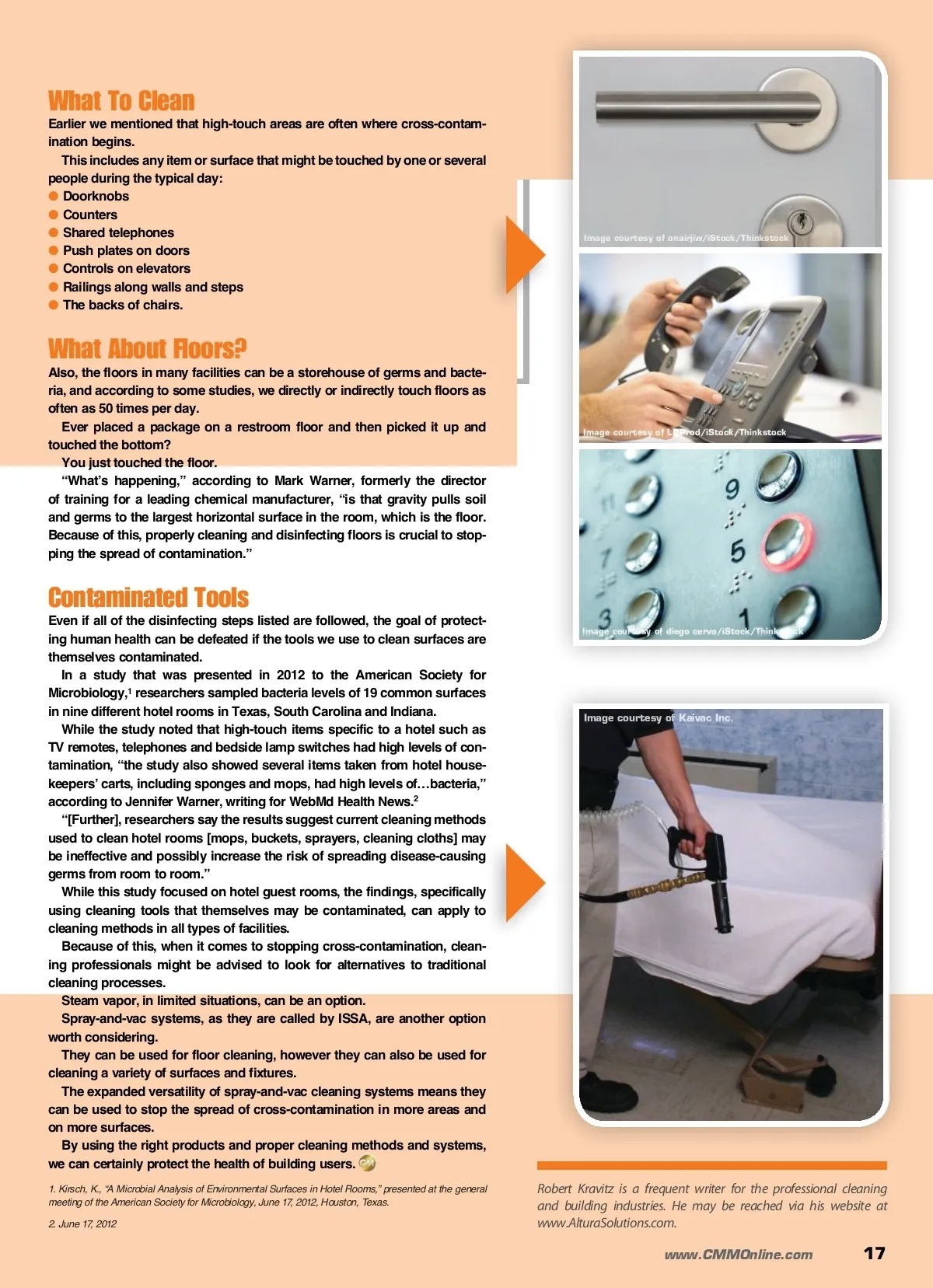
tech tip Cleaning To Stop Cross-Contamination Properly targeting the areas where bacteria and viruses thrive. By: Robert Kravitz Cross-contamination is an ongoing problem in all types of facili-ties — especially in schools and offices. These are places where people spend many hours per day, and studies indicate that even when they are sick, people may still go to school or work. This increases the likelihood that germs and bacteria from a sick person will be left on counters, doorknobs and other high-touch areas. In most cases, stopping cross-contamination before it causes illness depends on the proper use of disinfectants and sanitizers. Image courtesy of Kaivac Inc. Disinfectants And Sanitizers It is important to know that disinfectants have a higher level of antimicrobial efficacy than sanitizers. While sanitizers will show a 99.9 percent reduction in bacteria when applied to a sur-face, a disinfectant will take this to the next level and demonstrate a total inactivation of a stated pathogen. Note the emphasis on “stated.” Most disinfectants have specific “kill claims.” This means they are designed to kill spe-cific types of viruses, pathogens or bacteria. While there are broad-spectrum disinfec-tants that can and should be used for most cleaning purposes, if the goal is to eradicate a specific type of germ or bacteria — for instance, HIV — the product’s label should note that it kills that particular virus or pathogen. In addition, cleaning professionals should be aware that not all disinfectants have the same strength. Potency is measured in parts per million (ppm) of the active ingredient in the disin-fectant. The higher the ppm — usually 300 or higher — the more powerful and effec-tive the disinfectant if diluted and used properly. Along with allowing for proper dwell time — usually five to 10 minutes — cleaning pros should note that in many cases, disin-fecting is a two-step process. He or she must first clean the surface before applying the disinfectant. If this step is not performed, it could possibly render the disinfectant useless, defeating the entire purpose. How To Clean We have mentioned some of the key steps involved in using a disinfectant properly: 1 Select a broad-spectrum disinfectant designed to kill specific pathogens 2 Ensure proper dwell time 3 Make sure the product is potent enough to do the job 4 Most importantly, follow the two-step pro-cess of cleaning and then disinfecting. Image courtesy of Rubbermaid Commercial Products 16 CM/Cleaning & Maintenance Management ® July 2014
CMM – Archives July 2014: 16