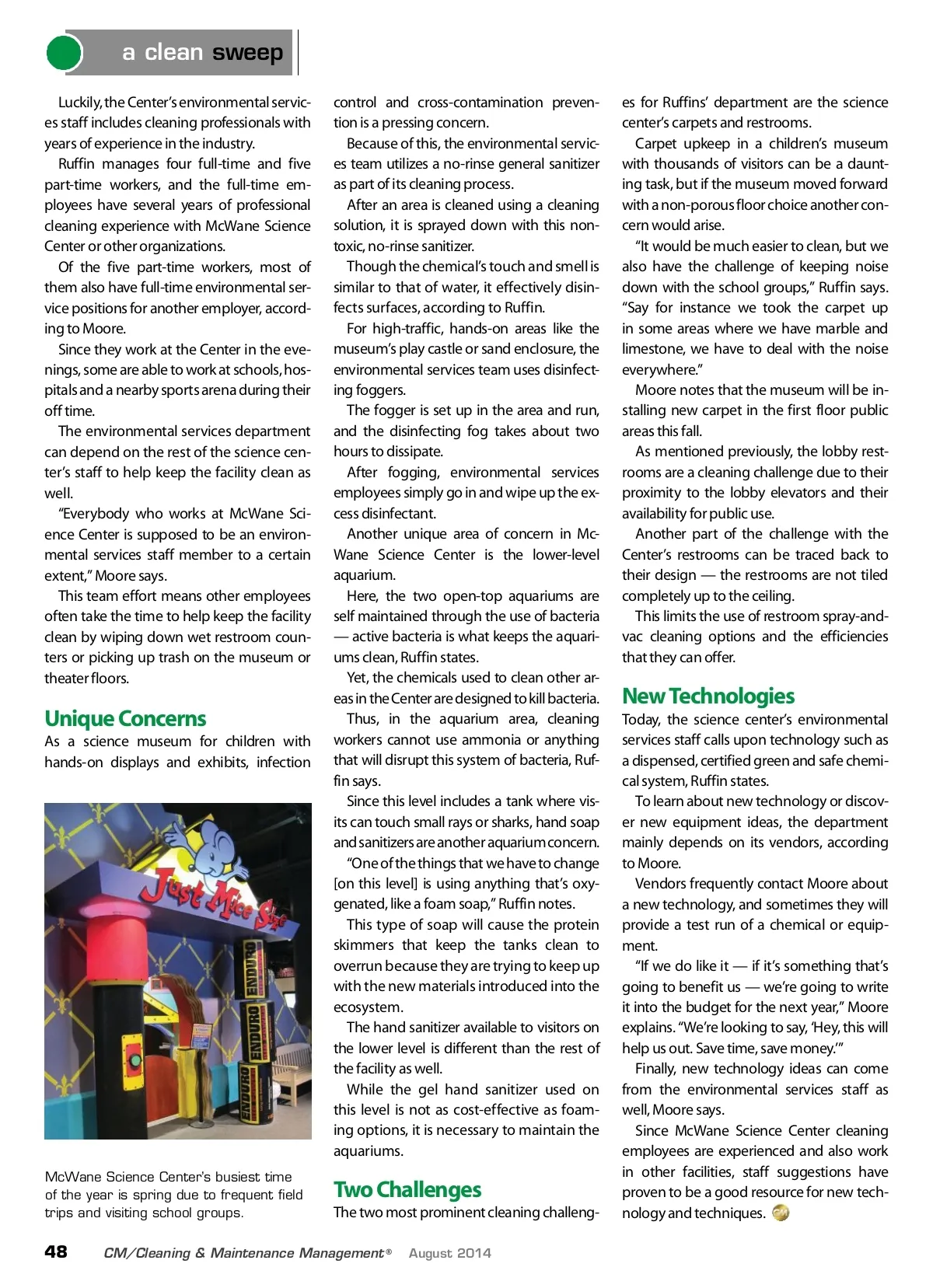
a clean sweep Luckily, the Center’s environmental servic-es staff includes cleaning professionals with years of experience in the industry. Ruffin manages four full-time and five part-time workers, and the full-time em-ployees have several years of professional cleaning experience with McWane Science Center or other organizations. Of the five part-time workers, most of them also have full-time environmental ser-vice positions for another employer, accord-ing to Moore. Since they work at the Center in the eve-nings, some are able to work at schools, hos-pitals and a nearby sports arena during their off time. The environmental services department can depend on the rest of the science cen-ter’s staff to help keep the facility clean as well. “Everybody who works at McWane Sci-ence Center is supposed to be an environ-mental services staff member to a certain extent,” Moore says. This team effort means other employees often take the time to help keep the facility clean by wiping down wet restroom coun-ters or picking up trash on the museum or theater floors. control and cross-contamination preven-tion is a pressing concern. Because of this, the environmental servic-es team utilizes a no-rinse general sanitizer as part of its cleaning process. After an area is cleaned using a cleaning solution, it is sprayed down with this non-toxic, no-rinse sanitizer. Though the chemical’s touch and smell is similar to that of water, it effectively disin-fects surfaces, according to Ruffin. For high-traffic, hands-on areas like the museum’s play castle or sand enclosure, the environmental services team uses disinfect-ing foggers. The fogger is set up in the area and run, and the disinfecting fog takes about two hours to dissipate. After fogging, environmental services employees simply go in and wipe up the ex-cess disinfectant. Another unique area of concern in Mc-Wane Science Center is the lower-level aquarium. Here, the two open-top aquariums are self maintained through the use of bacteria — active bacteria is what keeps the aquari-ums clean, Ruffin states. Yet, the chemicals used to clean other ar-eas in the Center are designed to kill bacteria. Thus, in the aquarium area, cleaning workers cannot use ammonia or anything that will disrupt this system of bacteria, Ruf-fin says. Since this level includes a tank where vis-its can touch small rays or sharks, hand soap and sanitizers are another aquarium concern. “One of the things that we have to change [on this level] is using anything that’s oxy-genated, like a foam soap,” Ruffin notes. This type of soap will cause the protein skimmers that keep the tanks clean to overrun because they are trying to keep up with the new materials introduced into the ecosystem. The hand sanitizer available to visitors on the lower level is different than the rest of the facility as well. While the gel hand sanitizer used on this level is not as cost-effective as foam-ing options, it is necessary to maintain the aquariums. es for Ruffins’ department are the science center’s carpets and restrooms. Carpet upkeep in a children’s museum with thousands of visitors can be a daunt-ing task, but if the museum moved forward with a non-porous floor choice another con-cern would arise. “It would be much easier to clean, but we also have the challenge of keeping noise down with the school groups,” Ruffin says. “Say for instance we took the carpet up in some areas where we have marble and limestone, we have to deal with the noise everywhere.” Moore notes that the museum will be in-stalling new carpet in the first floor public areas this fall. As mentioned previously, the lobby rest-rooms are a cleaning challenge due to their proximity to the lobby elevators and their availability for public use. Another part of the challenge with the Center’s restrooms can be traced back to their design — the restrooms are not tiled completely up to the ceiling. This limits the use of restroom spray-and-vac cleaning options and the efficiencies that they can offer. New Technologies Today, the science center’s environmental services staff calls upon technology such as a dispensed, certified green and safe chemi-cal system, Ruffin states. To learn about new technology or discov-er new equipment ideas, the department mainly depends on its vendors, according to Moore. Vendors frequently contact Moore about a new technology, and sometimes they will provide a test run of a chemical or equip-ment. “If we do like it — if it’s something that’s going to benefit us — we’re going to write it into the budget for the next year,” Moore explains. “We’re looking to say, ‘Hey, this will help us out. Save time, save money.’” Finally, new technology ideas can come from the environmental services staff as well, Moore says. Since McWane Science Center cleaning employees are experienced and also work in other facilities, staff suggestions have proven to be a good resource for new tech-nology and techniques. Unique Concerns As a science museum for children with hands-on displays and exhibits, infection McWane Science Center’s busiest time of the year is spring due to frequent field trips and visiting school groups. Two Challenges The two most prominent cleaning challeng-August 2014 48 CM/Cleaning & Maintenance Management ®
CMM – Archives August 2014: 48