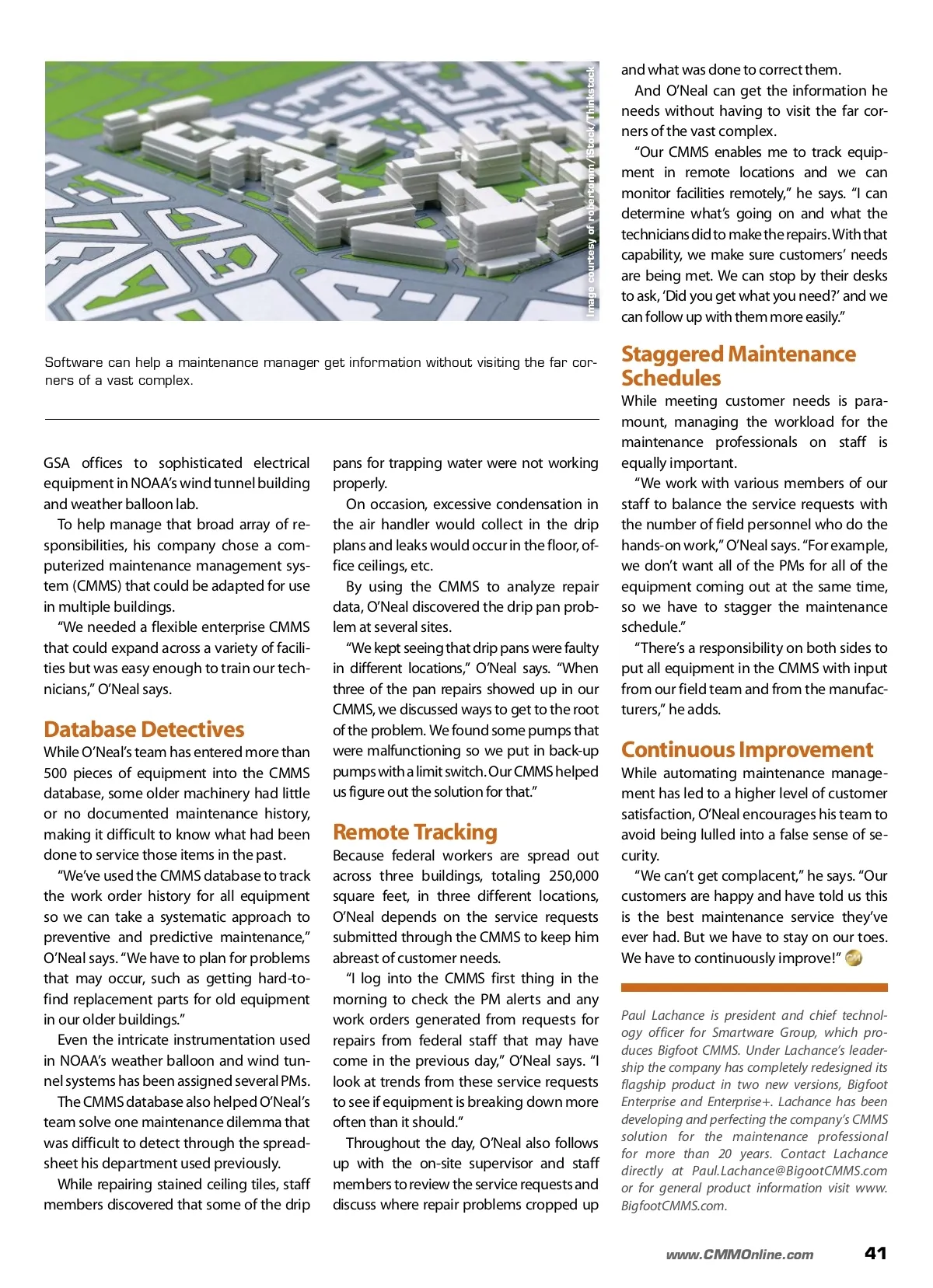
and what was done to correct them. And O’Neal can get the information he needs without having to visit the far cor-ners of the vast complex. “Our CMMS enables me to track equip-ment in remote locations and we can monitor facilities remotely,” he says. “I can determine what’s going on and what the technicians did to make the repairs. With that capability, we make sure customers’ needs are being met. We can stop by their desks to ask, ‘Did you get what you need?’ and we can follow up with them more easily.” Image courtesy of robertomm/iStock/Thinkstock Software can help a maintenance manager get information without visiting the far cor-ners of a vast complex. Staggered Maintenance Schedules While meeting customer needs is para-mount, managing the workload for the maintenance professionals on staff is equally important. “We work with various members of our staff to balance the service requests with the number of field personnel who do the hands-on work,” O’Neal says. “For example, we don’t want all of the PMs for all of the equipment coming out at the same time, so we have to stagger the maintenance schedule.” “There’s a responsibility on both sides to put all equipment in the CMMS with input from our field team and from the manufac-turers,” he adds. GSA offices to sophisticated electrical equipment in NOAA’s wind tunnel building and weather balloon lab. To help manage that broad array of re-sponsibilities, his company chose a com-puterized maintenance management sys-tem (CMMS) that could be adapted for use in multiple buildings. “We needed a flexible enterprise CMMS that could expand across a variety of facili-ties but was easy enough to train our tech-nicians,” O’Neal says. Database Detectives While O’Neal’s team has entered more than 500 pieces of equipment into the CMMS database, some older machinery had little or no documented maintenance history, making it difficult to know what had been done to service those items in the past. “We’ve used the CMMS database to track the work order history for all equipment so we can take a systematic approach to preventive and predictive maintenance,” O’Neal says. “We have to plan for problems that may occur, such as getting hard-to-find replacement parts for old equipment in our older buildings.” Even the intricate instrumentation used in NOAA’s weather balloon and wind tun-nel systems has been assigned several PMs. The CMMS database also helped O’Neal’s team solve one maintenance dilemma that was difficult to detect through the spread-sheet his department used previously. While repairing stained ceiling tiles, staff members discovered that some of the drip pans for trapping water were not working properly. On occasion, excessive condensation in the air handler would collect in the drip plans and leaks would occur in the floor, of-fice ceilings, etc. By using the CMMS to analyze repair data, O’Neal discovered the drip pan prob-lem at several sites. “We kept seeing that drip pans were faulty in different locations,” O’Neal says. “When three of the pan repairs showed up in our CMMS, we discussed ways to get to the root of the problem. We found some pumps that were malfunctioning so we put in back-up pumps with a limit switch. Our CMMS helped us figure out the solution for that.” Continuous Improvement While automating maintenance manage-ment has led to a higher level of customer satisfaction, O’Neal encourages his team to avoid being lulled into a false sense of se-curity. “We can’t get complacent,” he says. “Our customers are happy and have told us this is the best maintenance service they’ve ever had. But we have to stay on our toes. We have to continuously improve!” Remote Tracking Because federal workers are spread out across three buildings, totaling 250,000 square feet, in three different locations, O’Neal depends on the service requests submitted through the CMMS to keep him abreast of customer needs. “I log into the CMMS first thing in the morning to check the PM alerts and any work orders generated from requests for repairs from federal staff that may have come in the previous day,” O’Neal says. “I look at trends from these service requests to see if equipment is breaking down more often than it should.” Throughout the day, O’Neal also follows up with the on-site supervisor and staff members to review the service requests and discuss where repair problems cropped up Paul Lachance is president and chief technol-ogy officer for Smartware Group, which pro-duces Bigfoot CMMS. Under Lachance’s leader-ship the company has completely redesigned its flagship product in two new versions, Bigfoot Enterprise and Enterprise+. Lachance has been developing and perfecting the company’s CMMS solution for the maintenance professional for more than 20 years. Contact Lachance directly at [email protected] or for general product information visit www. BigfootCMMS.com. www.CMMOnline.com 41
CMM – Archives August 2014: 41