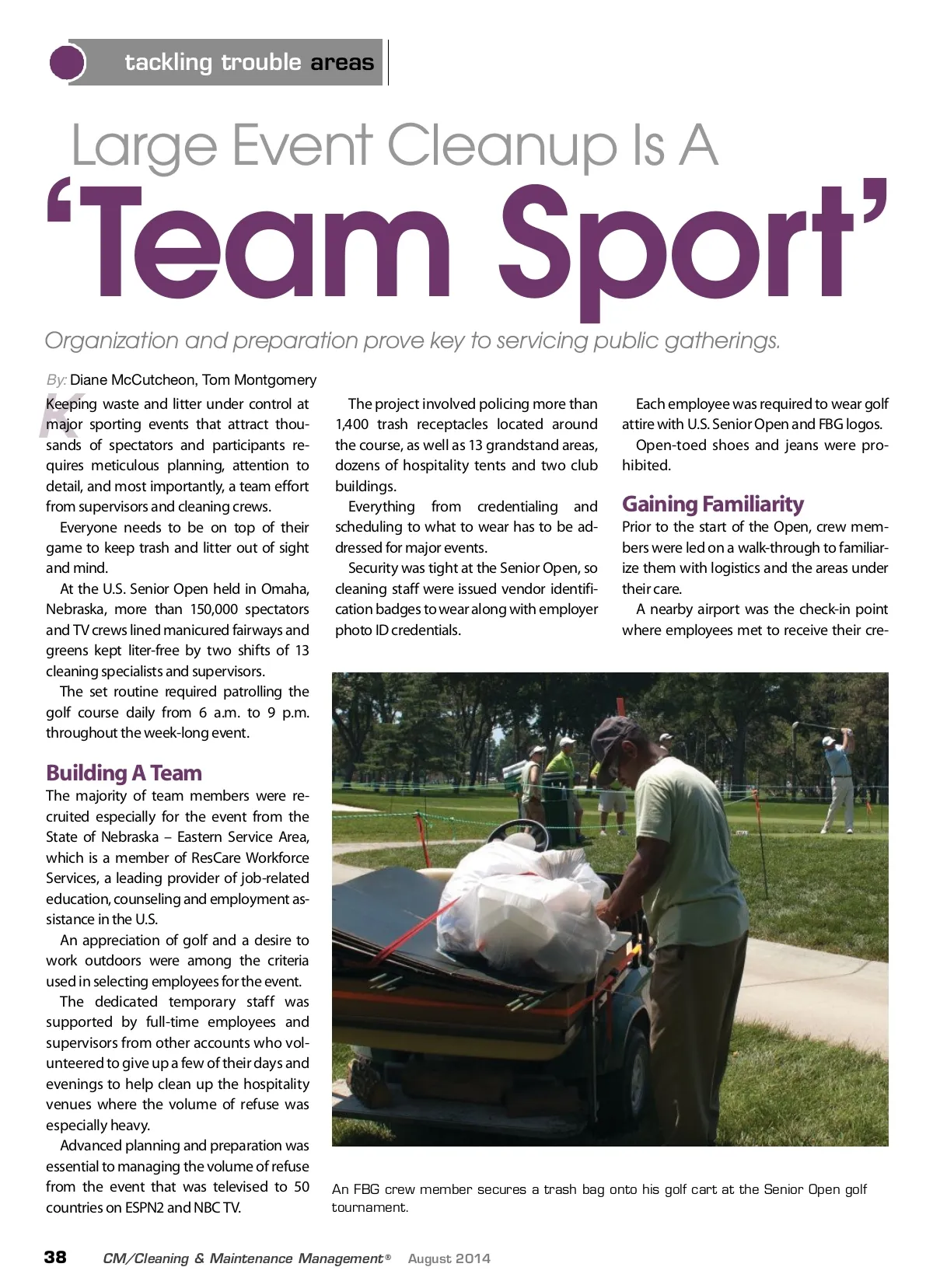
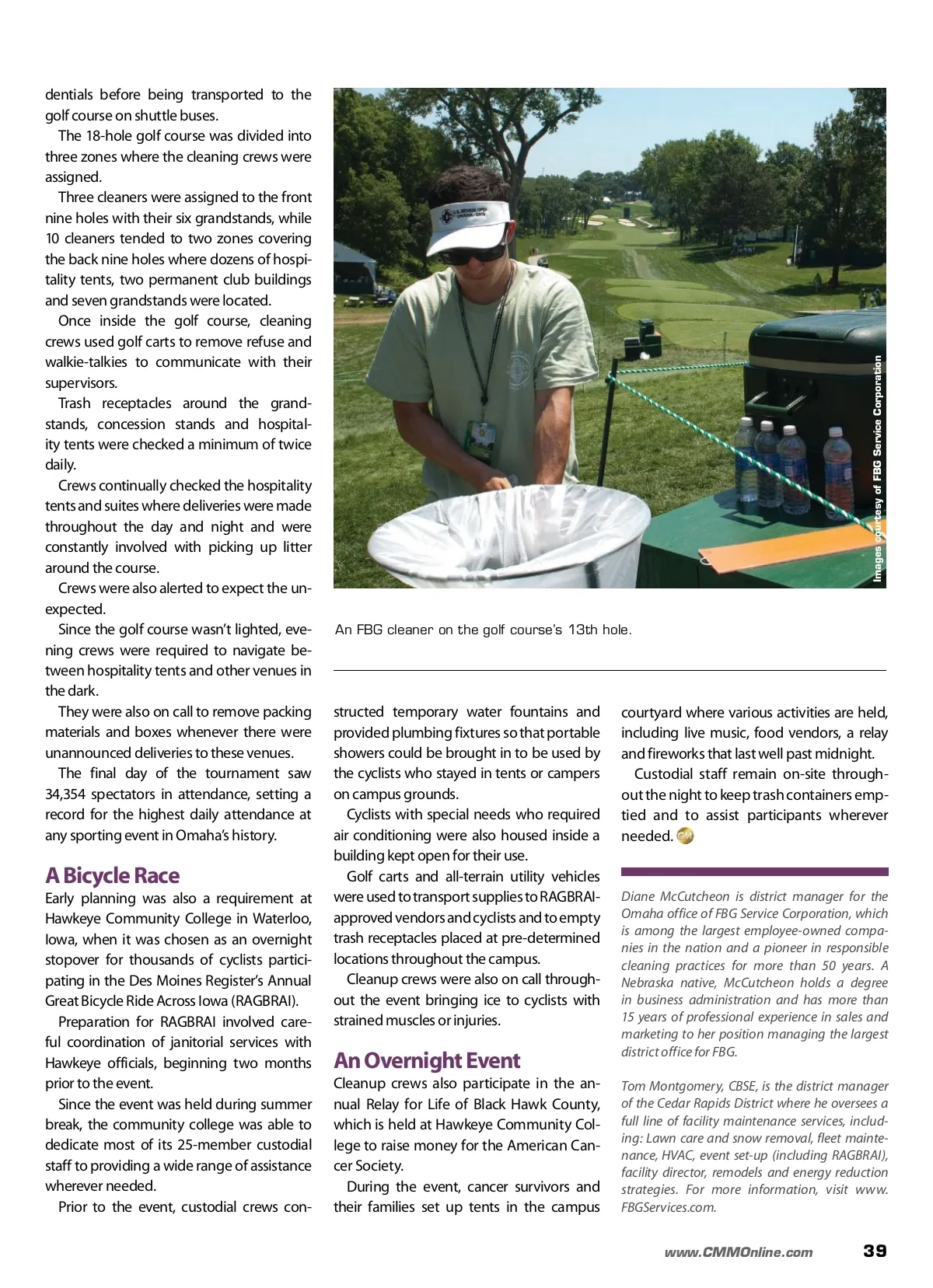
dentials before being transported to the golf course on shuttle buses. The 18-hole golf course was divided into three zones where the cleaning crews were assigned. Three cleaners were assigned to the front nine holes with their six grandstands, while 10 cleaners tended to two zones covering the back nine holes where dozens of hospi-tality tents, two permanent club buildings and seven grandstands were located. Once inside the golf course, cleaning crews used golf carts to remove refuse and walkie-talkies to communicate with their supervisors. Trash receptacles around the grand-stands, concession stands and hospital-ity tents were checked a minimum of twice daily. Crews continually checked the hospitality tents and suites where deliveries were made throughout the day and night and were constantly involved with picking up litter around the course. Crews were also alerted to expect the un-expected. Since the golf course wasn’t lighted, eve-ning crews were required to navigate be-tween hospitality tents and other venues in the dark. They were also on call to remove packing materials and boxes whenever there were unannounced deliveries to these venues. The final day of the tournament saw 34,354 spectators in attendance, setting a record for the highest daily attendance at any sporting event in Omaha’s history. An FBG cleaner on the golf course’s 13th hole. A Bicycle Race Early planning was also a requirement at Hawkeye Community College in Waterloo, Iowa, when it was chosen as an overnight stopover for thousands of cyclists partici-pating in the Des Moines Register’s Annual Great Bicycle Ride Across Iowa (RAGBRAI). Preparation for RAGBRAI involved care-ful coordination of janitorial services with Hawkeye officials, beginning two months prior to the event. Since the event was held during summer break, the community college was able to dedicate most of its 25-member custodial staff to providing a wide range of assistance wherever needed. Prior to the event, custodial crews con-structed temporary water fountains and provided plumbing fixtures so that portable showers could be brought in to be used by the cyclists who stayed in tents or campers on campus grounds. Cyclists with special needs who required air conditioning were also housed inside a building kept open for their use. Golf carts and all-terrain utility vehicles were used to transport supplies to RAGBRAI-approved vendors and cyclists and to empty trash receptacles placed at pre-determined locations throughout the campus. Cleanup crews were also on call through-out the event bringing ice to cyclists with strained muscles or injuries. courtyard where various activities are held, including live music, food vendors, a relay and fireworks that last well past midnight. Custodial staff remain on-site through-out the night to keep trash containers emp-tied and to assist participants wherever needed. An Overnight Event Cleanup crews also participate in the an-nual Relay for Life of Black Hawk County, which is held at Hawkeye Community Col-lege to raise money for the American Can-cer Society. During the event, cancer survivors and their families set up tents in the campus Diane McCutcheon is district manager for the Omaha office of FBG Service Corporation, which is among the largest employee-owned compa-nies in the nation and a pioneer in responsible cleaning practices for more than 50 years. A Nebraska native, McCutcheon holds a degree in business administration and has more than 15 years of professional experience in sales and marketing to her position managing the largest district office for FBG. Tom Montgomery, CBSE, is the district manager of the Cedar Rapids District where he oversees a full line of facility maintenance services, includ-ing: Lawn care and snow removal, fleet mainte-nance, HVAC, event set-up (including RAGBRAI), facility director, remodels and energy reduction strategies. For more information, visit www. FBGServices.com. www.CMMOnline.com 39 Images courtesy of FBG Service Corporation
CMM – Archives August 2014: 39