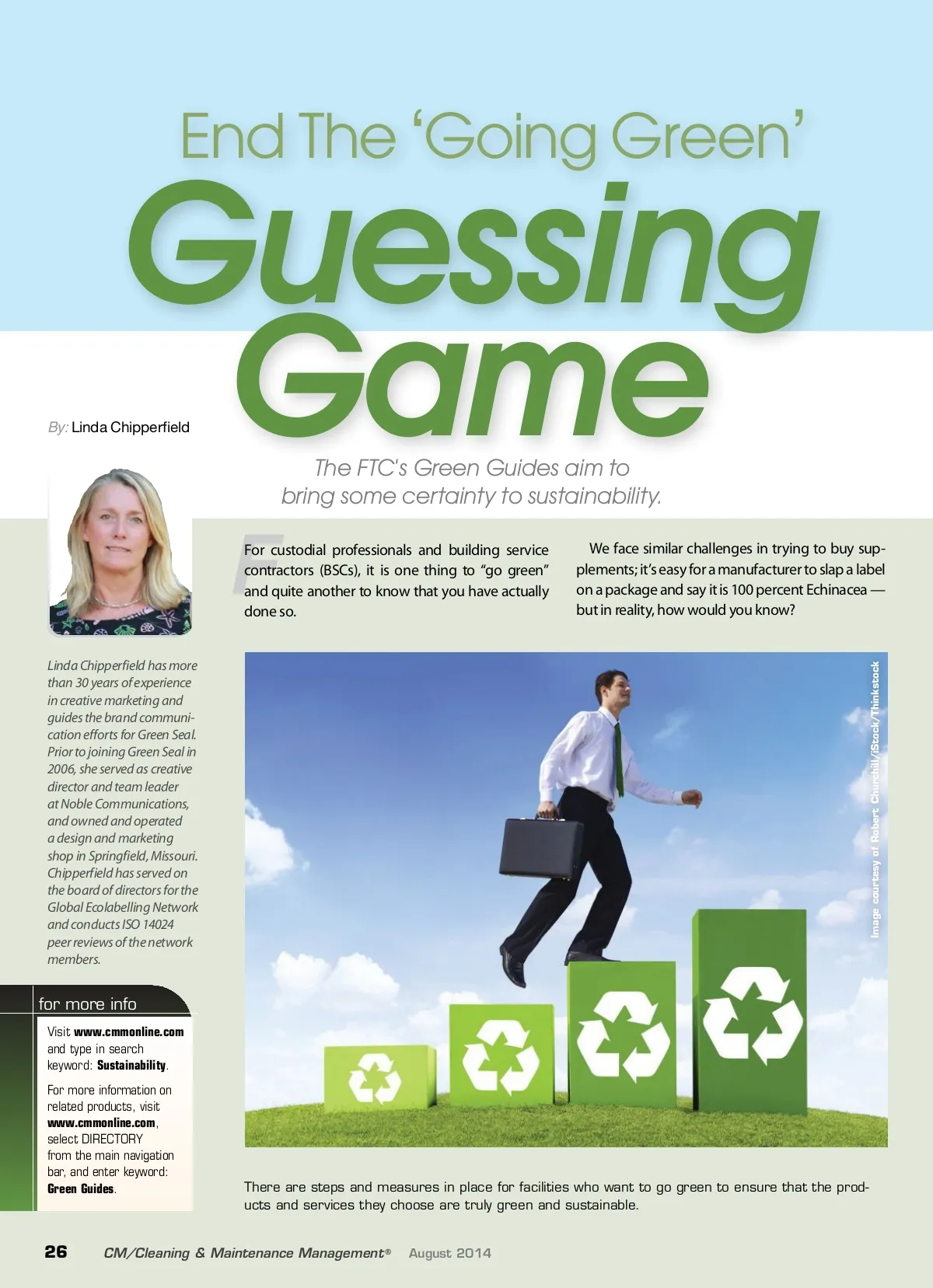
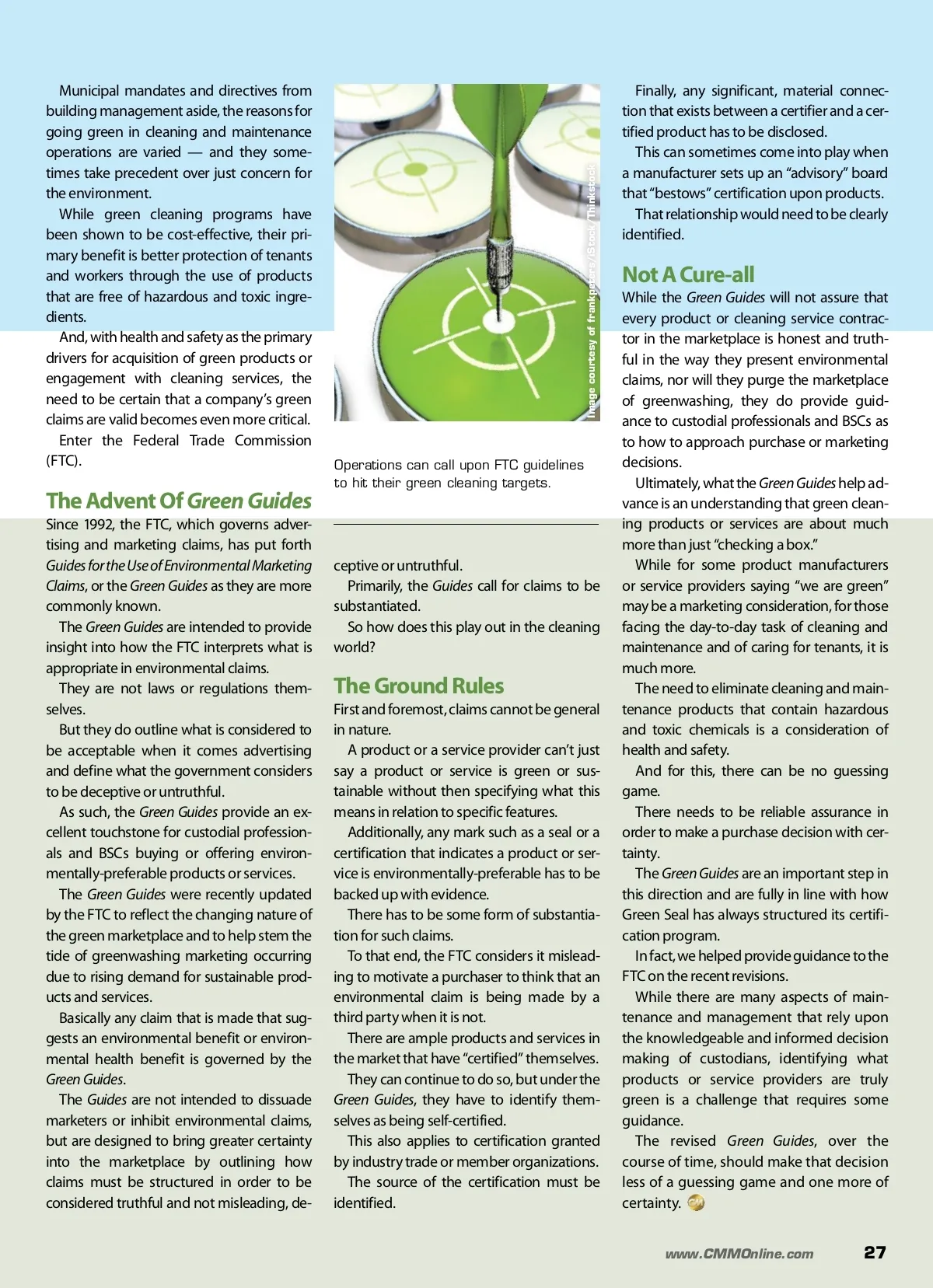
Municipal mandates and directives from building management aside, the reasons for going green in cleaning and maintenance operations are varied — and they some-times take precedent over just concern for the environment. While green cleaning programs have been shown to be cost-effective, their pri-mary benefit is better protection of tenants and workers through the use of products that are free of hazardous and toxic ingre-dients. And, with health and safety as the primary drivers for acquisition of green products or engagement with cleaning services, the need to be certain that a company’s green claims are valid becomes even more critical. Enter the Federal Trade Commission (FTC). Image courtesy of frankpeters/iStock/Thinkstock Finally, any significant, material connec-tion that exists between a certifier and a cer-tified product has to be disclosed. This can sometimes come into play when a manufacturer sets up an “advisory” board that “bestows” certification upon products. That relationship would need to be clearly identified. Not A Cure-all While the Green Guides will not assure that every product or cleaning service contrac-tor in the marketplace is honest and truth-ful in the way they present environmental claims, nor will they purge the marketplace of greenwashing, they do provide guid-ance to custodial professionals and BSCs as to how to approach purchase or marketing decisions. Ultimately, what the Green Guides help ad-vance is an understanding that green clean-ing products or services are about much more than just “checking a box.” While for some product manufacturers or service providers saying “we are green” may be a marketing consideration, for those facing the day-to-day task of cleaning and maintenance and of caring for tenants, it is much more. The need to eliminate cleaning and main-tenance products that contain hazardous and toxic chemicals is a consideration of health and safety. And for this, there can be no guessing game. There needs to be reliable assurance in order to make a purchase decision with cer-tainty. The Green Guides are an important step in this direction and are fully in line with how Green Seal has always structured its certifi-cation program. In fact, we helped provide guidance to the FTC on the recent revisions. While there are many aspects of main-tenance and management that rely upon the knowledgeable and informed decision making of custodians, identifying what products or service providers are truly green is a challenge that requires some guidance. The revised Green Guides , over the course of time, should make that decision less of a guessing game and one more of certainty. www.CMMOnline.com Operations can call upon FTC guidelines to hit their green cleaning targets. The Advent Of Green Guides Since 1992, the FTC, which governs adver-tising and marketing claims, has put forth Guides for the Use of Environmental Marketing Claims , or the Green Guides as they are more commonly known. The Green Guides are intended to provide insight into how the FTC interprets what is appropriate in environmental claims. They are not laws or regulations them-selves. But they do outline what is considered to be acceptable when it comes advertising and define what the government considers to be deceptive or untruthful. As such, the Green Guides provide an ex-cellent touchstone for custodial profession-als and BSCs buying or offering environ-mentally-preferable products or services. The Green Guides were recently updated by the FTC to reflect the changing nature of the green marketplace and to help stem the tide of greenwashing marketing occurring due to rising demand for sustainable prod-ucts and services. Basically any claim that is made that sug-gests an environmental benefit or environ-mental health benefit is governed by the Green Guides . The Guides are not intended to dissuade marketers or inhibit environmental claims, but are designed to bring greater certainty into the marketplace by outlining how claims must be structured in order to be considered truthful and not misleading, de-ceptive or untruthful. Primarily, the Guides call for claims to be substantiated. So how does this play out in the cleaning world? The Ground Rules First and foremost, claims cannot be general in nature. A product or a service provider can’t just say a product or service is green or sus-tainable without then specifying what this means in relation to specific features. Additionally, any mark such as a seal or a certification that indicates a product or ser-vice is environmentally-preferable has to be backed up with evidence. There has to be some form of substantia-tion for such claims. To that end, the FTC considers it mislead-ing to motivate a purchaser to think that an environmental claim is being made by a third party when it is not. There are ample products and services in the market that have “certified” themselves. They can continue to do so, but under the Green Guides , they have to identify them-selves as being self-certified. This also applies to certification granted by industry trade or member organizations. The source of the certification must be identified. 27
CMM – Archives August 2014: 27